🍕 Cold Proof Pizza Dough Calculator
Build a cold proof pizza dough formula from dough balls, flour, hydration, fridge temperature, proof hours, yeast percent, salt, starter or IDY, and the room-temperature finish before baking.
Choose IDY, active dry, fresh yeast, or sourdough starter. For starter mode, starter flour and water are counted inside the total flour and hydration so the finished dough target stays accurate.
Most predictable for long cold proof batches. Use tiny doses for 48 to 96 hours.
Use a little more than IDY and hydrate well before mixing if your process needs it.
Good for production dough, but long cold proofing still needs a light hand.
Adds flavor and acid. Count starter flour and water inside the dough formula.
| Fridge temp | Activity | Use case | Adjustment |
|---|---|---|---|
| 34 to 36 F | Very slow | 72 to 96 hr dough | Use a touch more yeast or longer room finish |
| 37 to 39 F | Balanced slow | 24 to 72 hr home dough | Good default cold-proof band |
| 40 to 42 F | Noticeably active | 24 to 48 hr dough | Reduce yeast for long storage |
| 43 to 45 F | Fast cold proof | Short cold rest | Watch for overproofing past 36 hr |
| Cold proof | Typical IDY | Room finish | Best for |
|---|---|---|---|
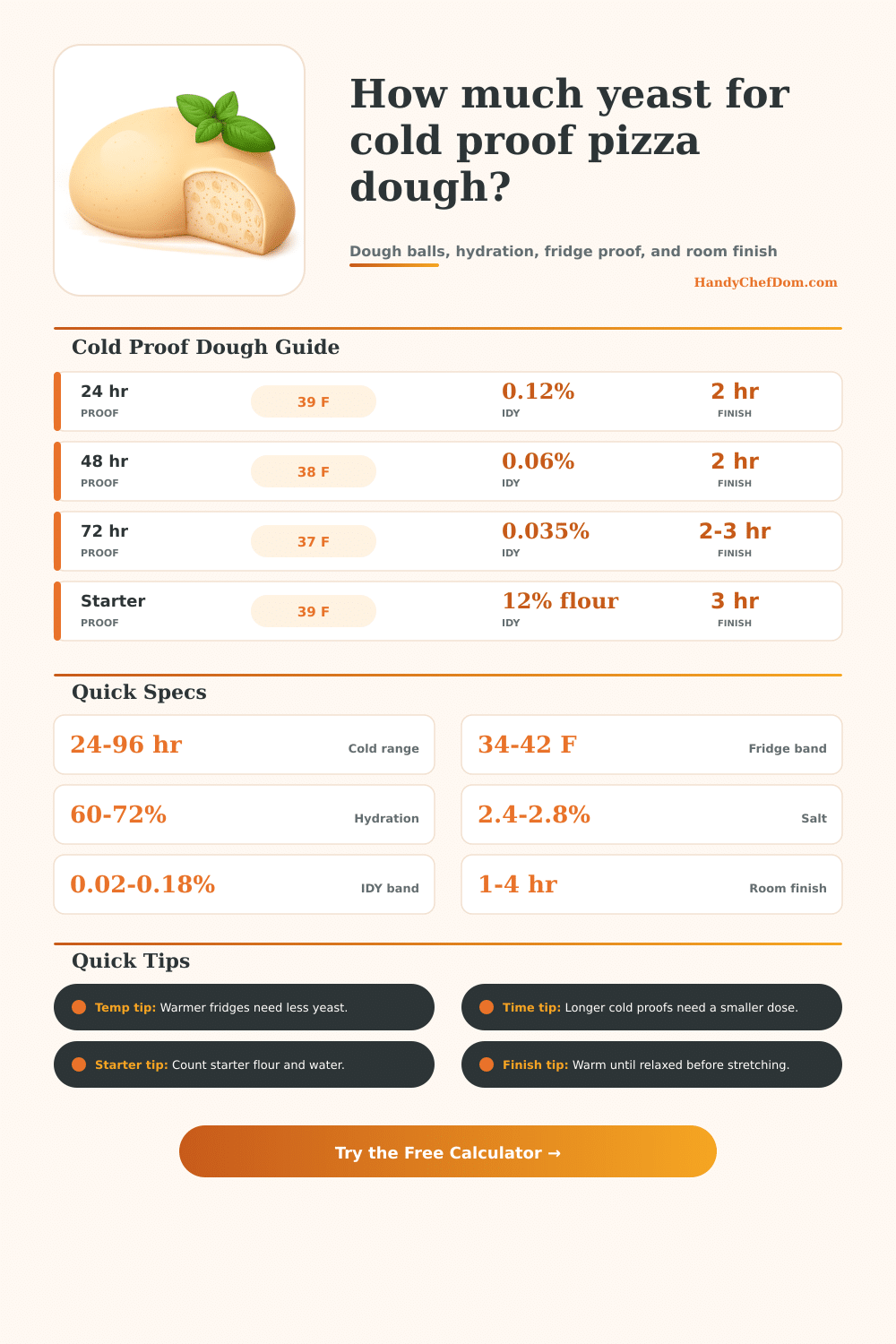
| 18 to 24 hr | 0.12 to 0.22% | 1.5 to 2.5 hr | Next-day pizza night |
| 36 to 48 hr | 0.05 to 0.12% | 2 to 3 hr | Flavor without much risk |
| 60 to 72 hr | 0.025 to 0.07% | 2 to 4 hr | Slow flavor development |
| 84 to 96 hr | 0.015 to 0.04% | 3 to 4 hr | Very low yeast production dough |
| Starter flour | Starter hydration | Cold proof | Flavor result |
|---|---|---|---|
| 6 to 8% | 100% | 48 to 72 hr | Mild sourdough note |
| 10 to 12% | 100% | 24 to 48 hr | Balanced flavor and lift |
| 14 to 18% | 80 to 100% | 18 to 36 hr | More aroma and faster proof |
| 20%+ | 100 to 125% | Short cold proof | Use carefully to avoid excess acid |
| Room finish | Dough cue | When to use | Stretch note |
|---|---|---|---|
| 0.5 to 1 hr | Still cool and tight | Warm kitchen or high yeast dough | May need a gentler opening |
| 1.5 to 2.5 hr | Relaxed and slightly puffy | Most IDY cold proofs | Best general window |
| 3 to 4 hr | Soft, airy, extensible | Cold fridge, low yeast, or starter | Handle lightly to keep gas |
| 4 hr+ | Very soft or fragile | Only for underproofed dough | Watch for overproofing |
Cold proof dough math is a planning tool. Yeast brands, flour strength, fridge cycling, and dough temperature after mixing can change the final timing, so keep notes and adjust the next batch by small percentages.
Cold proofing of pizza dough involve placing the dough in a refrigerator to ferment the dough slow. People use this method of cold proofing because cold fermentation of the pizza dough develop more flavor into the pizza dough as well as develops more strength in the pizza dough. To cold proof the pizza dough, first mix the pizza dough ingredient, then shape the pizza dough into ball.
Place the balls of pizza dough into the refrigerator for one or two day. The cold temperature of the refrigerator slow the movement of the yeast within the pizza dough, allowing the pizza dough to sit for forty-eight or seventy-two hour. The temperature of the refrigerator is one of the most important variable in the cold proofing process of pizza dough.
How to Cold Proof Pizza Dough
The temperature of the refrigerator alter the behavior of the yeast within the pizza dough. A warmer refrigerator will allow the yeast within the pizza dough to move at a faster rate. Therefore, if using a warmer refrigerator, less yeast will be required to perform the cold proofing process.
If the refrigerator is colder, the yeast will move at a slower rate so more yeast or more time within the refrigerator will be required to allow the pizza dough to proof. In either case, a calculator will allow an individual to determine the proper amount of yeast to use according to the temperature of the refrigerator and the hydration level of the pizza dough. The hydration levels of the pizza dough is another critical variable in the cold proofing process.
Hydration levels refer to the amount of water that is contained within the pizza dough. If the pizza dough contains sixty-two percent hydration, the pizza dough will be both tight and easy to shape but will be dense. However, if the hydration levels is increased to sixty-eight or seventy percent, the pizza dough will have a more open crumb structure and the pizza dough will puff good when baked.
Additionally, the amount of salt that is included in the pizza dough also need to be considered. Salt control the flavor of the pizza dough as well as the ability of the pizza dough to relax. The amount of salt should be set between two point four and two point eight percent so that the pizza dough is neither too tight nor too flat flavored.
The type of leavening agent that is used will also impact the timeline of the pizza dough. If instant dry yeast is used, the results will be predictable and suitable for long period of cold proofing. Active dry yeast can be used, but the active dry yeast must first be hydrated and the amount of active dry yeast must be twenty-five percent more than that required for the recipe using instant dry yeast.
Finally, sourdough starter will add acidity and aroma to the pizza dough. However, the amount of flour and water contained within the sourdough starter must be accounted for in the recipe. These variable will be accounted for in the calculator if the individual choose a specific leavening agent for there pizza dough.
When the pizza dough has proofed in the refrigerator for the time that is indicated on the recipe, a room temperature finish must be performed on the pizza dough prior to shape it into thin pizza. A room temperature finish is required because pizza dough that has proofed in the refrigerator may tear if you attempt to stretch it from the refrigerator. Allowing the pizza dough to sit at room temperature allow the gluten in the pizza dough to relax and the gases that have become trapped in the dough to expand.
The length of time that the pizza dough needs to proof at room temperature will depend upon the temperature of the refrigerator and the amount of yeast used in the pizza dough. Lean pizza dough will require less time to proof at room temperature than high hydration or oil enriched pizza dough. Common mistakes with the cold proofing process of pizza dough may involve copying the recipe without adjusting for the actual fridge that will be used or skipping the step of proofing the pizza dough at room temperature.
If the amount of yeast are not adjusted for the fridge in which the pizza dough will proof, the pizza dough may lack flavor or not rise within the oven. If the pizza dough is not allowed to proof to room temperature prior to shaping, the pizza dough will be too cold and too dense to properly shape. When the pizza dough is ready to be shaped, it will feel relaxed and may even feel slightly puff to the touch.
Oil can be added to the pizza dough to alter the characteristic of the dough. Oil will make the pizza dough more extensible which makes it easier to stretch and can be helpful when making pan style or Detroit style of pizza. However, if you add oil to the pizza dough, the total weight of the pizza dough will change so a calculator will help determine the impact of adding oil to the total weight of the pizza dough.
The process of cold proofing of pizza dough works due to the fact that the process separate the fermentation process into two phase. The first phase involve fermenting the pizza dough in the refrigerator, which develops the flavor of the pizza dough. During the second phase, the cold proofed pizza dough is allowed to warm to develop the rise in the pizza dough which will be shape into thin pizza.