🍓 Strawberries Per Cup Calculator
Estimate the number of strawberries per cup by berry size, cut style, hull loss, and recipe use for desserts, smoothies, jam, and fresh toppings.
Enter the cups your recipe needs. The calculator estimates how many strawberries to prep, then adds hull trimming and size variation so you do not come up short.
| Berry Size | Typical Whole Count | Approx Weight Each | Best Cup Use |
|---|---|---|---|
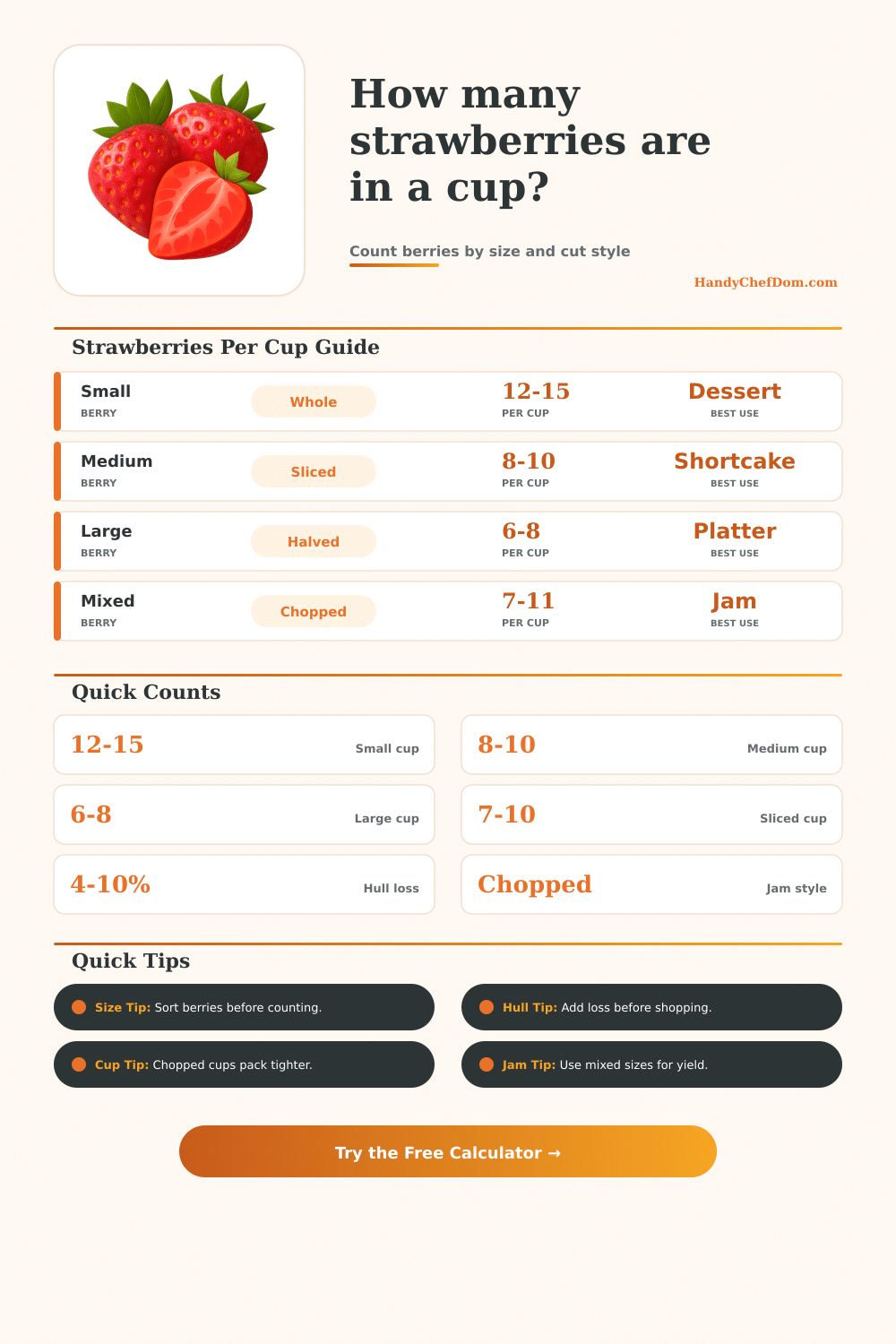
| Tiny | 16 to 20 per cup | 0.25 oz | Snack cups, garnish, freezer prep |
| Small | 12 to 15 per cup | 0.35 oz | Dessert bowls and fruit salad |
| Medium | 8 to 10 per cup | 0.55 oz | Sliced topping and shortcake |
| Large | 6 to 8 per cup | 0.75 oz | Platters, dipping, larger slices |
| Jumbo | 4 to 6 per cup | 1.05 oz | Chocolate berries and displays |
| Mixed basket | 8 to 12 per cup | 0.60 oz | Home recipes with mixed sizes |
| Prep Style | Count Effect | Cup Weight | Notes |
|---|---|---|---|
| Whole hulled | Lowest count density | 5.0 oz per cup | Air gaps make whole cups lighter. |
| Halved | About 8% more berries | 5.3 oz per cup | Good for salads and platters. |
| Sliced | About 16% more berries | 5.5 oz per cup | Common for desserts and cereal. |
| Chopped | About 28% more berries | 5.8 oz per cup | Tighter cup for fillings and freezer bags. |
| Crushed for jam | About 35% more berries | 6.0 oz per cup | Dense measuring style before cooking. |
| Recipe Use | Best Prep Style | Suggested Reserve | Why It Changes Count |
|---|---|---|---|
| Dessert topping | Sliced | 5% | Looks best with even slices and a small garnish buffer. |
| Smoothie or shake | Halved | 3% | Exact shape matters less, so trim waste can be lower. |
| Jam or compote | Chopped or crushed | 10% | Dense measuring and trimming can shift yield quickly. |
| Fruit salad | Halved or sliced | 8% | Extra berries cover uneven cuts and bowl presentation. |
| Whole berry platter | Whole | 12% | Presentation needs backup berries for bruises and gaps. |
| Cake or pastry filling | Chopped | 8% | Chopped fruit packs tightly and should fill layers evenly. |
| Recipe Volume | Small Whole | Medium Sliced | Large Halved |
|---|---|---|---|
| 1 cup | 12 to 15 berries | 8 to 10 berries | 7 to 9 berries |
| 2 cups | 24 to 30 berries | 16 to 20 berries | 14 to 18 berries |
| 4 cups | 48 to 60 berries | 32 to 40 berries | 28 to 36 berries |
| 6 cups | 72 to 90 berries | 48 to 60 berries | 42 to 54 berries |
| 8 cups | 96 to 120 berries | 64 to 80 berries | 56 to 72 berries |
| 10 cups | 120 to 150 berries | 80 to 100 berries | 70 to 90 berries |
Here’s the dilemma: You’re in produce aisle, clutching a carton of promising-looking berries. Can you judge how many berry there are, to know if it’ll be enough? You have a recipe calling for two cups of something. Is this the correct amount of fruit for that rhubarb crumble? Do those big berries packs densely into measuring cup, or will some fall out?
It’s not because they taste bad. Rather, it’s because they’re irregular solids, with air pockets and water, so visual inspection doesn’t gets you very far. Most home cooks believe relationship between weight and volume is pretty straightforward, until we start preparing our fruit. If I buy a pound of strawberries, I will only end up with three-quarters of a pound because removing the green tops account for four to ten percent of their original weight. It doesn’t sound like much, but if I’m trying to make enough jam to feed a group at a potluck or can some fruit, that difference add up. That’s one reason why we tend to not have quite enough fruit left over once we’ve baked something. We forget about all the waste from having to trim off part before cooking.
How to Measure Berries Correctly
By selecting your berry size (and cut) and plugging those numbers into calculator on the page, the math gets done for you. Now you’ll know exactly how much shrinkage to expect. Most recipes don’t admit that shape of the cut matters a lot. But it does. Because whole berries won’t stack up snugly against each other they leave big air spaces between them. Those whole berries also rolls around inside the cup, preventing them from packing down at all. Cut up the berries and their pieces fills those open spaces. A cup of sliced strawberries contains more actual strawberry than a cup of whole berry. Crushed or chopped berries pack even tighter. That’s why jam recipes has less cups of fruit but ask for more raw weight to get the same volume.
It makes a huge difference when you’re making your shopping list. Strawberry size is another variable that complicates guessing. Depending on variety, berry size introduce another layer of variance that throws off casual estimators. That means a pint of tiny berries may contain twenty or more, whereas a pint of jumbo could contains just four or five. Guessing medium will lead to empty bowls, or leftover fruit, if you don’t check the actual carton.
The number of berries vary by size (shown in reference table on the page). If you’re sorting mixed-size berry, count first; then combine large with large and small with small, packing patterns average won’t anticipate.
Should you heap up the measuring cup as with this, or pack down the mixture so it’s level? That depends on the recipe. You want a pastry filling packed tightly so no part of the crust get too dry. However, a dessert topping look better if piled loosely so it seems like there is more of it on the plate. In a smoothie, precision isn’t important since we don’t care about appearance (so long as it tastes right), just that the amount have the right balance of flavors. Knowing all of this will make your measurements a matter of judgment different than just habit, because you will decide whether to heap or pack down the fruit depending on how you plan to use it.
There is such a thing as being too exact when it comes to measuring strawberries (or any other ingredient). Perfect accuracy isn’t what matters: you’re learning how much to expect from each amount so that you can adjust actualy. After all, when you figure out how to calculate packing density and hull loss, then the mysterious void begins to make sense. What was once a guessing game becomes raw material. Unfamiliar berries in the box become ingredients ready for use.