🍞 Bread Dough Calculator
Scale bread dough by loaf count, pan or boule size, hydration, flour type, salt percentage, yeast or starter, preferment share, dough yield, and expected bake loss.
Choose the bread size first. The calculator treats your selected loaf weight as divided dough, adds handling loss for mixing, then estimates baked loaf yield after oven moisture loss.
Strong gluten handles pan loaves, boules, batards, and baguettes.
Softer flour works well for sandwich bread and lower hydration boules.
Bran absorbs more water, so a higher hydration target usually feels normal.
Rye dough feels sticky rather than elastic and benefits from pan support.
Spelt softens quickly, so use moderate water and gentle mixing.
Extra protein supports chewy bagels, tall batards, and high hydration dough.
Butter, eggs, and sugar reduce free water and make the dough feel softer.
Durum adds color and bite, with water needs between AP and bread flour.
| Shape or pan | Typical dough | Baked yield | Best use | Bake loss |
|---|---|---|---|---|
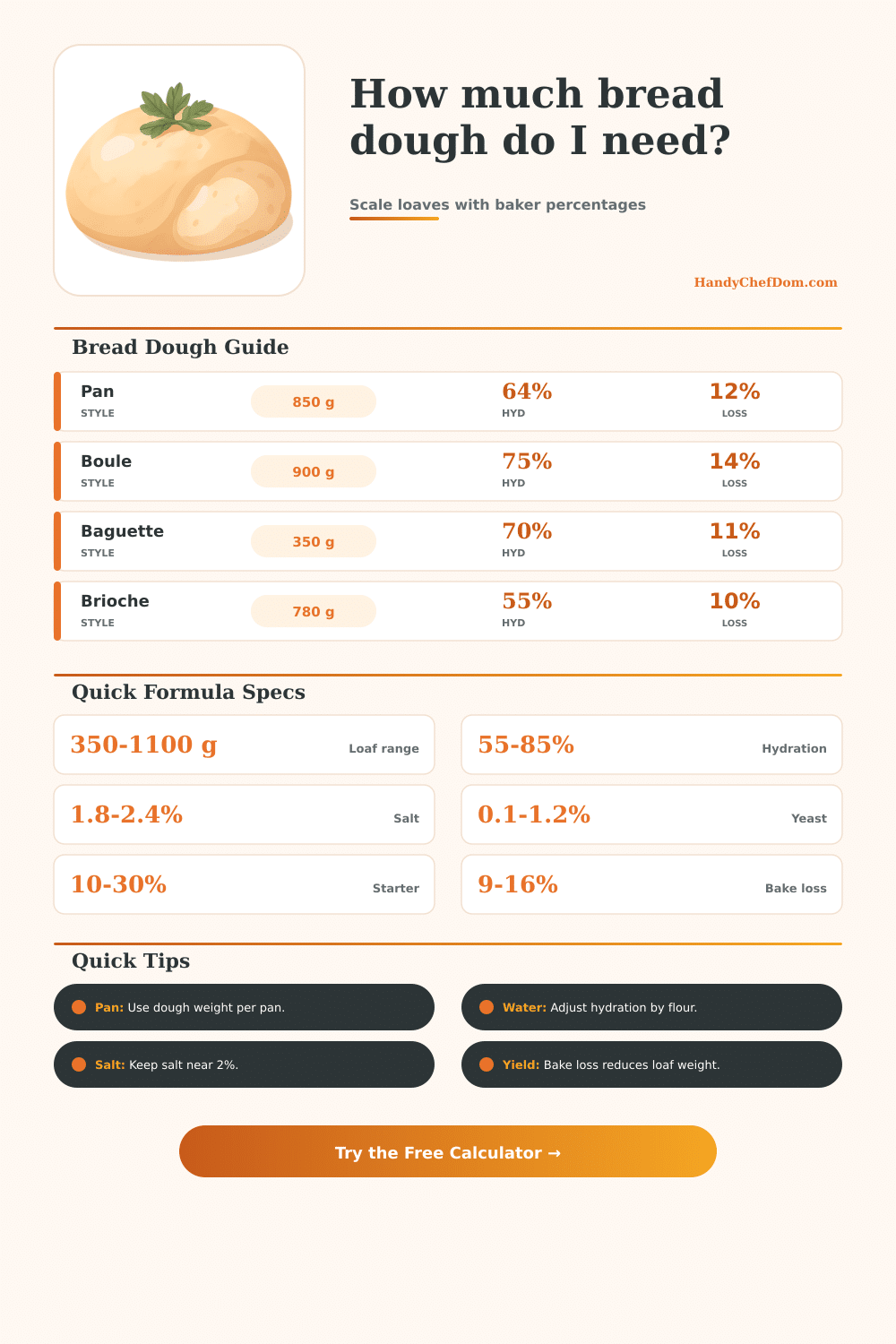
| 8.5 x 4.5 in pan | 750 to 900 g | 650 to 790 g | Standard sandwich loaf | 11 to 13% |
| 9 x 5 in pan | 900 to 1050 g | 780 to 930 g | Tall family loaf | 11 to 13% |
| Medium boule | 750 to 950 g | 640 to 820 g | Round artisan loaf | 12 to 15% |
| Large batard | 850 to 1100 g | 730 to 950 g | Oval hearth loaf | 12 to 15% |
| Baguette | 300 to 380 g | 260 to 340 g | Long lean loaf | 9 to 12% |
| Dinner roll | 60 to 90 g | 53 to 80 g | Portioned rolls | 8 to 11% |
| Bread style | Hydration | Salt | Leaven range | Common preferment |
|---|---|---|---|---|
| White sandwich loaf | 60 to 66% | 1.8 to 2.2% | 0.6 to 1.2% instant yeast | None or sponge |
| Country sourdough boule | 72 to 80% | 1.9 to 2.2% | 15 to 25% starter | Levain build |
| Baguette | 68 to 74% | 2.0 to 2.3% | 0.1 to 0.4% instant yeast | Poolish |
| Whole wheat pan loaf | 72 to 85% | 1.8 to 2.2% | 0.5 to 1.0% instant yeast | Sponge or levain |
| Rye blend loaf | 72 to 88% | 2.0 to 2.4% | 15 to 30% starter | Rye sour |
| Brioche or rich pan | 50 to 60% | 1.6 to 2.0% | 1.5 to 3.0% fresh yeast | None or sponge |
| Preferment | Flour share | Hydration | Dough impact | Calculator cue |
|---|---|---|---|---|
| None | 0% | Not used | Fastest formula setup | Keep preferment flour at 0% |
| Poolish | 20 to 50% | 100% | Extensible dough and mild flavor | Subtract equal flour and water |
| Biga | 20 to 45% | 50 to 60% | Strength and nutty aroma | Low preferment water |
| Sponge | 25 to 60% | 70 to 100% | Useful for pan and enriched bread | Moderate preferment water |
| Levain | 10 to 35% | 80 to 125% | Natural leavening and acidity | Count flour and water inside levain |
| Hydration | Dough feel | Good shapes | Flour match | Yield note |
|---|---|---|---|---|
| 50 to 58% | Firm | Brioche, bagels, tight pans | Enriched or high gluten | Lower bake loss, denser crumb |
| 59 to 66% | Balanced | Sandwich pans and basic batards | AP or bread flour | Predictable loaf volume |
| 67 to 74% | Tacky | Baguettes, batards, focaccia | Bread or high gluten | Moderate bake loss |
| 75 to 82% | Slack | Country boules and open crumb loaves | Bread, whole wheat, rye blends | Higher oven moisture loss |
| 83% plus | Very loose | Pan-supported or advanced hearth dough | Whole wheat or rye blends | Use a larger handling buffer |
To bake bread, you have to understand the correct amounts of dough that is required for each type of loaf. The amount of dough that is create changes with the addition of ingredient like water, salt, and leavening agents to the flour. If the proper amount of dough are not calculated prior to baking, then the dough may overflow the pan in which it is baked, or the baked bread may turn out to be smaller than that which was intended.
Dough can be measured in a variety of different ways. The hydration of the dough is one way to measure the dough, as hydration is the measurement of the amount of water that is present in the dough as compared to the total amount of flour that is contain in the batch of dough. The baker can make another measurement by adding the amount of salt to dough; salt is required for baking bread, but only if the correct amount of salt is added will the dough produce correctly (either too little salt will create a flat flavor for the bread, while too much salt will slow the fermentation of the dough).
How to Use a Dough Calculator for Baking Bread
The percentages of both yeast and leavening agents can change according to the rate of which the dough is to be risen, and ingredients like butter, oil, and sugar will impact both the way in which the dough is to be handled, as well as the amount of moisture that the dough will lose during baking. Each of these variable will impact the adjustment of other variables for the dough. A dough calculator is a tool that help to manage these connections between variables in the dough.
A dough calculator can calculate the percentages of each ingredient to be baked into the dough, the type of flour that is to be used, and the method for leavening the dough. Based off these variables, the dough calculator will calculate the total weight of the dough that will be mixed, the amount of flour that will be required, the amount of water that will be required, and the yield of the dough that will be baked. Furthermore, the dough calculator accounts for the handling losses for the dough, which are the amounts of dough that are lost during the mixing of the ingredients for the dough, the dividing of the dough into portions, and the shaping of the portions of dough into the desired shape.
If such losses are not accounted for in the calculations for the dough, the dough may end up with less weight than that which was calculated for the dough prior to baking. The type of flour that is used in the dough is another variable in the baking of bread. Different types of flour will absorb water differently.
For instance, bread flour has a higher protein content than other types of flour, such as all-purpose flour, so that it can absorb more water. Additionally, whole wheat flour contains bran, which will absorb some of the moisture from the dough, and rye flour behave differently from the other types of wheat flour. Dough calculators can adjust the hydration ranges of the dough according to the type of flour that is used, but the baker must still adjust the hydration of the dough according to how it feels when handle.
Preferments, such as poolish and biga, allow for flavoring of the dough prior to baking, as well as improve the extensibility of the dough. However, if preferments are used to flavor the dough prior to baking, the main dough will contain less flour and water than indicate by the dough formula. Dough calculators account for this reduction in flour and water to ensure that bakers dont add the flour and water for both the preferment and main dough at the same time.
Sourdough utilizes a levain, which is similar to preferments in that it both act as a leavening agent for the dough, as well as a source of the flour and water ingredient for the sourdough recipe. Dough will lose some of its weight during the baking process. For instance, dough may weigh 900 grams when baked as loaves, but may only weigh 780 grams after baking.
Dough calculators allow for adjustments to account for this bake loss, so that the amount of bread that will be baked yield the amount of weight that is desired for those baked loaves. If bake loss is not accounted for, the baker may find that he or she intended to bake four loaves, but only produce three loaves of bread. Reference tables exist within dough calculators that indicate the amount of dough to be baked for different type of loaves.
For instance, the weight of dough for baguettes ranges between 300 and 380 grams, and dinner rolls range between 60 and 90 grams. These ranges are provided because bakers can have different desired weights of the crumb structure of the bread, as well as the ratio of crust to crumb. The tables for dough calculators also contain bands of hydration for different types of bread, which provides bakers with a starting point for the hydration of their dough if they are not sure what the proper hydration rate should be for the flour that will be use.
Bakers should lock in the size of the loaf that will be baked prior to adjusting for hydration rate and leavening agents for the dough. If bakers change the percentages of ingredients after locking in the loaf size, the dough will be consistent in the outcome of the baked loaves. For instance, if bakers use a dough calculator to lock in the size of the loaves that will be baked, and change the hydration of the dough to make it wetter, the dough calculator will automatically recalculate the amount of flour and water that will be used for the dough to maintain the same ratio of ingredients.
Thus, lock in the loaf size prior to baking for best results. Bakers should also form the habit of tasting the dough at various stages of the baking process. Salt is one ingredient that can change the flavor of the dough; higher percentages of salt will make the dough more relaxed to handle, for instance, while lower percentages of salt will allow for the dough to ferment at a faster rate.
Thus, as the amount of salt changes, the dough may need to be adjusted. Dough calculators typically provide a default salt percentage of 2 percent, but this can be changed. Finally, because there are various other variables in real kitchens that the dough calculator cannot measure and account for, such as the temperature of the kitchen in which the dough is baked, the humidity of the air in that kitchen, and the way in which the flour is measured for the dough, the baker should use the recommended settings of the dough calculator as a point of departure for baking bread; however, the baker should still mix and feel the dough prior to baking to allow for adjustment to the dough prior to baking.
The point of using a dough calculator is so that the baked loaf will have the same weight as that which was intended for that loaf. If the correct amount of dough, hydration, and leavening agents are used in the baking of the bread, then the crust will have the correct color, and the crumb will have the correct structure. This outcome is achieved due to the consideration of the relationship of each of these variable.
Thus, once bakers understand each of these relationships, the dough calculator acts as confirmation of the correct decision for each of these variables.