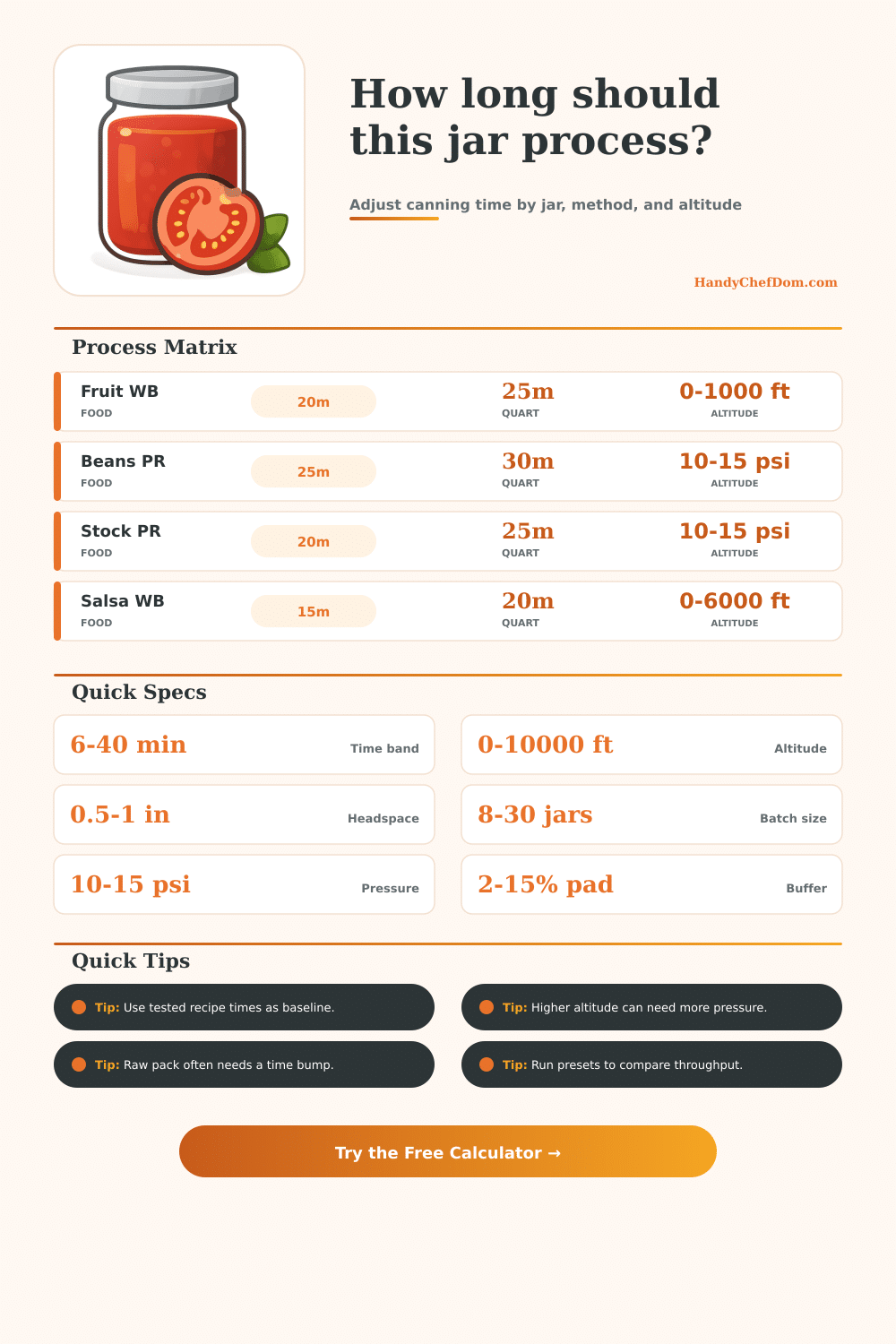
🫙 Canning Processing Time Calculator
Build a processing schedule from jar size, method, pack style, and altitude so your batch timeline stays consistent across weeknight prep and larger seasonal runs.
This calculator uses processing-time baselines plus method and altitude adjustments to estimate cycle timing. Keep your tested recipe as the source baseline and use this planner for schedule math.
| Food Profile | Half Pint | Pint | Quart | Method Bias |
|---|---|---|---|---|
| High-acid fruit | 15 min | 20 min | 25 min | Water bath |
| Jam or jelly | 10 min | 12 min | 18 min | Water bath |
| Pickled vegetables | 10 min | 15 min | 20 min | Water bath |
| Acidified tomatoes | 25 min | 35 min | 45 min | Water bath |
| Acidified salsa | 12 min | 15 min | 20 min | Water bath |
| Green beans | 20 min | 25 min | 30 min | Pressure |
| Corn kernels | 35 min | 55 min | 85 min | Pressure |
| Meat stock | 15 min | 20 min | 25 min | Pressure |
| Bean chili base | 40 min | 75 min | 90 min | Pressure |
| Altitude Band | Water Bath Add | Dial Gauge | Weighted Gauge | Use Case |
|---|---|---|---|---|
| 0-1000 ft | +0 min | 11 psi | 10 psi | Baseline |
| 1001-3000 ft | +5 min | 12 psi | 15 psi | Low hills |
| 3001-6000 ft | +10 min | 13 psi | 15 psi | Mountain towns |
| 6001-8000 ft | +15 min | 14 psi | 15 psi | High elevation |
| 8001-10000 ft | +20 min | 15 psi | 15 psi | Very high |
| Jar Size | Volume (ml) | Volume (cups) | Typical Fill | Batch @ 10 jars |
|---|---|---|---|---|
| Half pint | 236 ml | 1 cup | 0.5 in headspace | 2.5 qt |
| Pint | 473 ml | 2 cups | 0.5 in headspace | 5.0 qt |
| Quart | 946 ml | 4 cups | 1.0 in headspace | 10.0 qt |
| Liter | 1000 ml | 4.23 cups | 1.0 in headspace | 10.6 qt |
| Batch Style | Jars | Cycle Time | Cycles / 3 hr | Est. Jars / hr |
|---|---|---|---|---|
| Small evening run | 6 | 62 min | 2.9 | 5.8 |
| Standard load | 8 | 74 min | 2.4 | 6.5 |
| Dense pressure load | 10 | 96 min | 1.9 | 6.3 |
| Large seasonal run | 14 | 118 min | 1.5 | 7.1 |
| Two-run prep day | 20 | 142 min | 1.2 | 8.5 |
Canning at home include a variety of variable that can complicate the canning process. Despite the perception of canning as a simple task, there are a variety of detail to track during the canning process, such as the altitude where the canning will occur, the size of the jar that will be used, and the processing time for the cans. If these variable are not properly track, the canned product may not be safe to consume.
Processing time is the length of time that the coldest portion of the food must be boiled in order to kill any bacteria that may be present within the food. Foods that is high in acid, such as fruits and pickles, will be processed in a boiling water bath. However, low acid foods, such as beans, corn, and meat stock, will not boil in a boiling water bath to ensure that the food reach the temperature necessary to kill the bacteria that may be in those foods.
Things That Change Canning Time and Safety
Instead, low acid foods must be processed in a pressure canner to reach the high temperatures necessary to kill the bacteria. The calculator that is provided will allow for the input of the profile of the food that is to be canned, the processing method that will be used, and the size of the jars that will be used to contain the food. Based off these value, the calculator will display the processing time necessary to safe prepare the food.
The variable of altitude change the boiling temperature of the water. Because boiling temperature change with altitude, the processing time for recipes that are created at sea level may not be accurate if used at high altitude. However, processing time for pressure canned foods will not change with altitude, as the pressure canner uses pound per square inch as a means of controlling the boiling temperature.
Therefore, the calculator will automatically adjust the time for the canning process with the adjustment of the altitude or the method that is use for processing the jars. The pack style and texture of the food can change the processing time for the cans. Foods that are package when they are hot will heat to the necessary processing temperatures faster than foods that are pack when they are raw and cold.
Additionally, foods with a firm texture may contain air pockets that prevent heat from fully penetrate the food, while softer foods will release the liquid necessary to allow heat to penetrate the food faster. Headspace is the amount of space that is left between the food and the jar; too little or too much headspace can affect the safety of the canned foods. If the headspace is too small, the jar may not properly seal.
Too much headspace may cause the foods at the top of the jars to cook too long, but the middle portion of the jars may not cook for long enough. Foods that require a headspace of one-half inch include fruits and tomato product. Foods that are dense, such as chili or meat stock, require a headspace of one inch.
The size of the batch of jam, sauce, or other canned product will impact the length of time that it will take to complete the canning process. Small batches of six jar of food may take a few minute to complete, but larger batch of fourteen jars will take longer to complete. The canning time calculator will allow for the viewing of the total length of time that will be required to complete the batch of jam or sauce.
Many people will make mistake when canning at home. For instance, they may use a dial-gauge recommendation on a weighted-gauge canner, or they may ignore the altitude of the area where they are following a recipe that was create at a different altitude. The time calculator will help to prevent these mistake by displaying the impact of one variable on another.
It is also recommended to include a planning buffer into the plan for the canning process. A planning buffer will include time for loading the jar, venting the canner, reaching the appropriate pressure for boiling the liquid, and allowing the canner to cool. All of these step will take some amount of time, so adding a small percentage of extra time to the processing time will ensure that the can will not take longer than expected to be processed.
There are a number of variable that must be accounted for in the planning and execution of a canning process. The profile of the food, the processing method, the altitude, the size of the jar, and the pack style are all variable that must be accounted for. Additionally, understanding how each of these variable interact with each other will allow for more greater control of the canning process.
Understanding these variable will ensure that the canned food are safe and predictable in there results.