🍞 Bread Dough Weight Calculator
Plan bread from the finished loaf backward: choose baked target weight, bake loss, hydration, pan size, and loaf count to allocate flour, water, salt, and yeast.
Enter the baked loaf weight you want to serve. The calculator adds oven loss to find dough per loaf, adds mixing loss for the batch, then divides total dough into flour, water, salt, and yeast by baker percentage.
Best for standard sandwich loaves with a rounded crown.
Useful when you want taller family slices and more yield.
Works for square sandwich bread with controlled expansion.
Good for gift loaves, test bakes, and small batch formulas.
A manageable hearth loaf for two to four servings.
A classic round loaf range for bannetons and Dutch ovens.
Long lean loaves usually lose less moisture than large boules.
Use the loaf count as the piece count for roll trays.
| Pan or shape | Typical dough weight | Target baked loaf | Pan volume cue | Best use |
|---|---|---|---|---|
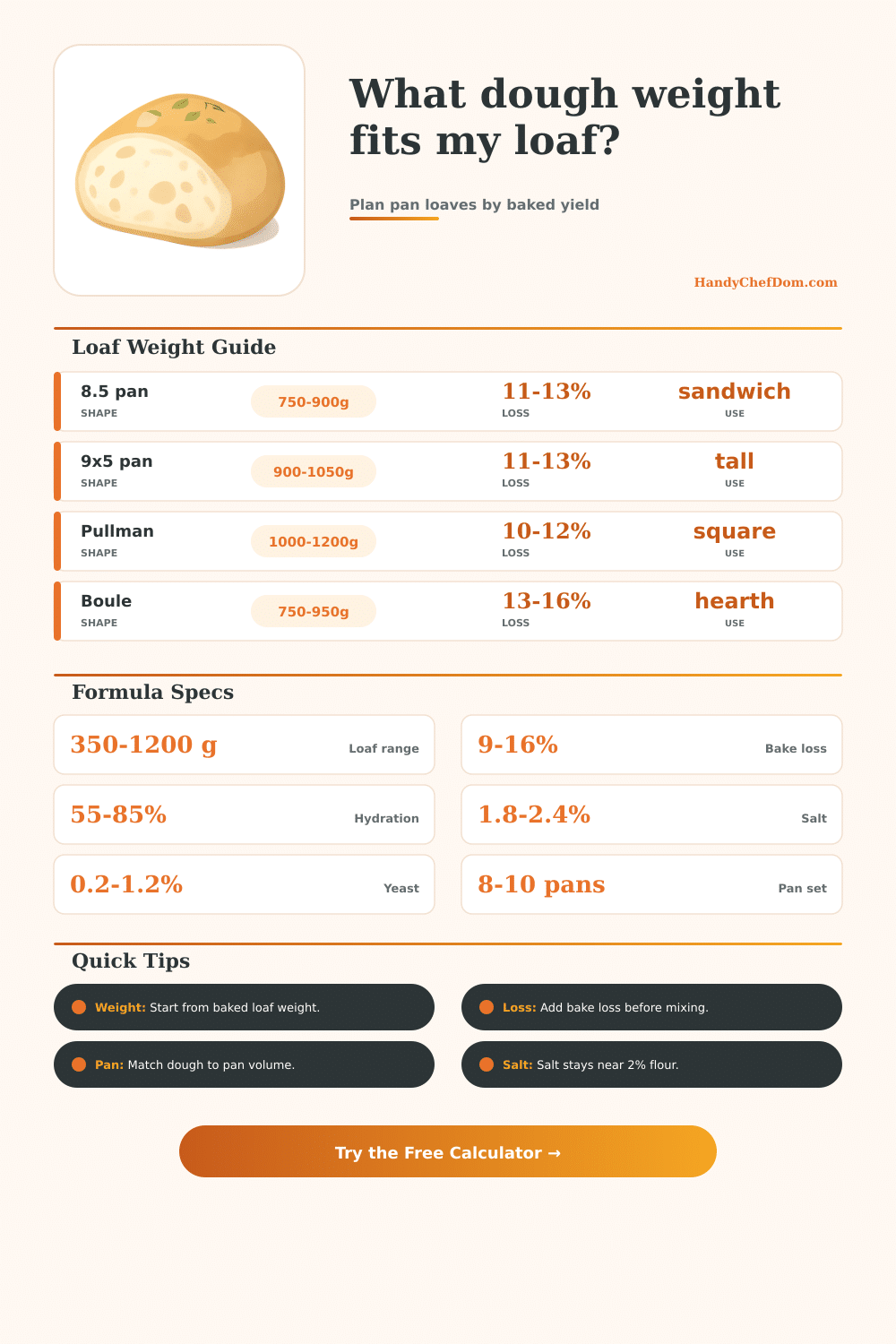
| 8.5 x 4.5 in loaf pan | 750 to 900 g | 660 to 790 g | About 105 cu in | Standard sandwich bread |
| 9 x 5 in loaf pan | 900 to 1050 g | 790 to 925 g | About 135 cu in | Taller family loaf |
| 9 x 4 x 4 Pullman | 1000 to 1200 g | 890 to 1060 g | About 144 cu in | Lidded square slices |
| Mini loaf pan | 280 to 360 g | 245 to 320 g | About 38 cu in | Small gift loaves |
| Medium boule | 800 to 1000 g | 680 to 870 g | 8 to 9 in basket | Round hearth loaf |
| Baguette | 300 to 380 g | 265 to 340 g | 16 to 20 in long | Lean crusty bread |
| Bread style | Common bake loss | 500 g baked needs | 750 g baked needs | Weight note |
|---|---|---|---|---|
| Soft pan loaf | 10 to 12% | 556 to 568 g dough | 833 to 852 g dough | Moderate crust and enclosed crumb |
| Lean sandwich loaf | 11 to 13% | 562 to 575 g dough | 843 to 862 g dough | Reliable planning range for pans |
| Country boule | 13 to 16% | 575 to 595 g dough | 862 to 893 g dough | Open bake loses more moisture |
| Baguette | 9 to 12% | 549 to 568 g dough | 824 to 852 g dough | Smaller diameter bakes faster |
| Rolls | 8 to 11% | 543 to 562 g dough | 815 to 843 g dough | Small pieces finish quickly |
| Hydration | Dough feel | Water per 500 g flour | Best pan or shape | Weight planning cue |
|---|---|---|---|---|
| 55 to 60% | Firm | 275 to 300 g | Pullman, enriched loaf | Easy to shape and lower oven loss |
| 61 to 66% | Balanced | 305 to 330 g | Sandwich pans | Most pan loaves fit this band |
| 67 to 74% | Tacky | 335 to 370 g | Batards and baguettes | Add flour only if shaping demands it |
| 75 to 82% | Slack | 375 to 410 g | Boules and open crumb bread | Expect higher bake and handling loss |
| 83% plus | Very loose | 415 g plus | Pan-supported dough | Use a bigger bench loss buffer |
| Formula choice | Percent of flour | Per 500 g flour | When to use | Allocation note |
|---|---|---|---|---|
| Instant yeast, same day | 0.6 to 1.2% | 3 to 6 g | Room temperature pan loaves | Add directly with flour |
| Instant yeast, cool rise | 0.15 to 0.4% | 0.8 to 2 g | Overnight or long proof | Reduce rate before cold time |
| Active dry yeast | 0.75 to 1.5% | 3.8 to 7.5 g | Recipes calling for active dry | About 1.25x instant yeast |
| Fresh yeast | 1.8 to 3.6% | 9 to 18 g | Bakery style formulas | About 3x instant yeast |
| Salt | 1.8 to 2.4% | 9 to 12 g | Most lean and pan bread | Weight by flour, not water |
When you plan a loaf of bread, you must first decide how much bread you would like to have once the bread is baked. This target weight is called the baked weight, and it is the most important number within the bread formula because the baked weight determines how much doughs you will have to mix. Since dough will lose moisture during the baking process, you must take into account how much moisture dough will lose to ensure that the finished bread will have the weight that you calculated.
By knowing the finished weight of your bread, you can build the recipe for bread backward to ensure that the dough will weigh the same as the baking pans that you will use. Each type of bread will lose a different amount of moisture during the baking process. For instance, pan loaves with soft crusts may lose ten or twelve percent of their total weight during the baking process.
How to Plan the Weight of Bread and Dough
However, freestanding loaves baked in a steamy oven may lose up to sixteen percent of their total weight. Since each type of bread will lose a different amount of moisture during the baking process, you must account for those percentages if you would like to have a specific amount of slice or sandwiches. Using a calculator will allow you to account for the moisture loss of each type of bread, which will ensure that you dont undermix the dough or overproof the dough.
The type of pan that you use also plays a role in the baking of each loaf of bread. A loaf baked in a standard sandwich pan will yield a different result than a loaf baked in a wide pan like a Pullman pan. If a loaf contains too much dough for the pan, it may bake short of the pans rim.
However, if a loaf contains too little dough for a wide pan, the center of the loaf may remain gummy. Each type of pan will require a specific amount of dough to ensure that the bread expands in the pan during baking. Another ingredient that will impact the baking process is hydration.
Dough with low percentages of hydration will hold its shape during the kneading of the dough. However, dough with high percentages of hydration will be slack and easily spread out. The type of flour used in the recipe will play a role in the hydration of the dough.
If you use flour such as whole wheat or rye flour, the dough will absorb more water than dough that contains only white bread flour. Adjusting the hydration of the recipe for the specific type of flour will ensure that the dough is easy to mix and wont pose a challenge to the baker. Other percentages that can be adjusted in the recipe are the percentage of salt and the percentage of yeast.
These two percentages is usually stable in most bread recipes. However, salt should be close to two percent of the weight of the flour. The percentage of yeast will change according to the type of yeast that is used.
Instant yeast contains a lower percentage of yeast than active dry yeast. Additionally, fresh yeast will contain an even higher percentage of yeast than both instant and active dry yeast. Using a calculator will allow the baker to change the type of yeast in the recipe without having to recalculate the entire formula.
Some dough may be lost due to the mixing process and the bench process. Dough will stick to the bowls, scrapers, and the bakers hands. Therefore, the baker must add a small percentage of dough to counteract the dough that will be lost during these processes.
This percentage ensures that the last loaf of bread is not too small to be desired. This logic will also be used to calculate the number of batches of dough to ensure that the dough is not under-mixed or under-weighed for the number of loaves that will be baked. Baking environments can change the process of baking bread.
The room temperature in the kitchen can change, as well as the activity of the starter with changes in the rooms temperature. The type of flour that the baker uses on the bench also has an effect on the baking process of the dough. Planning the dough formula ahead of time is helpful in these variables in the kitchen.
Planning the dough percentages will allow the baker to add more or less dough to the recipe prior to mixing the flour and water. Many people will make mistakes in the baking process due to starting the recipe at the wrong end point. People will typically add a round number of dough, such as one kilogram, and then find that the baked loaves are not as desired.
If people start with the weight of the finished loaf of bread, they will avoid these mistakes. Additionally, if people begin with the weight of the finished loaf, it will be easier to compare the weights of different types of bread recipes to find the perfect recipe for each type of bread. Bake loss can change according to the size of the loaf of bread.
Small rolls will lose a different percentage of moisture than large loaves of bread. If a baker uses the same percentage of dough loss for all types of bread, it is possible that they will add too much dough to the large loaves and not enough dough for small rolls of bread. Using a calculator will allow the baker to use the proper percentage of dough loss for each type of bread to be baked.
The type of flour that is used in the recipe can play a role in the baking process. Bread flour contains more gluten than all-purpose flour. The more gluten in the flour, the more hydration that can be used in the dough.
All-purpose flour contains less gluten than bread flour, meaning that it will require a lower hydration percentage in the dough. Enriched dough that contains milk or eggs will behave differently in the dough. Bakers should pay attention to the dough as it is being mixed to ensure that it has the proper hydration to the target.
Planning the dough weight in advance will allow bakers to have repeatable results for their batches of bread, even in different seasons. The hydration rates of dough will change in the summer months when the kitchen is warmer versus the winter months when the kitchens are cooler. The type of flour that is used in the winter months may also be different than the type of flour that is used in the summer months.
Planning the dough weight in advance will allow the baker to account for these differences in advance. The overall goal of planning the recipe for bread is to remove any variations in the recipe for bread. By knowing the weight of the dough needed for each type of pan and by knowing the desired weight of the finished bread, bakers can develop a process that is based off observation.
Bakers who understand the weight of the dough and the finished bread can develop a repeatable formula for baking bread.