🍞 Sourdough Proofing Calculator
Estimate sourdough bulk fermentation, final proof, fridge proof, and readiness cues from dough temperature, room temperature, starter percentage, hydration, dough strength, flour blend, folds, and target bulk rise.
Use the window as a planning guide, then confirm with dough cues. Sourdough speed changes with flour, starter maturity, actual dough temperature, fermentation container shape, and how much strength the dough has built.
Relative speed after temperature, starter, flour, and hydration adjustments.
Expansion target before preshape or final shaping.
Approximate room-temperature equivalent fermentation in the fridge.
The sign that should overrule the clock for this dough.
Dough feels dense, tears during shaping, and shows few bubbles along the sides.
Rounded edge, visible bubbles, smoother surface, and gentle jiggle in the container.
Poke mark fills slowly and partially while the loaf keeps its domed structure.
Dough spreads, feels foamy, loses tension, or the poke mark stays deeply dented.
Use lower bulk rise, earlier shaping, extra folds, or pan support to protect structure.
Can usually handle a higher rise target and longer fridge proof without collapsing.
Expect shorter windows and check for readiness before the timer says to stop.
Expansion may lag; use bubbles, edge rounding, and elasticity with the time estimate.
| Dough and room range | Approx bulk speed | Starter reference | Bulk cue | Adjustment |
|---|---|---|---|---|
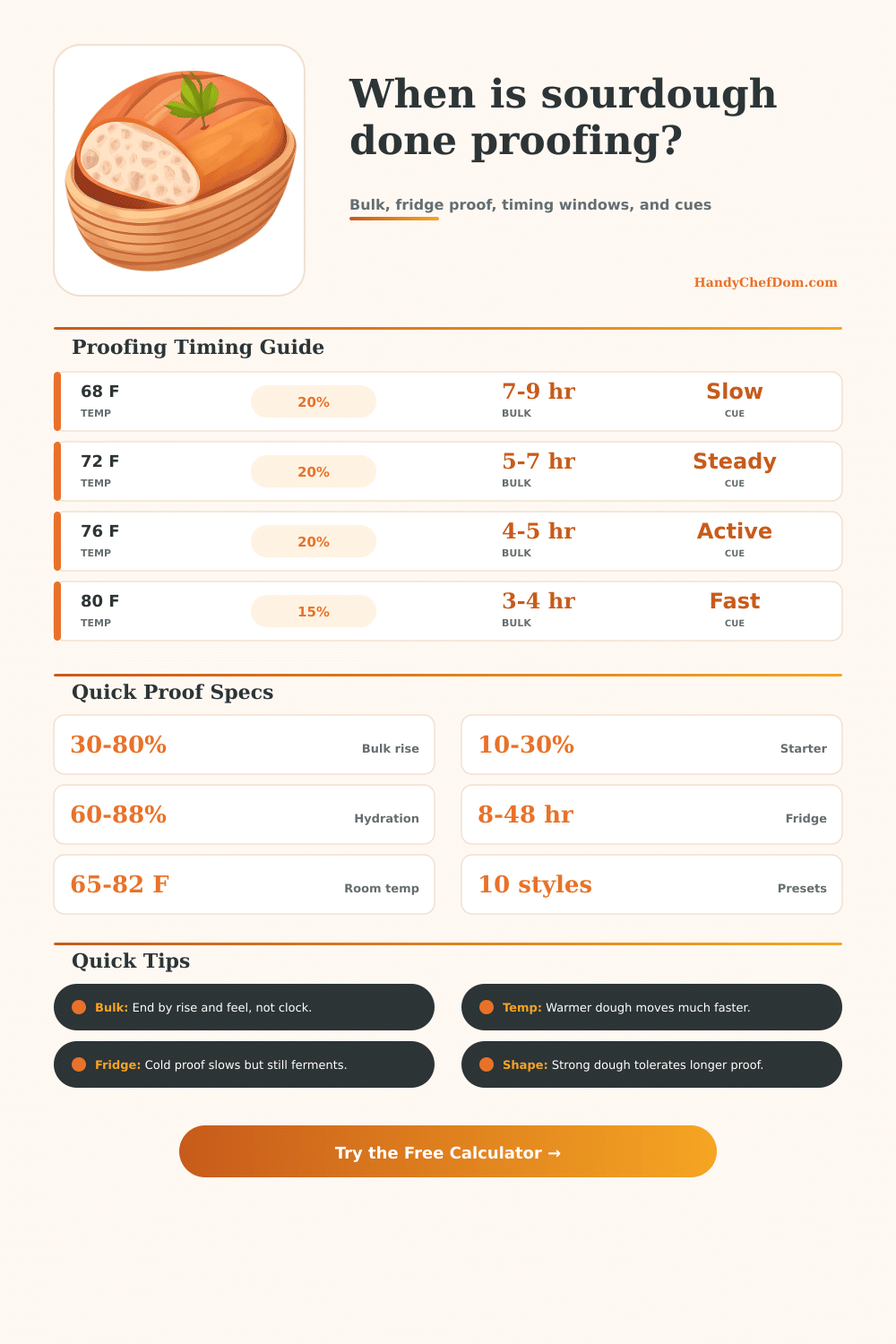
| 64 to 68 F / 18 to 20 C | Slow | 20% starter may need 7 to 10 hours | Bubbles arrive late, dough stays tight | Use warm water next batch or extend bulk |
| 69 to 72 F / 21 to 22 C | Moderate | 20% starter often needs 5.5 to 7.5 hours | Gradual rise and smoother surface | Good range for low-risk home proofing |
| 73 to 77 F / 23 to 25 C | Active | 20% starter often needs 4 to 6 hours | Visible edge bubbles and jiggle | Check early if starter is very strong |
| 78 to 82 F / 26 to 28 C | Fast | 15 to 20% starter can finish in 3 to 4.5 hours | Rise accelerates after folds | Use a lower rise target or less starter |
| 83 F+ / 28 C+ | Very fast | High overproof risk with 20% starter | Dough softens quickly | Shorten bulk or cool the dough |
| Starter percent | Best use | Common bulk rise | Timing effect | Readiness cue |
|---|---|---|---|---|
| 8 to 12% | Overnight room bulk or warm kitchen | 40 to 70% | Slower and more forgiving | Aroma builds gradually |
| 15% | Balanced daytime or warm dough | 40 to 60% | Moderate speed | Look for early side bubbles |
| 20% | Standard country sourdough | 35 to 60% | Reliable home baseline | Jiggle plus rounded edge |
| 25% | Cool kitchen or same-day loaf | 30 to 50% | Faster acid and gas buildup | Shape before dough weakens |
| 30%+ | Very cool room or quick bake | 25 to 45% | Fastest, less forgiving | Use feel more than volume |
| Fridge proof | Best dough state before chilling | Cold effect | Bake cue | Risk note |
|---|---|---|---|---|
| 4 to 8 hours | Slightly under-proofed basket | Small flavor and firmness boost | Poke still springs back clearly | May need brief room proof before bake |
| 10 to 16 hours | Shaped with moderate tension | Balanced overnight proof | Poke fills slowly and partially | Most reliable home cold proof |
| 18 to 24 hours | Shaped a little earlier | More acidity and extensibility | Loaf feels airy but still domed | Weak dough may spread |
| 30 to 36 hours | Lower bulk rise and strong shaping | Long flavor development | Score directly from cold | Use strong flour and cooler fridge |
| 40 to 48 hours | Under-bulked, strong dough only | High acid and gluten stress | Watch for sticky or fragile surface | Can overproof or weaken structure |
| Stage | Underproofed cue | Ready cue | Overproofed cue | What to change |
|---|---|---|---|---|
| Bulk container | Flat sides, few bubbles, tight dough | Rounded edge, bubbles, jiggle, target rise | Foamy top, collapsing edge, very sticky | Change bulk time or target rise |
| Preshape | Tears and resists rounding | Holds a loose round with light tension | Spreads into a puddle quickly | Adjust folds and dough strength |
| Final basket | Poke springs back instantly | Poke fills slowly and not fully | Poke stays dented or loaf deflates | Adjust final proof or fridge time |
| Scoring | Very tight skin, little expansion | Blade opens a clean ear path | Sticky drag or spreading cut | Shorten proof or bake colder |
| Baked loaf | Dense crumb and large tunnels | Even lift, open but supported crumb | Flat loaf, gummy band, weak spring | Review bulk and final proof balance |
This calculator estimates proofing windows for planning. Starter strength, flour batch, dough container shape, water temperature, and fridge cycling can shift real timing, so keep notes and adjust one variable at a time.
Sourdough proofing is a processes of determining when sourdough dough is ready for shaping. Many people finds sourdough proofing to be a difficult process due to the number of variables that can affect sourdough dough fermentation. These variables includes the temperature of the sourdough dough, the sourdough starter activity, the type of flour used in the sourdough dough, and the strength of the sourdough dough.
Each of these variables can impact the speed at which sourdough dough ferments, making it impossible to implement a fixed schedule for sourdough proofing. The temperature of the sourdough dough is one of the first variable that should be considered during sourdough proofing. More importantly, you should consider the temperature of the sourdough dough than the temperature of the room in which the sourdough dough is proofing.
How to Tell When Sourdough Dough Is Ready
For instance, sourdough dough at twenty-four degrees Celsius will ferment more faster than sourdough dough that is at twenty-one degrees Celsius. Although the temperature of the room is one of the variables to consider, it is less important than the temperature of the sourdough dough itself as it will take some time for the sourdough dough to reach the temperature of the room. Additionally, the percentage of sourdough starter in the sourdough dough will impact the speed at which the sourdough dough ferments.
Using a higher percentage of sourdough starter will increase the speed at which the sourdough dough ferments, but using a lower percentage of sourdough starter will decrease the speed of fermentation of the sourdough dough. The maturity of the sourdough starter used in the sourdough dough will also impact the timing of sourdough proofing. If using a sourdough starter that has reached the peak of its maturity, it will provide more lift to the sourdough dough and provide a more easily predictable timing for the sourdough proofing process.
However, if using an overripe sourdough starter, the sourdough starter may add acidity to the sourdough dough that weakens the gluten in the dough. Additionally, the activity rate of the sourdough starter will impact the sourdough proofing process. If the activity rate of sourdough starter is above one, it means that the sourdough starter ferments faster than average; thus, you should more frequently assess sourdough dough during the sourdough proofing process.
If the activity rate is below one, it means that the sourdough starter ferments more slow than average, which means the sourdough proofing process will take more time to complete. Finally, the hydration levels of the sourdough dough and the type of flour that is used will impact the tolerance that can be allowed during the sourdough proofing process. The higher the hydration level of the sourdough dough, the more extensible the dough will be.
Using a high hydration level, however, makes it more difficult to determine if the sourdough dough is under proofed. Using flour that contains more whole grains will accelerate the fermentation process of the sourdough dough due to the increased amount of food provided to the yeasts. However, the higher amount of whole grain flour will also make the sourdough dough less able to hold its shape.
You can use the strength setting to account for these differences. A recipe that calls for weak sourdough dough will have a lower rise target than the same recipe with strong sourdough dough. Strong sourdough dough can handle higher rise targets and can rise for longer periods of time while still proving.
Cold proofing in a refrigerator will slow the sourdough fermentation process. However, it will not stop the sourdough fermentation process entirely. The refrigerator will slow the sourdough dough fermentation process, allowing the sourdough to continue fermenting.
The mass of the sourdough dough will impact how the sourdough dough reacts to the refrigerator. Larger batches of sourdough dough will retain heat longer than smaller batches. If the sourdough dough is near the fermentation limit, long cold proofing periods in the refrigerator could over-proof the sourdough dough.
You must use physical cues to determine if the sourdough dough is ready as the sourdough dough itself is the best indicator of when the sourdough dough is ready for shaping. The poke test is the most common physical cue that bakers use to determine if the sourdough dough is ready. If the sourdough dough is under-proofed, it will feel tight when poked and may tear when attempting to shape the sourdough dough.
If the sourdough dough is ready, it will slowly return to its original volume when poked. If the sourdough dough is over-proofed, it will spread out when poked and may feel foamy to the touch. Volume is not the best or most accurate indication of when to proof sourdough dough.
A fifty percent rise in volume may be perfect for one batch of sourdough dough but could be too much for another batch. Use the sourdough calculator to determine the best rise for your batch of sourdough dough. If the sourdough dough feels tight and has few bubbles when you touch it, it needs more time to proof even if its past the suggested proofing window.
If the sourdough dough is jiggling and rounding, it must be shaped before the proofing window end. Many mistake in sourdough proofing come from treating one variable while assuming it will never change. Using the same amount of sourdough starter every time may be convenient, but the activity of the sourdough starter can change from day to day.
The sourdough calculator can show the impact of changing one variable at a time. Changing the room temperature will impact the sourdough dough proofing time as will changing the percentage of sourdough starter needed for a batch. Keep the sourdough dough in the proofing window where it have enough strength to be shaped and scored.
Wait, you should of checked the doughs temperature again before shaping. This is how you recieve the best results, its naturaly a bit of a lerning curve. Youll find that the dough is different than what you expected, then you just adjust.
Dont worry if you make alot of errors at first.