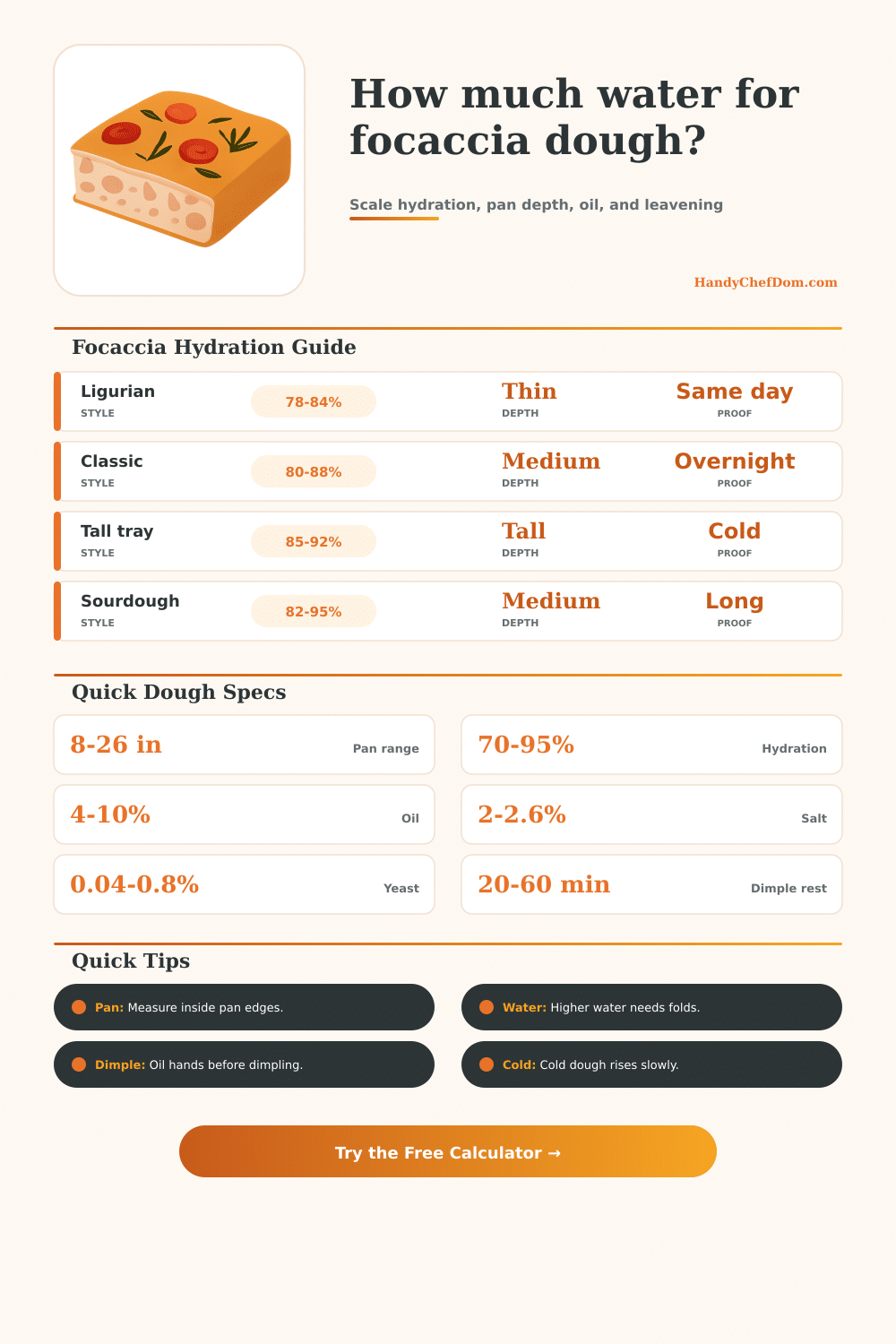
🍞 Focaccia Hydration Calculator
Scale focaccia dough from pan size, pan count, target dough depth, flour strength, water, oil percentage, salt percentage, yeast or starter, fermentation time, and dimpling rest.
Measure the inside base of the pan. Dough depth is the pre-proof dough thickness you want to load into the pan; the calculator uses it to estimate total dough, then converts the formula into flour, water, oil, salt, and leavening.
Inside pan area used to size the dough load.
Dough grams per square inch for this depth.
Yeast, starter, or combination weight.
Water to hold back for easier mixing.
Lower pan depth with brine-friendly surface dimples.
Medium tray depth with tender crumb and crisp edges.
Balanced high-hydration dough for home sheet pans.
Higher depth and stronger flour for a lofty slab.
Starter water counts toward the final hydration number.
Bran absorbs more water, so the dough can feel firmer.
Round pan loading with enough oil for crisp sides.
Large tray formula sized for predictable portions.
| Hydration range | Dough feel | Best focaccia use | Handling cue | Dimpling cue |
|---|---|---|---|---|
| 70 to 76% | Soft but manageable | Beginner trays and skillet focaccia | Use light oil on hands | Dimples stay shallow |
| 77 to 84% | Wet and elastic | Ligurian or medium-depth trays | Use folds during bulk | Rest before dimpling deeply |
| 85 to 92% | Very slack and glossy | Classic high-hydration sheet pan | Use bassinage and a scraper | Oil fingers well |
| 93 to 100% | Pourable and delicate | Tall airy focaccia with strong flour | Mix gently and avoid bench flour | Dimple once, then rest |
| Pan size | Inside area | Thin load | Classic load | Tall load |
|---|---|---|---|---|
| 8 x 8 inches | 64 sq in | 250 to 320 g | 360 to 460 g | 500 to 620 g |
| 9 x 13 inches | 117 sq in | 455 to 585 g | 655 to 840 g | 915 to 1140 g |
| 10 x 14 inches | 140 sq in | 545 to 700 g | 785 to 1005 g | 1095 to 1365 g |
| 13 x 18 inches | 234 sq in | 910 to 1170 g | 1310 to 1680 g | 1830 to 2280 g |
| 18 x 26 inches | 468 sq in | 1820 to 2340 g | 2620 to 3360 g | 3660 to 4560 g |
| Fermentation plan | Instant yeast | Starter amount | Hydration fit | Rest cue |
|---|---|---|---|---|
| Same day 4 to 8 hr | 0.35 to 0.80% | 0 to 10% | 75 to 86% | Warm bulk, shorter pan proof |
| Overnight 12 to 24 hr | 0.12 to 0.30% | 0 to 15% | 80 to 90% | Room start, cool finish |
| Cold proof 24 to 48 hr | 0.04 to 0.16% | 0 to 20% | 82 to 92% | Oil pan before cold proof |
| Sourdough 8 to 14 hr | 0 to 0.08% | 15 to 35% | 82 to 95% | Use starter maturity as the clock |
| Long cold 48 to 72 hr | 0.02 to 0.08% | 0 to 12% | 78 to 88% | Degas gently before dimpling |
| Formula item | Typical range | What it changes | Calculator input | Practical cue |
|---|---|---|---|---|
| Dough oil | 4 to 10% | Softness, browning, and tenderness | Oil in dough percent | Raise for richer crumb |
| Pan and top oil | 20 to 60 g per pan | Crisp bottom and glossy dimples | Pan oil per pan | Use more for tall trays |
| Salt | 2.0 to 2.6% | Flavor and gluten strength | Salt percent | Use flour-based percent |
| Dimpling rest | 20 to 60 min | Gas retention and even wells | Dimpling rest minutes | Rest longer if dough springs back |
| Handling loss | 2 to 5% | Sticky transfer buffer | Loss percent | Higher for very wet dough |
Focaccia hydration calculations are planning estimates. Flour strength, water temperature, starter maturity, pan material, and proofing temperature can change how the same formula feels.
Focaccia hydration mean the ratio of water to flour within a focaccia recipe. The amount of water that is include within the focaccia dough will determine the texture of the focaccia that is produced. If too little water is include within the focaccia dough, the crumb of the focaccia will be tight and dryly.
If too much water is include within the focaccia dough, the focaccia dough will be slippery and difficult to handle. The hydration level of focaccia dough can control how open the crumb of the focaccia becomes, how the focaccia dough spread within the pan, and how long the focaccia dough must rest prior to dimpling the focaccia dough. Pan size is one of the primary factor in the production of focaccia dough.
How water, pan size and ingredients change focaccia dough
The size of the pan will determine the total weight of the focaccia dough that can be bake within that pan. A person must consider the dimensions of the baking pan in which the focaccia dough will be baked, as the dimensions of the baking pan will determine the area that the focaccia dough will cover. Additionally, the cook should also consider the depth of the focaccia dough, as the depth of the focaccia dough will determine the total weight of the focaccia dough.
If an individual desire focaccia dough that is thicker then that which would be create with the current depth of the focaccia dough, the individual can adjust the depth of that focaccia dough. The same adjustment of the depth of the focaccia dough is one of the most direct methods of adjust the total weight of the focaccia dough. Oil and salt are two additional ingredient that can be include within focaccia dough.
The percentage of oil that is include within the focaccia dough will impact the tenderness of the focaccia and how the focaccia brown. The oil will also change the way that the focaccia dough feel when it is being mix. Salt is an ingredient that will impact the flavor of the focaccia as well as the strength of the gluten that is contain within the focaccia dough.
The amount of salt that is include within the focaccia dough influences the strength of the gluten within the focaccia dough, especially if the hydration level of the focaccia is high. Fermentation and temperature is two variable in the focaccia dough that will impact the behavior of the focaccia dough. Different schedule for fermenting the focaccia dough will impact the flavor of the focaccia.
For instance, employing an overnight cold proof fermentation schedule allows for less yeast to be include in the focaccia dough, and reduce the chance of overproofing the focaccia dough. If sourdough focaccia is to be produce, the sourdough starter must be account for in the focaccia dough. The sourdough starter contains both flour and water component, which impact the hydration of the focaccia dough.
Following the dough has rest in the baking pan, the focaccia dough can be dimpled. Dough with a high percentage of hydration will require more time to rest in the baking pan than dough with a lower percentage of hydration. This is due to the fact that high hydration focaccia dough will spring back and tear if it is dimpled too soon.
Low hydration focaccia dough will not require as much rest time prior to dimpling, but will not have the same degree of opening within the focaccia dough that high hydration focaccia dough will exhibit. The time that the focaccia dough rest following it is place in the baking pan must be match to the hydration level of the focaccia dough for the dimpling process to be successful. Many individual make mistake in the production of focaccia dough when they use the same percentage of hydration for every baking pan and for every type of flour.
For example, an individual may use 85 percent hydration for a focaccia recipe because that hydration level create successful focaccia once, but that same 85 percent hydration may not create focaccia that is successful if the baking pan is deeper than the current depth of the focaccia dough or if the flour that is use is a whole grain flour. The focaccia dough will respond to the ratio of water to flour within the focaccia dough, as well as the strength of the flour that is use in the focaccia dough recipe. However, focaccia dough does not respond to the number that is write within the recipe.
Finally, another factor that should be account for in the focaccia dough is the loss of dough that stick to the bowl or the hands of the individual that is mixing the focaccia dough. Accounting for this loss of focaccia dough will ensure that the amount of focaccia dough that end up in the baking pan is the same as that which was calculate when producing the focaccia recipe.