🍺 Bottle Conditioning Yeast Calculator
Estimate priming sugar, target CO2, residual carbonation, yeast viability, ABV stress, and dry or slurry repitch amounts for beer, cider, and wine.
Enter the warmest temperature reached after fermentation. That temperature sets residual dissolved CO2 before priming sugar is added.
| Warmest Temp | Residual CO2 | Use In Calculator | Notes |
|---|---|---|---|
| 50°F / 10°C | 1.21 volumes | Cool lager cellar | More CO2 remains dissolved |
| 55°F / 13°C | 1.10 volumes | Cool fermentation | Moderate residual gas |
| 60°F / 16°C | 1.00 volumes | Ale cellar | Common priming reference |
| 65°F / 18°C | 0.90 volumes | Room finished ale | Less dissolved gas remains |
| 70°F / 21°C | 0.83 volumes | Warm ale or cider | Add more sugar for same target |
| 75°F / 24°C | 0.77 volumes | Warm conditioning | Low residual gas estimate |
| 80°F / 27°C | 0.72 volumes | Hot room peak | Use if batch warmed after fermenting |
| Beverage Style | Low CO2 | Typical CO2 | High CO2 |
|---|---|---|---|
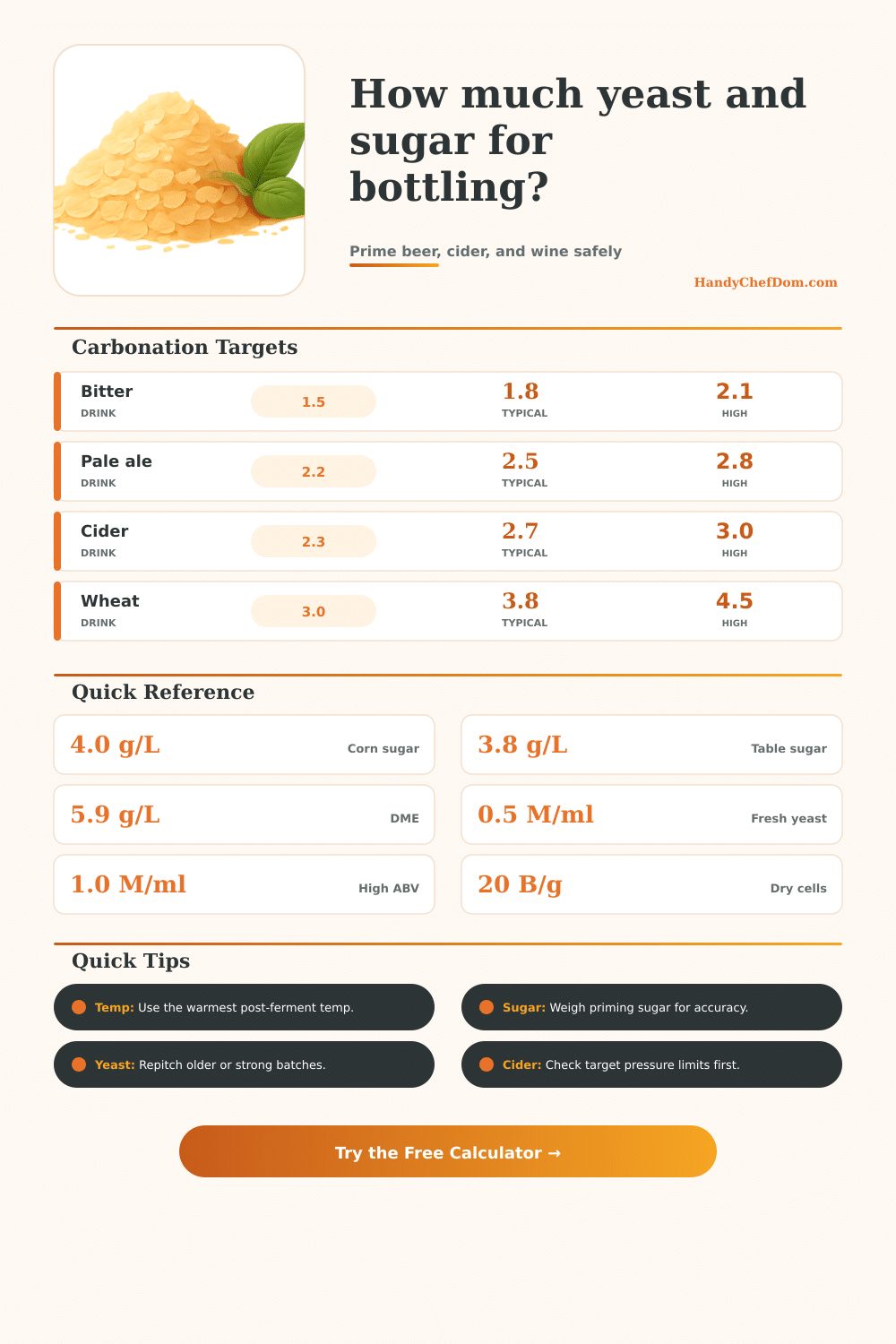
| English bitter, mild, porter | 1.5 | 1.8 | 2.1 |
| American ale, IPA, amber | 2.2 | 2.5 | 2.8 |
| Lager, pilsner, kolsch | 2.4 | 2.6 | 2.9 |
| Belgian ale or saison | 2.4 | 2.9 | 3.5 |
| German wheat beer | 3.0 | 3.8 | 4.5 |
| Hard cider | 2.3 | 2.7 | 3.0 |
| Sparkling wine or mead | 2.5 | 3.0 | 4.0 |
| Priming Fermentable | Calculator Factor | Typical Basis | Best Use |
|---|---|---|---|
| Corn sugar / dextrose | 4.0 g/L/vol | Highly fermentable | Neutral beer and cider priming |
| Table sugar / sucrose | 3.8 g/L/vol | Slightly higher yield | Small accurate additions |
| Light dry malt extract | 5.9 g/L/vol | Less fermentable by weight | Beer-only malt profile |
| Honey | 4.7 g/L/vol | About 82% sugar solids | Cider, mead, specialty beer |
| Maple syrup | 5.0 g/L/vol | About 66% sugar solids | Mead or specialty batches |
| Brown sugar | 3.9 g/L/vol | Sucrose plus molasses | Darker beer or cider |
| Yeast Situation | Cell Dose | Typical Source | When To Use |
|---|---|---|---|
| Fresh low-ABV beer | 0.25 M/ml | Existing yeast | Recent fermentation under 5% ABV |
| Standard repitch | 0.50 M/ml | Dry ale yeast | Normal ale, lager, cider, or wine |
| Cold-aged lager | 0.75 M/ml | Dry lager yeast | Long lagering or clear beer |
| High-ABV batch | 1.00 M/ml | Alcohol-tolerant dry yeast | Strong beer, cider, mead, or wine |
| Very old yeast cake | 1.00 M/ml | Fresh dry yeast | When primary yeast is weak or settled |
| Very strong bottle conditioning | 1.50 M/ml | Fresh wine yeast | High ABV with long aging |
Bottle conditioning is use after the fermentation of the beer is finished. During this stage, a person adds more gas to the beer to make the beer carbonated within the bottles. In order to accomplish this, a person must understand how much carbon dioxide is already dissolved within the beer, and how much carbon dioxide must be added to the bottles in order to avoid flat bottles or bottles that burst from too much pressure.
The amount of carbon dioxide that is added is dependent upon the temperature of the beer, the health of the yeast, the alcohol content of the beer, and the type of sugar that is added to the bottles during this process. To figure out these different variables and the amount of carbon dioxide that should be added to the bottles, a calculator is use. The temperature at which the beer was brewed is one of the variable that has an impact on the amount of carbon dioxide that is contained within the beer.
How to Use a Bottle Conditioning Calculator
Warm temperatures lead to less dissolved gas within the beer, and cooler temperatures allow for more carbon dioxide to be dissolved into the beer. Thus, the calculator will ask for the temperature of the beer that reached the warmest stable temperature after primary fermentation. That carbonation level is the amount of carbon dioxide that is already present within the beer, and the person subtracts that amount from the target carbonation level of the beer so that too much priming sugar is not added.
The health and viability of the yeast that was used in the brewing of the beer is another of the variables in the brewing process. Dry yeast will remain active for longer periods of time if stored in a cool place, whereas yeast slurry may lose it’s viability if it is stored in a refrigerator or even on a warm shelf within the fridge. Additionally, beer with high amounts of alcohol has a negative effect upon the yeast; the yeast becomes stressed with these high alcohol levels and is unable to effectively ferment the priming sugar that is added to the bottles.
Both the alcohol content of the beer and the age of the yeast are variables that must be accounted for in order to determine the amount of yeast that must be added to the bottles. The type of priming sugar that is used also has an impact upon the amount of sugar that is required to be added to the bottles during the bottle conditioning process. For example, corn sugar and table sugar is similar in relation to the amount of sugar that each type contains, but each is treated as a separate item in the conditioning process.
Dry malt extract contains less fermentable sugar than table sugar, so the brewer must add more of the dry malt extract to the bottles in order to achieve the same level of carbonation as table sugar. Additionally, sweeteners like honey or maple syrup contain water and non-fermentable solids that impact the amount of sugar that is actively fermentable; thus, each of these types of sweeteners will require different calculations to determine the amount of sugar that should be added to the bottles. Each type of priming sugar has its own weight that is calculated by the bottle conditioning calculator.
The target carbonation level of the beer is another of the variables that will be inputted into the calculator. Each type of beer has its own target carbonation level. For instance, English bitters will have a low target carbonation level, while wheat beers will contain a higher target carbonation level.
Additionally, beers like cider and sparkling wine will have high target carbonation levels; however, the target carbonation level should not be beyond the limits of the bottles. The person will enter the target carbonation level for the beer into the calculator, and the calculator will indicate the amount of carbonation that is subtracted for the residual carbonation. High amounts of alcohol in the beer will have two effects upon the yeast.
First, high amounts of alcohol will slow the fermentation process of the yeast; thus, if the beer contains high amounts of alcohol, the yeast will work at a slower rate than it would in a beer with low alcohol levels. Second, high amounts of alcohol will also decrease the viability of the yeast; the longer the beer contains high alcohol levels, the less effective the yeast becomes. Therefore, when using the calculator, the calculator will multiply the amount of yeast to account for these high alcohol levels, as well as to account for the loss in viability of the yeast after long periods of high alcohol levels.
Either dry yeast or yeast slurry can be used in the conditioning process; however, the amount of yeast that is added must be measured correctly. Yeast slurry can be dense with the yeast cells or thin with the amount of yeast cells within the same volume. Therefore, the calculator will account for the type of yeast slurry that is used, so that either dry yeast or slurry can be used.
Furthermore, there is a field for the margin in which both the amount of priming sugar and the amount of yeast can be increased by a small amount. Adding this extra amount of sugar and yeast provides some security in case the yeast is not as healthy as the person that is bottling the beer believes. Bottle conditioning calculators include tables of the different variables of the process.
For instance, one table may include different temperatures at which the beer can be kept, as well as the amount of carbonation that will be lost at each of those temperatures. Another table may include the carbonation levels for the different types of beer. A third table may include the conversion factors of the different types of priming sugars.
These tables provide a general knowledge of the variables of the process, but the calculations within the calculator is what must be used to calculate the amount of each ingredient that should be added to each batch of beer. Despite the availability of the calculator, there are still mistakes that can be made in the bottling of beer. One of the most common mistake is in the temperature of the beer.
For example, a lot of beer lovers will use the temperature at which the beer will be served; however, this is an incorrect temperature that must be used in the calculation. Another of the most common mistakes is the assumption of the strength of the yeast. Some people believe that all brands of yeast are of the same strength, which leads to under-carbonated beer.
Yet another mistake is the addition of all of the priming sugar without the subtraction of the amount of carbonation that is already within the bottles. When the brewer adds all of the priming sugar without subtracting for the carbonation that is already within the bottles, the bottles may become over-pressured and burst. The bottling process requires patience.
When the beer is moved to a cold place, the yeast will work at a slower rate. Thus, patience is required in waiting for the yeast to completely ferment the priming sugar that was added to the bottles, as well as allowing for the flavors of the beer to settle. The calculator will assist the individual in preparing the beer correctly and efficient, but the calculator itself will not speed the fermentation process.
Time is required for the yeast to complete its process of adding carbonation to each bottle of beer.