🍚 Pearl Barley Per Person for Risotto Calculator
Estimate dry pearl barley cups, grams, stock cups, cooked yield, and per-serving orzotto portions from guests, meal role, appetite, add-ins, leftovers, and cook method.
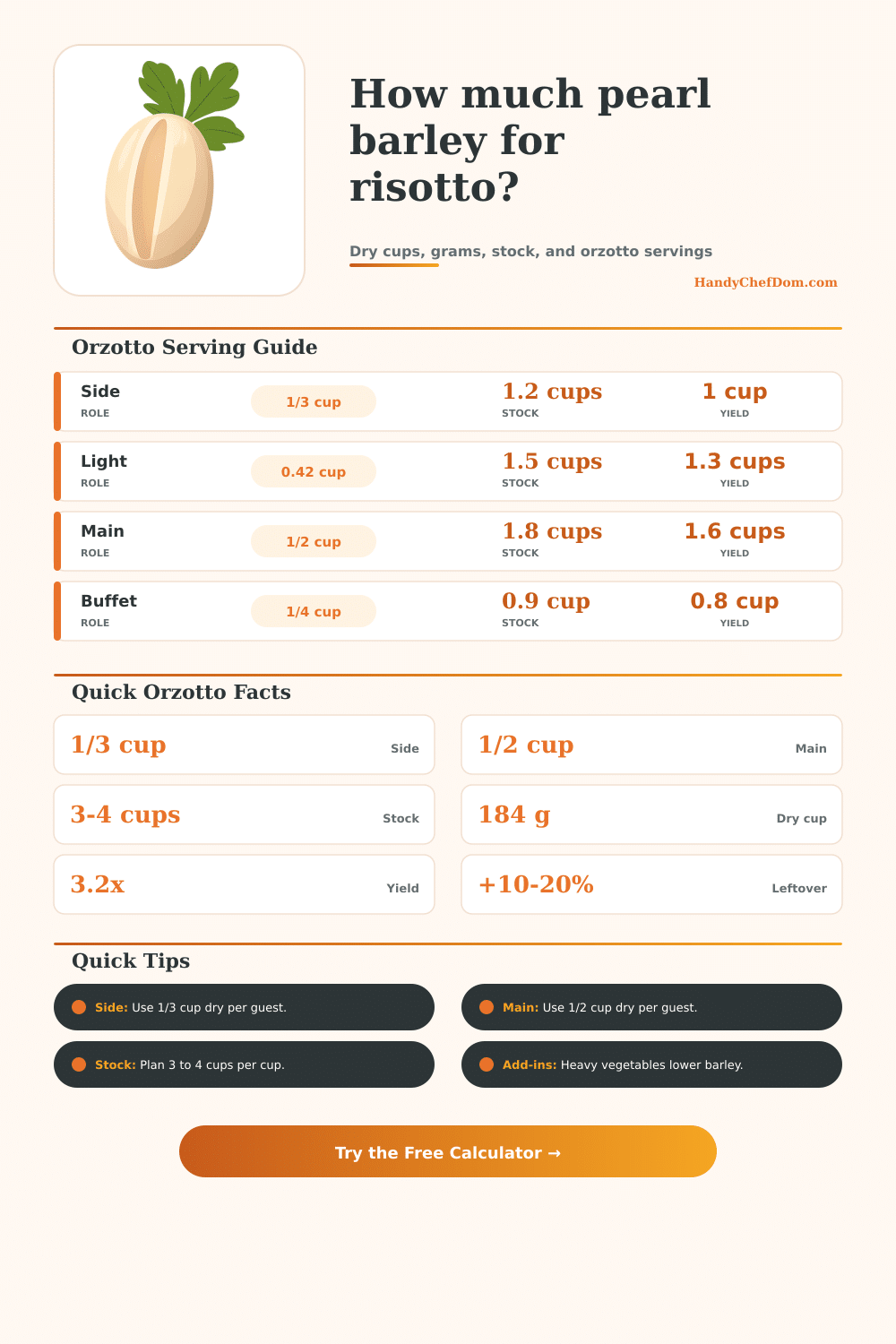
Reference rule: use about 1/3 cup dry pearl barley per person for a side and 1/2 cup for a main. Plan 3 to 4 cups of stock per dry cup of barley for a risotto-style orzotto texture.
A plate-side amount that works beside roasted vegetables, fish, chicken, or several other sides.
A grain-forward bowl portion when pearl barley is the main starch and guests may want seconds.
A balanced middle ratio for tender barley with enough stock to stir into a risotto-like finish.
Vegetables, mushrooms, beans, meat, and cheese add bowl volume, so the calculator trims barley.
| Meal role | Dry pearl barley per person | Approx cooked yield | Best use |
|---|---|---|---|
| Tasting course | 3 tablespoons dry barley | About 2/3 cup cooked | Small starter portions or a tasting menu plate. |
| Buffet spoon | 1/4 cup dry barley | About 3/4 to 7/8 cup cooked | Potluck, holiday spread, or many side dishes. |
| Standard side | 1/3 cup dry barley | About 1 cup cooked | Classic side serving for orzotto or barley risotto. |
| Light main | About 0.42 cup dry barley | About 1 1/3 cups cooked | Lunch bowl or lighter main with vegetables and cheese. |
| Main course | 1/2 cup dry barley | About 1 1/2 to 1 2/3 cups cooked | Barley-forward dinner bowl or vegetarian main. |
| Stock ratio | Stock per 1 cup dry barley | Texture target | Planning note |
|---|---|---|---|
| Firm 3:1 | 3 cups stock | Chewy grains, less loose finish | Good when add-ins are juicy or the barley is par-cooked. |
| Balanced 3.25:1 | 3 1/4 cups stock | Tender grains with moderate creaminess | Useful for side servings and covered simmer methods. |
| Creamy 3.5:1 | 3 1/2 cups stock | Risotto-like texture without being soupy | Best default for stovetop pearl barley orzotto. |
| Loose 3.75:1 | 3 3/4 cups stock | Very creamy finish | Helpful for pot barley, warm holding, or leftovers. |
| Very creamy 4:1 | 4 cups stock | Softest and loosest result | Use when barley will sit before serving or reheat later. |
| Barley type | Dry cup weight used | Cooked yield factor | Risotto-style note |
|---|---|---|---|
| Pearl barley | About 184 grams per cup | About 3.25 cups cooked per dry cup | Most predictable choice for creamy orzotto and this calculator's default. |
| Quick pearl barley | About 170 grams per cup | About 3 cups cooked per dry cup | Fast and soft; use slightly less stock and watch the finish closely. |
| Pot barley | About 190 grams per cup | About 3.4 cups cooked per dry cup | Chewier and less polished, so it may need a little more stock. |
| Hulled barley | About 200 grams per cup | About 3.7 cups cooked per dry cup | Whole grain and longest cooking; best if soaked or par-cooked first. |
| Dish base | Common dry main amount | Liquid pattern | How it compares |
|---|---|---|---|
| Pearl barley orzotto | 1/2 cup per person | 3 to 4 cups stock per dry cup | Chewier than rice, with a nutty flavor and slower starch release. |
| Arborio rice risotto | 1/3 to 1/2 cup per person | About 3 to 4 cups stock per dry cup | Softer and starchier; rice releases creaminess faster than barley. |
| Farro risotto | 1/3 to 1/2 cup per person | About 3 cups liquid per dry cup | Chewy and nutty, but usually less creamy than pearl barley. |
| Wheat berry risotto | About 1/3 cup per person | Often pre-cooked, then finished with stock | Very chewy, so the final dish depends heavily on pre-cooking. |
| Short pasta risotto style | About 2 ounces dry per person | Added gradually until tender | Quicker and softer; not measured by barley cup rules. |
Pearl barley risotto, also called orzotto, is a dish made with pearl barley instead of rice. The chewy texture of the pearl barley make it different than the texture of rice risotto. In order to make the dish, one must first decide how many pearl barley to use for each person who will eat the dish.
The amount of pearl barley that is use will determine the amount of stock that is required to make the dish, as well as the amount of pearl barley risotto that will be left over after each person eats there portion of the risotto. A calculator are helpful in determining the amount of pearl barley that is required for the recipe due to the calculator’s ability to determine the amount of pearl barley needed in both dry and cooked volumes. The amount of pearl barley required for the dish can vary depending on the role that the dish will play in the meal.
How much pearl barley and stock to use
For instance, if the pearl barley risotto is to be served as a side dish to fish or vegetables, then less pearl barley will be required than if the dish are to be served as the main course for each person. The calculator can be adjusted for whether the pearl barley risotto is to be a side dish, a light main course, or a full main course. In addition to the role of the dish, the appetite for each person will also change the amount of pearl barley that will be required for each person.
For example, each person with a large appetite will require more pearl barley than a person with a small appetite. Additionally, the ingredients that is added to the pearl barley will change the amount of pearl barley that should be used in the recipe. For instance, if vegetables or meat are added to the dish, the body of the recipe may require fewer pearl barley than if those ingredients are not added to the dish.
In addition to the amount of pearl barley that is to be used, the amount of stock that will be used in the recipe is also an important part of the recipe. The pearl barley slowly absorbs the stock, and the pearl barley release starch into the stock to create a creamy texture to the dish. Thus, one must decide the ratio of pearl barley to stock based off the desired creaminess of the dish, as well as based upon how long the dish will sit prior to being eaten.
For instance, if the pearl barley risotto is to be reheated later, a higher ratio of stock to pearl barley should be used, as the pearl barley will absorb more of the stock while sit. Furthermore, the cooking methods that is to be used will alter the amount of stock that is needed for the recipe. For instance, methods like pressure cooking or baking the dish will alter the amount of liquid that evaporates from the pan during cooking.
Many people makes mistakes when they prepare pearl barley risotto. One common mistake is treating the pearl barley as if it is the same than arborio rice. The grains of pearl barley are larger than the grains of rice, so they cook more slow than rice.
Another common mistake is not remembering that pearl barley expand in size when it is being cooked. Thus, a small amount of dry pearl barley will create a large amount of cooked pearl barley. The calculator display both dry and cooked measurements of pearl barley at the same time.
In addition to the type of pearl barley that is used in the recipe, the cooking method for the dish will also impact the texture of the pearl barley risotto. For instance, stovetop cooking allow for more control of the texture of the cooked pearl barley risotto than baking the dish. However, baking the dish allow for more convenience in its cooking.
Additionally, pressure cooking the dish will cook the pearl barley more quick than stovetop or baking methods; however, because less liquid evaporates during pressure cooking, a firmer grain of pearl barley is formed compared to stovetop cooking methods. The calculator account for these different cooking methods. To prepare the dish successfully, one should of first determine the role of the dish, and then use the calculator to adjust the recipe according to the appetite of those who will eat the dish, the ingredients that is to be added to the dish, and the cooking method for the dish.
By first determining the role of the dish, one can avoid adding too much pearl barley to the dish if the dish is to be a side dish only. Finally, once one determines the amounts of pearl barley and stock, one can begin cooking the dish.