🦠 Yeast OD600 Calculator
Estimate corrected OD600, cell density, viable cells, and harvest volume for lab yeast, brewing starters, and propagation cultures.
Use a blank-corrected spectrophotometer or plate reader when possible. If the raw OD is above the instrument's linear range, dilute the sample and enter the dilution factor.
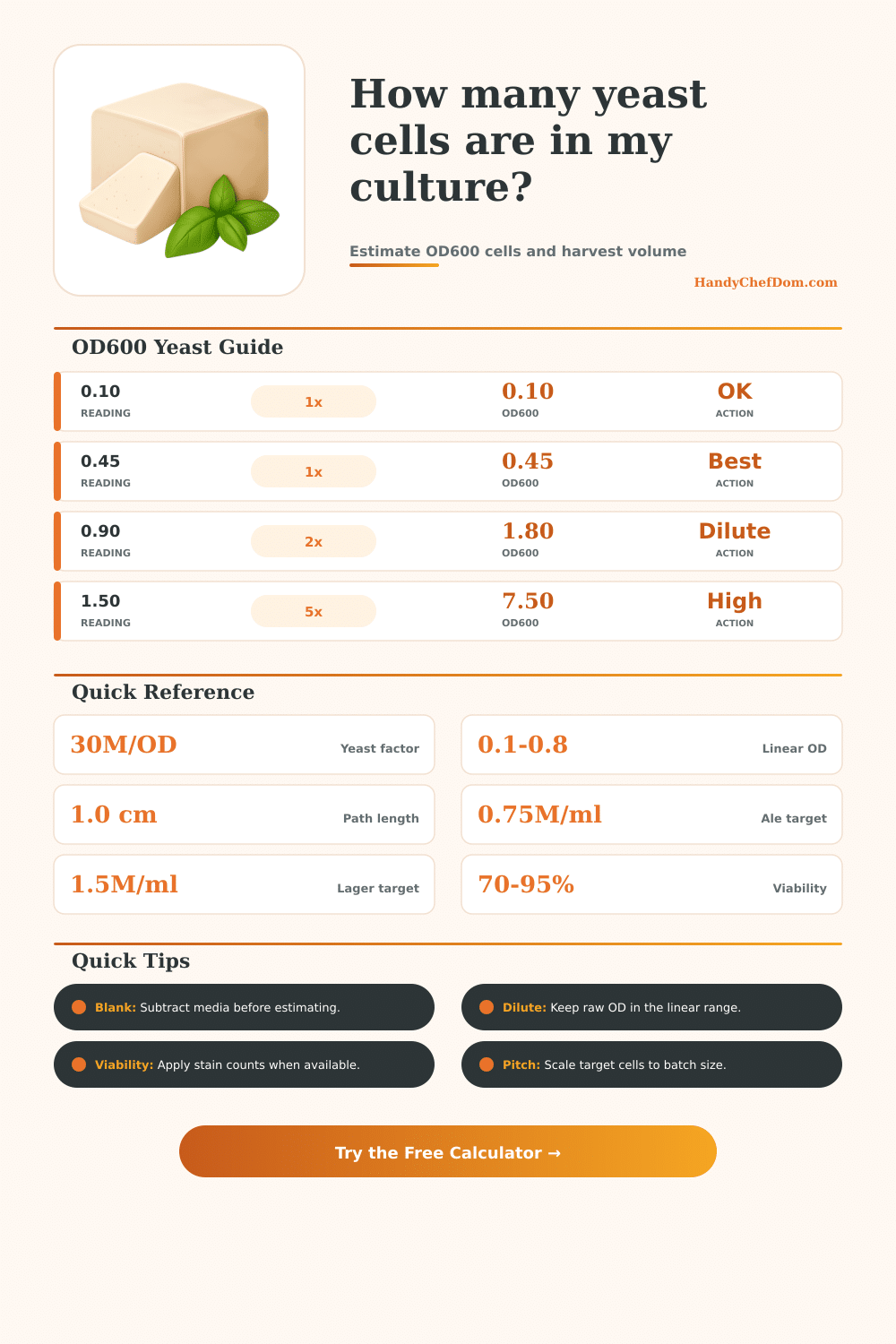
| Raw OD600 | Typical status | Recommended action | Why it matters |
|---|---|---|---|
| 0.05-0.10 | Low signal | Use longer path or more cells | Blank error can dominate the estimate. |
| 0.10-0.60 | Best range | Read directly after blanking | Many instruments remain linear here. |
| 0.60-0.80 | Upper range | Accept or dilute for precision | Small nonlinearity may start to appear. |
| 0.80-1.50 | Needs dilution | Dilute 2x to 5x and re-read | Scattering is no longer reliably linear. |
| Above 1.50 | High density | Dilute 5x to 20x before reading | Direct OD can understate actual cells. |
| Yeast culture | Factor used | Common use | Calibration note |
|---|---|---|---|
| S. cerevisiae haploid lab strain | 20 million/ml/OD | Growth curves | Smaller cells often read lower per OD. |
| S. cerevisiae diploid lab strain | 30 million/ml/OD | Starter estimates | A frequent practical default for yeast. |
| Ale brewing yeast starter | 30 million/ml/OD | Ale pitch planning | Use a hemocytometer to tune your factor. |
| Lager brewing yeast starter | 35 million/ml/OD | Lager pitch planning | Cells and flocculation change readings. |
| Brewery propagation culture | 40 million/ml/OD | Harvest sizing | Verify against stain counts when possible. |
| Pichia or K. phaffii culture | 25 million/ml/OD | Expression culture | Species and media can shift scattering. |
| Batch target | Pitch rate | Example wort | Cells needed |
|---|---|---|---|
| 20 L ale | 0.75 M/ml/P | 12 P | 180 billion |
| 20 L lager | 1.50 M/ml/P | 12 P | 360 billion |
| 5 L trial ale | 0.75 M/ml/P | 12 P | 45 billion |
| 10 L strong ale | 1.00 M/ml/P | 18 P | 180 billion |
| 1 L lab wort | 0.75 M/ml/P | 10 P | 7.5 billion |
| Measured OD | Dilution | Path length | Corrected OD600 |
|---|---|---|---|
| 0.45 | 1x | 1.00 cm | 0.45 |
| 0.45 | 2x | 1.00 cm | 0.90 |
| 0.45 | 1x | 0.50 cm | 0.90 |
| 0.30 | 10x | 1.00 cm | 3.00 |
| 0.70 | 5x | 0.70 cm | 5.00 |
Optical density are used to estimate the number of yeast cells in a culture because yeast cultures dont have an exact count of the number of cells that are in those samples. When using a spectrophotometer, optical density can be used to determine how much light is scatter by the yeast cells in the sample. Optical density is a helpful measurement of the yeast culture because it is fast and inexpensively to perform.
However, the brewer must translate the optical density reading into an estimate of the number of yeast cells. Such an estimation can be used to determine when to begin using a yeast starter, or the amount of volume that must be removed from a propagation tank. The optical density reading for a yeast culture is correlated with an amount of light that is scattered by the yeast cells in the sample.
Counting Yeast Cells with Optical Density
The amount of light that the yeast cells scatter is correlated with both the size and the shape of those cells. Additionally, because the amount of light scattering is also correlated with the refractive index of the medium in which the yeast cells is growing, it is possible for the same optical density reading to correlate with different amounts of yeast cell depending upon the strain of yeast being used. For instance, a laboratory diploid strain may contain thirty millions yeast cells per milliliter in relation to the optical density units, but a lager strain may contain more cells per optical density unit due to the fact that the lager yeast cells are larger in size.
In order to account for these differences in yeast strains, it is necessary to use conversion factors within the calculation to account for these difference. In order to obtain an accurate optical density reading, it is necessary to account for the background absorbance of the cuvette that will be used in the spectrophotometer as well as the background absorbance of the growth medium in which the yeast cultures are grown. Should these factor be ignored, the offset in optical density can alter the determined density of yeast cells in the culture.
Additionally, path length is another factor that must be accounted for in the determination of optical density. Most spectrophotometers use cuvettes that have a path length of one centimeter, but microplate readers may have a path length of only half a centimeter. Any difference in path length will create inaccuracies in the optical density reading; any calculation made after determining the optical density will also be inaccurate if the path length is not account for in determining the optical density reading.
Dilution of the yeast culture is another factor to consider in the measurement of optical density. If the optical density readings are above 0.8, it is important to take a dilution of the yeast culture prior to making the measurement. Additionally, it is important to take the raw optical density reading prior to making the dilution to ensure the reading is trustworthy.
Failure to take a dilution of the yeast culture can lead to inaccuracies in the raw optical density reading. Since optical density cannot distinguish between living and dead yeast cells, it is important to consider the viability of the yeast strain in relation to the optical density reading. It is possible for the optical density reading to be high due to the presence of numerous dead yeast cells, yet the viability of the yeast culture to perform its biological functions can be low.
In this case, it is important to enter the viability percentage in the yeast calculator. If a yeast stain count was performed with methylene blue or propidium iodide, it is important to use that stain count to ensure the viability percentage is accurate. With the viability percentage entered into the yeast calculator, the number of viable yeast cells can be estimated.
From the count of the viable yeast cells, it is possible to calculate the volume of yeast that should be harvested from the propagation tank. The volume of yeast that is harvested will allow for the desired amount of yeast to be introduced into batches of liquid of a certain volume and wort strength. For these calculations, it is necessary to provide information regarding the volume of beer batches that will be produced, the Plato of the batches, and the pitch rate for that type of beer.
For example, the pitch rate for an ale can be different then the pitch rate for a lager. Each of these variables will be multiplied in the yeast calculator to determine the volume of yeast that should be harvested; however, the brewer must ensure that the proper pitch rate is select for the type of beer that will be produced. While the yeast calculator can provide estimates for the number of live yeast cells in a culture, the estimates may not always match the results of the cultures.
For instance, flocculation of the yeast cells can remove many of those cells from the culture in which they is growing. Additionally, the components of the growth medium may affect the refractive index of the medium, which will affect the optical density reading. Additionally, the conversion factor may not always be accurate if the yeast strain has changed from the original culture, or if the aeration procedures used for the yeast culture have changed.
Thus, although the yeast calculator is helpful for brewing estimates, the calculations are only estimates, and adjustments can be made according to previous batches of beer produce. It is important to consider the type of yeast culture that is being used in the brewing process. For instance, a propagation tank with high levels of aeration will often contain yeast cells that are larger than the yeast cells grown in a static flask.
Therefore, if the culture type is changed in the calculator, the conversion factor and the viability percentage will automatically be update. However, no amount of automation within the yeast calculator will account for the specific type of yeast culture that is being used; yeast cultures must be manually counted from time to time to determine the accuracy of the yeast calculations relative to the specific culture. Since optical density readings are usually taken with a spectrophotometer, the temperature of the yeast culture can impact the optical density reading.
Spectrophotometers are calibrated to the refractive index of the liquids at room temperature, so if the yeast culture is too warm, the expansion and change in the refractive index of that warm liquid can alter the optical density readings by as much as a few percent. Therefore, it is important to allow the yeast culture to equilibrate to the temperature of the environment in which the spectrophotometer will be used for a minute or two. As with any calculation, optical density can only provide an estimation of the number of yeast cells in a culture; it is not a direct count of the number of yeast cells.
However, optical density is helpful in that the two variables relate in a reliable manner within a specific range of yeast cells. Yet, if the yeast culture deviates from the factors that are assumed in the creation of the conversion factor, the optical density will not be as helpful in providing accurate estimations. Thus, while the yeast calculator will perform the calculations required to determine the number of yeast cells in a culture based off the optical density reading, it is up to the yeast scientist to ensure the values entered into the calculator are representative of the actual culture of yeast cells being used in the brewing process.