☕ Espresso Extraction Calculator
Dial in dose, beverage yield, shot time, TDS, extraction yield, brew ratio, retained water, and practical espresso adjustment notes.
Enter measured dose, beverage yield, shot time, and TDS. The calculator estimates extraction yield, brew ratio, average flow, brew water retained in the puck, and whether your shot sits inside the selected target range.
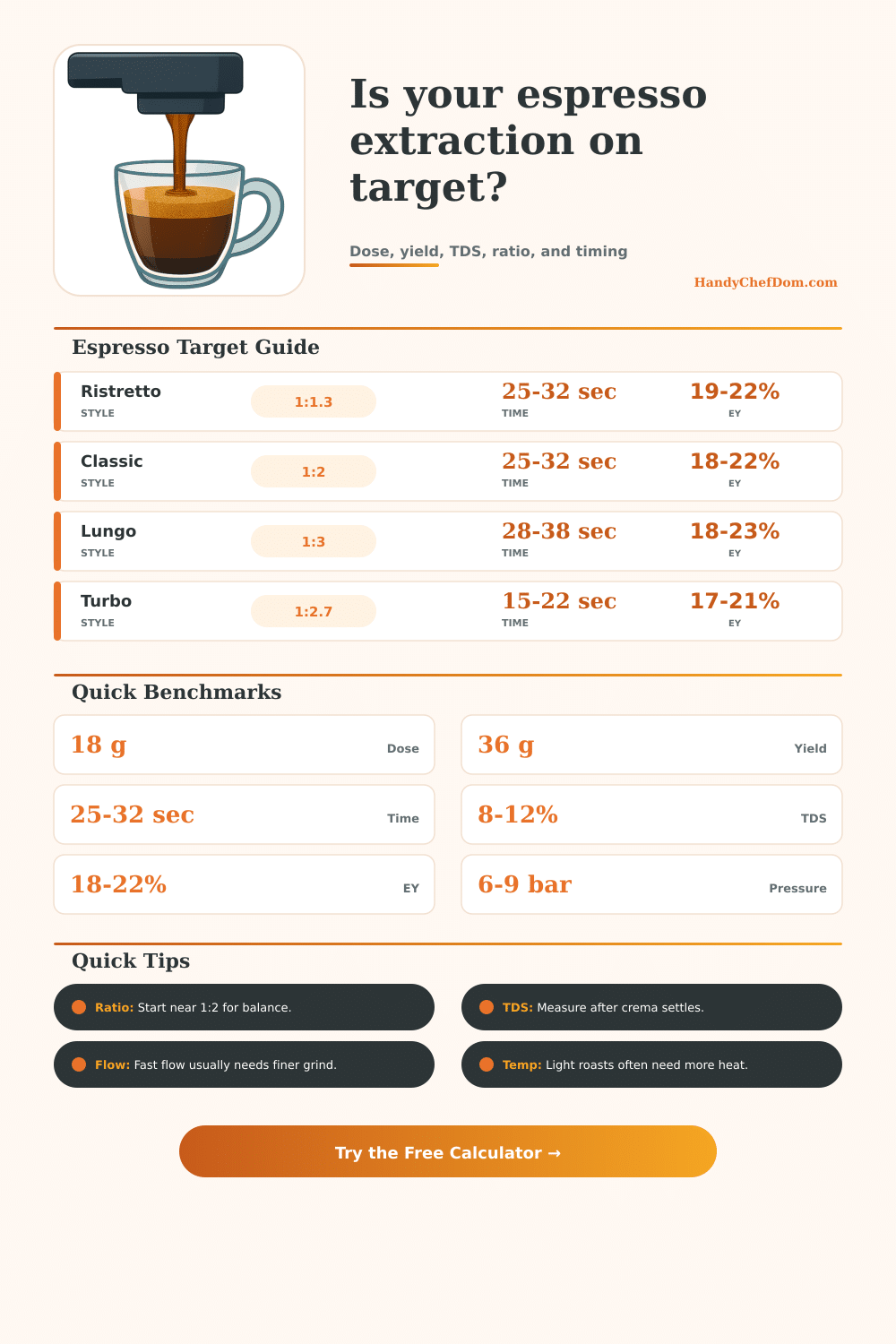
| Espresso style | Dose example | Yield ratio | Shot time | TDS range | Extraction yield |
|---|---|---|---|---|---|
| Classic balanced double | 18 g | 1:1.8 to 1:2.2 | 25 to 32 sec | 8.5 to 12.0% | 18 to 22% |
| Dense ristretto | 19 to 21 g | 1:1.1 to 1:1.5 | 25 to 35 sec | 11.0 to 15.0% | 18 to 22% |
| Longer lungo | 16 to 19 g | 1:2.4 to 1:3.2 | 28 to 38 sec | 6.0 to 9.0% | 18 to 23% |
| Fast turbo espresso | 16 to 19 g | 1:2.4 to 1:3.2 | 15 to 22 sec | 5.8 to 8.5% | 17 to 21% |
| Milk drink foundation | 18 to 21 g | 1:1.7 to 1:2.1 | 24 to 31 sec | 9.0 to 13.0% | 18 to 22% |
| Light roast clarity | 17 to 20 g | 1:2.1 to 1:2.6 | 28 to 38 sec | 7.0 to 10.0% | 19 to 23% |
| Dark roast comfort | 17 to 20 g | 1:1.6 to 1:2.0 | 22 to 30 sec | 9.5 to 13.5% | 17 to 21% |
| Decaf gentle shot | 17 to 19 g | 1:1.7 to 1:2.1 | 24 to 32 sec | 8.0 to 12.0% | 17 to 21% |
| Roast cue | Temp range | Pressure idea | Retention cue | Adjustment note |
|---|---|---|---|---|
| Light roast harder to extract | 201 to 205°F | 7 to 9 bar | 1.10 to 1.30 | Try warmer water or slightly longer yield before grinding much finer. |
| Medium roast balanced | 198 to 202°F | 8 to 9 bar | 1.05 to 1.25 | Keep dose steady and tune ratio in small yield steps. |
| Dark roast easy to extract | 194 to 199°F | 6 to 8.5 bar | 1.00 to 1.20 | Lower heat or shorten ratio if bitterness arrives before sweetness. |
| Decaf fragile puck | 194 to 200°F | 6 to 8 bar | 1.05 to 1.35 | Use gentle pressure, careful puck prep, and avoid aggressive grind jumps. |
| Milk blend body focused | 196 to 201°F | 8 to 9 bar | 1.05 to 1.25 | Prioritize a stable 1:1.8 to 1:2.0 ratio for chocolate and body. |
| Natural process aromatic | 197 to 202°F | 7 to 9 bar | 1.10 to 1.30 | Watch fast channeling; aromatics can mask a thin extraction. |
| Calculator signal | What it often means | First adjustment | Second adjustment | What to avoid |
|---|---|---|---|---|
| Low EY with fast flow | Under-extracted and likely too coarse | Grind finer | Check distribution | Raising dose before fixing flow |
| Low EY with slow flow | Solubility or channeling issue | Increase yield slightly | Raise temperature | Grinding much finer |
| High EY with harsh taste | Over-extracted finish | Shorten yield | Lower temperature | Chasing TDS alone |
| High TDS with low EY | Short dense shot | Extend ratio | Keep grind steady | Assuming high strength means high extraction |
| Low TDS with target EY | Longer but well extracted cup | Shorten ratio for body | Raise dose if basket allows | Changing three variables at once |
| Target ratio but low TDS | Thin or channeled extraction | Improve puck prep | Grind slightly finer | Only increasing pressure |
| Measurement | Useful range | How calculator uses it | Common measurement issue | Helpful habit |
|---|---|---|---|---|
| Dose | 16 to 21 g | Denominator for ratio and extraction yield | Changing dose when only yield changed | Keep dose fixed while dialing in |
| Beverage yield | 25 to 55 g | Numerator for ratio, flow, and extraction yield | Stopping by volume instead of weight | Stop by scale weight |
| Shot time | 15 to 38 sec | Checks flow speed against recipe style | Mixing pump start and first drip timing | Use one timing convention |
| TDS | 5.5 to 15% | Calculates dissolved coffee mass | Reading through crema or dirty prism | Stir, settle, and clean prism |
| Pressure | 6 to 9 bar | Creates machine note and pressure warning | Watching peak only during channeling | Watch stable extraction pressure |
| Retention factor | 1.0 to 1.4 | Estimates brew water held by the puck | Using one value for every roast and basket | Track wet puck weight occasionally |
To make espresso that taste the same every time, you must measure several specific number. These numbers will allow you to understand the extraction yield of your espresso. The extraction yield is the percentage of the dry coffee grounds that will dissolve into the liquid espresso.
You can calculate the extraction yield with the dose, the beverage yield, the shot time, and the TDS reading. The dose is the weight of the dry coffee grounds in a basket of your machine. The beverage yield is the weight of the liquid espresso that is dispensed into the cup.
Make Espresso Taste the Same Every Time
The shot time is how long the water take to flow through the coffee grounds. The TDS, or total dissolved solid, is the measurement of how much solid matter is dissolved into the espresso liquid. The extraction yield can help you to compare one shot of espresso to another shot of espresso.
If you are using medium roast coffee beans, the extraction yield should be between 18 and 22 percents. However, the extraction yield for coffee beans of a different roast level will be different. Light roast coffee beans requires higher extraction yields to extract the sweetness from the coffee.
Dark roast coffee beans can taste flatly if the extraction yield is too high. By selecting a target profile with the extraction yield calculator, you can compare your extraction yield to the specifications for a ristretto, turbo pull, or milk drink base espresso. Another number to measure in the brewing process is the flow rate.
Flow rate is the speed at which the water move through the coffee grounds. High flow rates can cause low extraction yields as the water moves through the coffee too fast. Low flow rates will create high extraction yields, although it may also produce a bitter extraction yield if too many water can channel through the coffee grounds.
The extraction yield calculator can measure the average flow rate. Knowing the average flow rate can help you to determine whether the grind size or the preparation of the coffee puck causes a problem in the brewing process. The second and third measurements of importance are the temperature and pressure of the water.
These measurements is different from the primary measurements of extraction yield. If the temperature of the brew water is high, the solubility of the coffee will increase. This will lead to an increased extraction yield without changing the grind size of the coffee beans.
If you lower the pressure, there will be fewer instances of channeling. Channeling happen when water finds areas of low resistance in the coffee grounds and bypasses the grounds altogether. However, decreasing the brewing pressure will also decrease the flow rate.
You can record the flow rate with the extraction yield calculator. By recording the temperature and pressure of the espresso machine, you can determine whether your espresso machine is help or hindering your extraction yield. Roast level and puck retention will also impact the espresso you brew.
Coffee beans that are light roast require higher temperatures to extract the sweetness from the coffee beans. The darker the roast of the coffee bean, the easier it extract. Therefore, dark roast coffee will reach high extraction yields quickly.
Puck retention is the amount of water that remain within the coffee puck once the espresso shot is done. Puck retention can change based off the design of the coffee basket or the roast level of the coffee beans. The extraction yield calculator includes a factor to account for puck retention, and you can adjust that if the weight of the wet puck are changing.
Another essential part of using the extraction yield calculator is to track the measurements over many espresso shots. As you brew espresso for yourself and record the dose, the yield, the time, and the TDS, you will eventually find patterns in the taste of your coffee. Patterns will become visible in your coffee as you continuously record these variables.
These patterns will allow you to fine-tune your brew settings to enhance the coffees reaction to specific doses or yields of ground coffee beans. The last of the primary methods of evaluating espresso is tasting the espresso. While the numbers can help you to explain the taste of the espresso, the taste is the last method of evaluation.
For example, if the espresso tastes sour, the extraction yield is probably too low. Low extraction yields will happen from ground beans that are too coarse or too little contact time between the coffee grounds and the hot water. If the espresso tastes bitter, the extraction yield is too high.
High extraction yields result from using too high a brew temperature or a long brew ratio. By making only one variable different than your previous shot, you can observe its effect on the dose, the yield, the time, and the TDS of your espresso. You should of tried many different beans to find your favorite.
Its important to be patient with the process. Youll see results eventually. Don’t get discouraged if the first few shots dont taste perfect.
It takes alot of practice to master the moddern espresso machine.