🍹 Standard Drink Calculator
Estimate standard drinks for single serves or large batches using ABV, pour volume, dilution, and serving count.
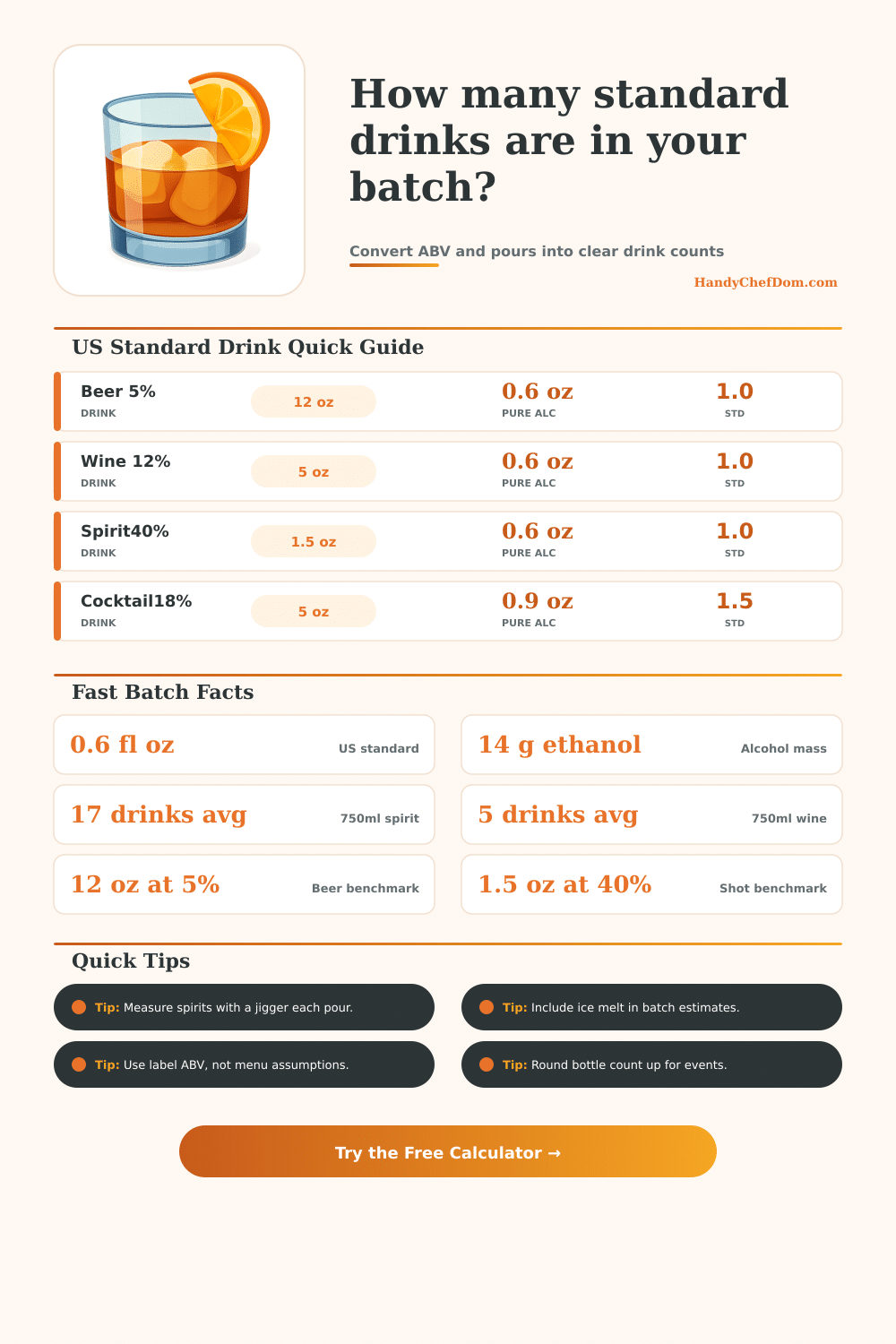
The calculator uses U.S. standard drink math: 0.6 fl oz (14 g) pure alcohol per drink. Choose style, ingredient strengths, and dilution to estimate total drinks and bottle planning.
| Pour | ABV | Pure Alc | Std Drinks |
|---|---|---|---|
| 1.5 oz | 40% | 0.60 oz | 1.0 |
| 2.0 oz | 40% | 0.80 oz | 1.3 |
| 5.0 oz | 12% | 0.60 oz | 1.0 |
| 12 oz | 5% | 0.60 oz | 1.0 |
| 5.0 oz | 18% | 0.90 oz | 1.5 |
| 3.5 oz | 24% | 0.84 oz | 1.4 |
| Group Size | Target Drinks | Total Drinks | 750 ml Bottles |
|---|---|---|---|
| 4 guests | 1.0 each | 4.0 | 0.3 |
| 6 guests | 1.5 each | 9.0 | 0.5 |
| 12 guests | 1.5 each | 18.0 | 1.1 |
| 25 guests | 1.2 each | 30.0 | 1.8 |
| 50 guests | 1.0 each | 50.0 | 3.0 |
| 50 guests | 1.5 each | 75.0 | 4.5 |
A standard drink calculation are a method to determine the amount of alcohol that will be in a batch of drinks. As the number of peoples who will drink increases, it becomes more difficult to gauge how much alcohol will be in each person’s drink. Thus, standard drink calculations allows for the determination of how many servings of alcohol will be in a batch of drinks.
In order to calculate the number of standard drinks in a batch of drinks, a number of different variables must be entered into the calculation tool. Firstly, you should enter the alcohol by volume of the base spirit (liquor). Additionally, the alcohol by volume of the liqueur (if any) should be entered.
How to Calculate Standard Drinks for a Party
The amount of non-alcoholic mixer that will be used in the drinks should also be entered, as should the expected level of dilution of those drinks. Dilution occur when the ice melts or when the drinks are stirred or shaken. A drink that contains forty percent alcohol may only contain fifteen percent alcohol after dilution by melted ice.
A calculation tool that determine the number of standard drinks accounts for these different variable, and can display the total number of standard drinks in the batch of drinks, the number of standard drinks per serving, the final alcohol by volume of the drinks, and the number of bottle of alcohol of the calculated volume that should be purchased. The number of servings of drinks that you plan to provide to your guests will also affect your calculation. For instance, you may be planning to provide drinks for a small group of four people, as opposed to a large group of twenty people.
Thus, the number of servings will impact your calculation. Additionally, the pacing at which the drinks will be consumed will also affect the calculation; if a small group of people intends to consume a drink quickly, the dilution of the drink will be less than if the drink is to be provided for a larger group of people that will sit at there drinks for longer periods of time. Thus, dilution levels will impact the calculation for the total amount of standard drinks that will be provided in the batch of drinks.
The number of servings and pacing of the drinks will each alter the calculation of the total amount of standard drinks that the guests will consume. A standard drink has a specific measurement for the amount of alcohol that it contains. For instance, one standard drink of beer is twelve ounces of five percent beer, one standard drink of wine is five ounces of twelve percent wine, and one standard drink of spirit is one and a half ounces of forty percent spirit.
Cocktails can be more difficult to measure the amount of alcohol that is in each drink. However, style presets can help to account for this in the calculation of the number of standard drinks in each batch of cocktails. Pre-set styles will allow for the cocktails to be prepared in amounts that provide for realistic pour sizes, realistic dilution of the drinks, and the conversion of those amounts to the total amount of alcohol that will be in the batch.
By comparing different types of drinks to each other, you can plan your drinks to suit the mood that you would like to create at your event. For instance, a whiskey sour will contain more alcohol than a spritz, so there will be more standard drinks of whiskey sour than there will of spritz. A spritz contains more volume and more ice melt than a whiskey sour, so there will be fewer standard drinks of spritz than there will be of whiskey sour.
By comparing each type of drink to another, you can make sure that you provide drinks that match the mood that you want to create at your event, and to ensure that you do not unintentionally provide too much alcohol to your guests. Beyond planning your drinks to provide for the correct mood at your event, you can also use the calculation to determine how many bottle of alcohol of each type that should be purchased. For instance, a seven hundred and fifty milliliter bottle of forty percent spirit will contain approximately seventeen standard drinks of spirit if you pour it without any other mixers.
However, if mixers are added to that spirit, the number of standard drinks of alcohol that the bottle will contain will change. Thus, the calculation tool will allow you to determine the total amount of pure alcohol that will be in the batch of drinks, as well as the number of bottles of alcohol that should be purchased for the batch of drinks. The calculation of the alcohol in your batch of drinks also allows for the estimation of the nutritional content of the drinks.
Alcohol contains approximately seven calories per gram, as well as the calories from the sugar content in the mixers for each drink. By determining the total number of calories in the drinks, you can ensure that your guests that consume those drinks are aware of the amount of calories that they are consuming. While not perfect, this calculation is the most accurate estimate of the calories in each drink that you can determine in advance of serving the drinks to your guests.
Despite the calculations that the calculation tool can make, there are still a few variables that will impact the amount of alcohol that is consumed at the event. Some guests may consume alcohol at a much slower rate than others. The weather may impact the amount of ice that melts at the event; if the weather is warm, more ice melt will occur than if it is cold outside.
Additionally, the guests that enjoy your drinks may consume more alcohol than you have planned for them. Thus, while the calculation tool can provide a great estimate of the amount of alcohol that will be consumed at the event, the tool does not provide a guarantee of how much alcohol will be consumed. However, it does provide a great starting point from which to plan the event.
By measuring the amount of spirits for each batch of drinks at the beginning of the evening, you can ensure that each guest that receives your drinks will have the amount of alcohol that you calculated for each drink. For instance, using a jigger to measure each type of spirit will ensure that each batch contains the amount of alcohol that you calculated. Thus, by using this calculation tool and measuring each spirit, you can remove the guesswork from your drinks, and prepare accordingly for whether or not you need to purchase additional bottles of alcohol to ensure that you have enough for your guests.