💧 How Much Water to Drink While Breastfeeding Calculator
Plan a practical daily drink target from body weight, nursing sessions, pumping output, activity, climate, food moisture, and your current cups or ml.
The planner starts with a lactation total-water anchor, estimates extra fluid demand from milk removal, then adjusts for activity, warm rooms, and food moisture. Food and soups count toward total water, while the result focuses on drinks you can pour into cups or bottles.
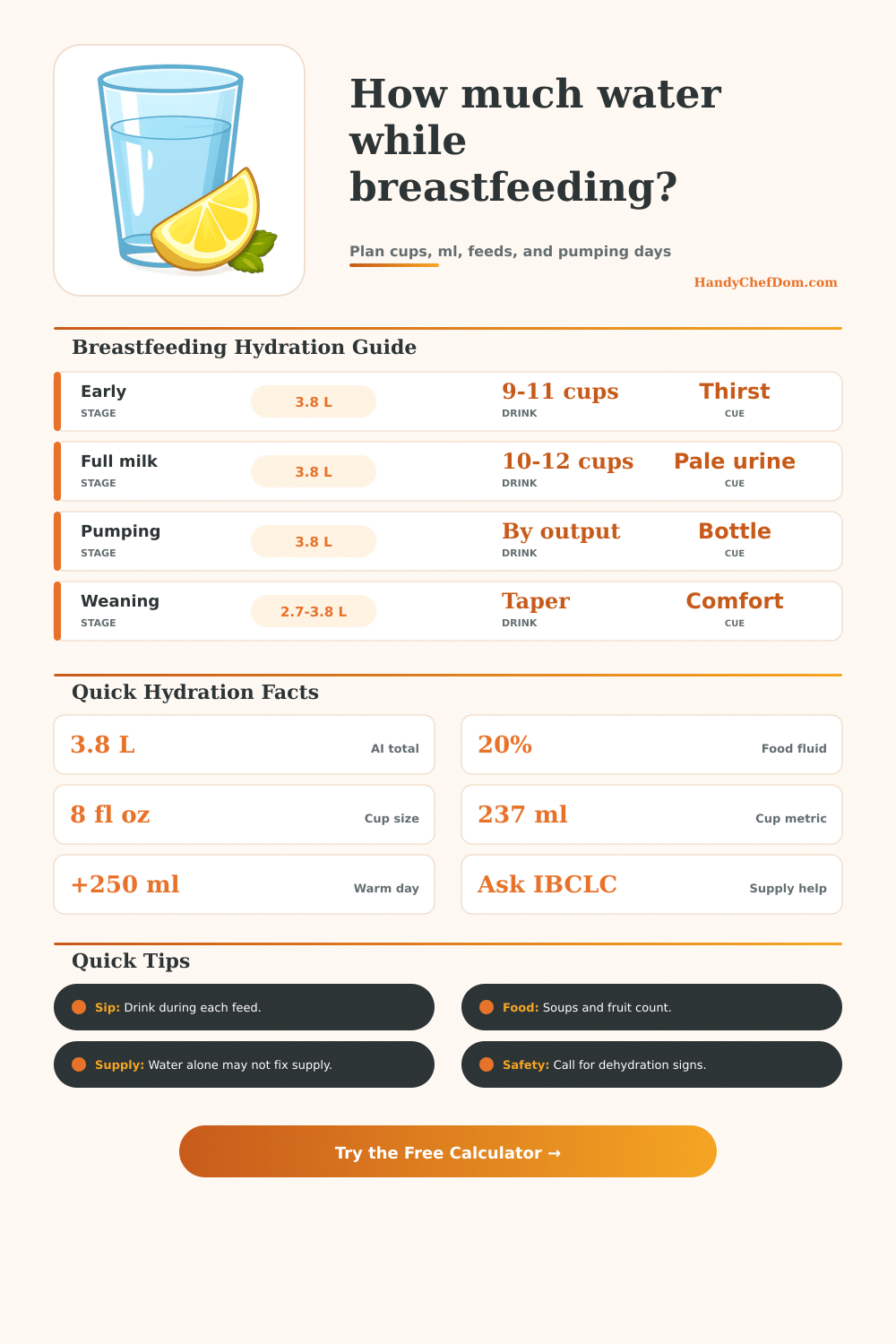
| Breastfeeding Pattern | Total Water Planning Anchor | Drink Target After Food | Use This Cue |
|---|---|---|---|
| Early weeks, frequent feeds | About 3.8 L total water | Often 9-12 cups drinks | Thirst during feeds, pale yellow urine |
| Established exclusive nursing | About 3.8 L total water | Often 10-12 cups drinks | Refill near nursing chair or bedside |
| Combination nursing and pumping | 3.8 L plus output awareness | Adjust around pumped ounces | Pair water with each pump break |
| Twins or tandem feeding | 3.8 L minimum anchor | Often higher with clinician input | Track thirst, output, fatigue, and supply |
| Older baby eating solids | 3.3-3.8 L planning range | Usually tapers with fewer feeds | Watch comfort and daily routine |
| Weaning transition | 2.7-3.8 L planning range | Taper toward normal adult needs | Avoid sudden forced changes |
| Session Type | Planner Estimate | Drink Pairing Idea | Milk Supply Note |
|---|---|---|---|
| Short newborn feed | 45-65 ml milk estimate | Small glass nearby | Latch and transfer matter more than forcing water |
| Established nursing session | 70-95 ml milk estimate | Half cup to one cup | Drink to thirst and track baby diapers |
| Power pumping block | Use actual bottle output | Refill before and after | Ask an IBCLC if output drops suddenly |
| Night feed or dream feed | Use same daily target | Bedside bottle helps | Do not overdrink if sleep is already broken |
| Solids plus nursing | Lower milk estimate | Regular meal drinks | Baby intake naturally changes with age |
| Weaning feed | Comfort-based estimate | Normal thirst pattern | Call for painful engorgement or fever |
| Activity or Climate | Calculator Add-On | When It Applies | Practical Planning Move |
|---|---|---|---|
| Cool room, low sweat | 0-100 ml | Mostly resting indoors | Keep a cup where you nurse |
| Mild day | About 100 ml | Normal errands and rooms | Use regular refill habits |
| Warm stroller walk | About 250 ml | Noticeable warmth or light sweat | Add one extra small bottle |
| Hot, humid, sweaty | About 500 ml plus activity | Sweating or outdoor heat | Plan extra water and electrolytes if advised |
| Dry air or altitude | About 350 ml | Heated rooms, dry climate, travel | Use visible bottle reminders |
| Exercise minutes | 6-10 ml per minute | Walking, workouts, chores, sweat | Drink before and after activity |
| Food or Drink Source | Typical Fluid Credit | How to Count It | Planning Note |
|---|---|---|---|
| Water, seltzer, milk | Nearly full cup credit | Count the poured amount | Choose what you can drink consistently |
| Soup or broth bowl | 1-2 cups | Estimate serving volume | Helpful when appetite is low |
| Yogurt or smoothie | Half to one cup | Count most of the liquid portion | Also supports snack timing |
| Melon, oranges, cucumber | Partial cup credit | Use the food moisture percent field | Best counted as a daily estimate |
| Coffee or tea | Counts as fluid | Pair with water if desired | Discuss caffeine limits for newborn or preterm babies |
| Electrolyte drink | Count the poured amount | Use when clinician advised or sweating | Avoid using it to replace meals |
CupsmlFood FluidsNursing SessionsPumping OutputClimateActivitySupply Note
Breastfeeding require a good degree of hydration from the mother’s body, as the body need to replace the amount of fluid that it loses while producing breast milk. The amount of fluid that a mother need to consume from all sources each day depends upon a variety of different factor, including the number of times that she nurse her babies, the amount of fluid that she remove from her system during pumping session, her level of activity throughout the day, and the climate in which she reside. The calculator can determine the amount of fluid of which a mother should drink each day by using these same factor to arrive at a target for her fluid intake.
The average recommendation for a mother who is lactating is that she consume approximately three point eight liter of fluid from all sources each day. This amount of fluid include the fluid that she gets from the food that she eat throughout the day. The calculator remove the amount of fluid from food from the total amount of fluid that is required of a mother, as this allow the calculator to provide the correct amount of fluid of which she should drink.
How Much Fluid Breastfeeding Mothers Need
Additionally, the calculator accounts for the amount of fluid that is removed from the body through the production of breast milk; the calculator increase the total fluid requirement of a mother according to the amount of milk that she produce, as the body requires that the mother replace the fluid lost through milk production with fluid that is consumed. The activity and climate levels of a mother can change the amount of fluid that she lose from the body. For instance, if she walk outside in warm weather or spend time inside in a dry climate, she will lose fluid from her body through both physical activity as well as through the act of breathing.
The inclusion of a fluid “buffer” to account for such fluid loss increases the fluid requirement of a mother in the calculator. Such a buffer ensure that the mother is not become dehydrated after she consume all of the milk that she produce and perform all of her nursing or pumping duty during the 24-hour period; however, the amount of fluid that is included within this buffer is not a large amount. Additionally, small adjustment can be made to the caffeine intake of the mother within the calculator; many mother consume caffeine instead of water, and the caffeine amount is accounted for within the calculation.
The stage of breastfeeding and the pattern of breastfeeding can impact the amount of fluid that is required of a mother. For example, mothers who have baby who are drinking milk during the early week of breastfeeding may experience a higher loss of fluid from the body; their babies require more milk during these initial period. In contrast, mothers who have babies who are consuming solid food may require less fluid from the body during these later stage of breastfeeding.
Additionally, if a mother is nursing twin or is performing tandem nursing of both baby, the fluid requirement will increase. The calculator can account for these different breastfeeding pattern to ensure that a mother does not drink too much or too little fluid each day. While this supply note box can be used to encourage a mother to increase the amount of milk that is produced, it should not be used as a means to address other breastfeeding issue, such as an issue with the baby’s latch.
The table that are provided on the calculator contain the same information as the fluid calculation that the calculator performs; however, the information is provided in table form. These table indicate the different fluid requirement for a mother during the early week of breastfeeding, once breastfeeding is established, on heavy pumping day, and during the weaning period. Additionally, the table provide information regarding the fluid content of various food, as well as information regarding the impact of climate on the fluid requirement of a mother.
While these table do not need to be memorized, they can help a mother to understand the reason for the fluid requirement that are calculated by the calculator. For many mother, it is easier to consume fluid during nursing or pumping session than it is to drink large amount of fluid at one time. Thus, it may be helpful for a mother to keep a bottle of fluid or a cup placed at the location at which she nurse; this will make it easier for her to consume fluid without having to make a decision as to what fluid to consume at what time of the night or during feeding session.
The fluid that are consumed with food also contribute to the fluid intake of a mother. Food such as soups, yogurt, fruit, and cooked vegetable contain fluid. The percentage of fluid in food can be adjusted in the calculator; if a mother find that she is unable to consume much food during the day, she can adjust that percentage to indicate that she require more fluid to consume during the day.
Many mother make error in their consumption of fluid. For instance, many ignore their feeling of thirst; they may ignore their thirst because they want to have some specific amount of fluid as a goal or from another mother. In contrast, other mother may drink too much coffee or tea, or may not drink enough water.
The mother can avoid these potential error by utilizing the suggestion that are provided within the calculator. Additionally, there is a field within the calculator for the amount of caffeine that a mother consume; this help to ensure a more accurate fluid intake for the mother. A mother can monitor the amount of fluid that she consume by paying attention to her body.
For instance, if a mother become light in color in the urine of which she has consume too much fluid, if she feel thirsty, if she feel fatigued, or if she feel that she is experiencing dizziness, she may need to consume more fluid. However, she should not force the body to drink fluid; this is not a helpful habit to establish for the body. The calculator also provide a suggestion of the amount of fluid that should be consumed during each pumping or nursing session.
The amount that is suggest during each session may be high for the mother; this may be due to the total amount of fluid that is suggest for the mother for the day, or it may be due to the activity and climate setting of the mother. The different field within the calculator can be adjusted one at a time to determine the effect that each variable can have upon the total amount of fluid that is recommended for the mother to consume. Additionally, the different field will help the mother to understand what amount of fluid she should consume to maintain her body’s health and strength, as well as to meet the demand of her babies.
The body’s fluid requirement will change according to the amount of milk that the babies are consuming; thus, the calculator can be used to determine an amount of fluid that the mother should consume each day.