🍚 Water Per Cup of Rice Calculator
Dial in the right rice-to-water ratio by grain, dry cups, cooking method, rinse level, texture target, altitude, resting absorption, and display units.
Use dry rice cups as the anchor, then adjust for the grain style and the water that rinsing, altitude, texture, and resting change in the pot.
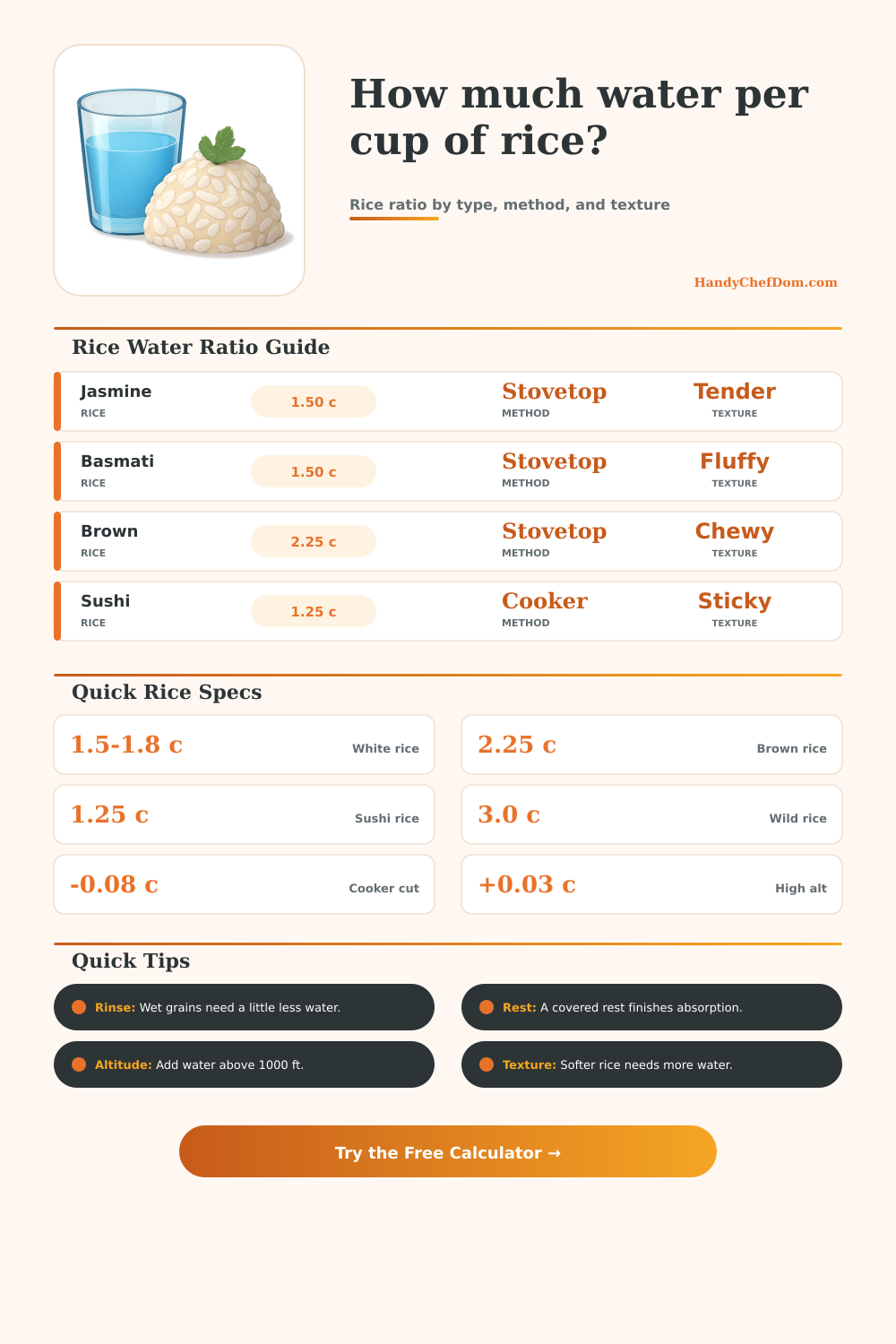
| Rice type | Base water per cup | Cooked yield | Best target |
|---|---|---|---|
| Long-grain white | 1.75 cups | 3.0 cups | Fluffy daily rice |
| Jasmine | 1.50 cups | 3.0 cups | Tender aromatic grains |
| Basmati | 1.50 cups | 3.2 cups | Separate long grains |
| Sushi or short-grain | 1.25 cups | 2.6 cups | Sticky compact grains |
| Brown rice | 2.25 cups | 3.5 cups | Chewy whole grain |
| Wild rice blend | 3.00 cups | 3.8 cups | Firm side dish |
| Arborio | 3.50 cups | 3.0 cups | Creamy absorption |
| Parboiled rice | 2.00 cups | 3.1 cups | Resilient grains |
| Adjustment | Typical change | Use when | Calculator effect |
|---|---|---|---|
| Wet clear rinse | -0.08 cup | Rice is drained but damp | Subtracts added water |
| Soaked grains | -0.25 cup | Rice sat in water first | Offsets absorbed moisture |
| Soft texture | +0.25 cup | Rice should spoon easily | Adds more steam water |
| Pressure cooker | -0.55 cup | Little evaporation occurs | Lowers the cup ratio |
| Loose saucepan lid | +0.12 cup | Steam escapes visibly | Replaces evaporated water |
| High altitude | +0.03 cup | Each 1000 ft above 1000 | Adds boil-off margin |
| Dry rice | White water | Brown water | Cooked yield |
|---|---|---|---|
| 1 cup | 1.5 to 1.75 cups | 2.25 cups | About 3 cups |
| 2 cups | 3 to 3.5 cups | 4.5 cups | About 6 cups |
| 3 cups | 4.5 to 5.25 cups | 6.75 cups | About 9 cups |
| 4 cups | 6 to 7 cups | 9 cups | About 12 cups |
| 6 cups | 9 to 10.5 cups | 13.5 cups | About 18 cups |
| 8 cups | 12 to 14 cups | 18 cups | About 24 cups |
| Cooking setup | Water cue | Rest cue | Texture cue |
|---|---|---|---|
| Covered stovetop pot | Use base ratio | 10 minutes covered | Fluffy to tender |
| Standard rice cooker | Use slightly less | Warm hold counts | Even grains |
| Electric pressure cooker | Use much less | Natural release helps | Moist compact grains |
| Covered oven casserole | Add a small buffer | Rest before fluffing | Gentle batch rice |
| Toasted pilaf pan | Use a touch less | Keep covered after heat | Separate grains |
| Wide absorption pan | Add evaporation margin | Rest off heat | Fast family rice |
Water amounts for rice are important to consider because the amount of water that will be used to cook the rice will determine the textures of the cooked rice. Using too much water will make the rice glue-like, while using too little water will make the rice dry and hard. The texture of the rice will depend on how much water the rice grains absorb during the cooking process, as well as how much water evaporate during those cooking steps.
Additionally, different types of rice have different structures, so each type of rice require a different amount of water to properly cook. For instance, long grain white rice absorbs a moderate amount of water, but rice varieties like brown rice require more water to cook because of the bran layer surrounding the rice grains. Basmati rice and jasmine rice varieties requires a specific amount of water to ensure that the grains of basmati rice remains separate after cooking.
How Much Water to Use for Rice
The step of rinsing rice prior to cooking will change the amount of water that you should add to the pot. Rinsing rice remove the surface starch from the rice grains, which prevents the rice from cooking to a thick texture. However, rinsing rice also leaves a small amount of water on the rice, so it is necessary to use slightly less water than would be required if the rice was not rinsed prior to cooking.
Soaking the rice prior to cooking changes the amount of water required for the rice to cook; soaking rice allow the rice grains to absorb water prior to cooking. The cooking method also alters the amount of water that is required to cook the rice. Methods like covering the pot with a lid reduces the amount of steam that escapes from the pot, while methods like using a pressure cooker trap the steam inside the cooker.
Because a pressure cooker traps steam, less water is required to cook rice in a pressure cooker than in a covered pot over heat from stovetop burners. Additionally, wider and shallower cooking pans allow for more evaporation of cooking water than deep pans, which require more water to properly cook the rice. Furthermore, the altitude at which the rice is cooked changes the water requirement for the rice.
The boiling point of water decreases at higher altitudes. Thus, it takes longer to cook rice at higher altitudes, meaning that more water evaporate during cooking. Furthermore, the texture that you desire from the cooked rice will dictate the amount of water that is used.
Rice cooked with more water will result in a softer texture for the rice grains, while using less water will result in a fluffy rice products. If the rice grains are supposed to be firm, like rice used for sushi, less water will be used in the cooking process. These different textures have different water requirements, which are considered in the rice calculator provided.
Lastly, allowing the rice to rest after cooking is required for proper texture. If rice is rested within the covered pot, the rice absorbs the steam that is left in the pot. This absorption of steam allow for the desired texture of the rice to be finalized without having to add water to the rice prior to cooking.
If rice is not allowed to rest, or if the resting time is altered, the texture of the rice will change. Many people makes mistakes with cooking rice. For instance, they often use the same amount of water that is used for white rice to cook brown rice, which will be chewy if water is not added to brown rice according to cooking specification.
Another common mistake is to skip the resting time for the rice, which then leads to the addition of water to the next batch of rice being cooked. This mistake creates a cycle where the rice becomes too wet. These mistakes can be avoided by using the reference tables to determine the differences in the amount of water based off the type of rice that is to be cooked, the cooking method, and the altitude at which the rice is to be prepared.
All of these variable are processed by the calculator to determine the amount of water required to properly cook the specific type of rice.