🍋 Juice in a Lime Calculator
Estimate usable lime juice from specific lime sizes, juicing methods, ripeness, cocktail tablespoons, acidity target, and straining waste.
Choose the actual lime type, count, and extraction style. The calculator estimates raw juice, usable juice after waste, and how many lime-balanced cocktails your batch covers.
| Lime type and size | Typical juice | Tablespoons | Best calculator use |
|---|---|---|---|
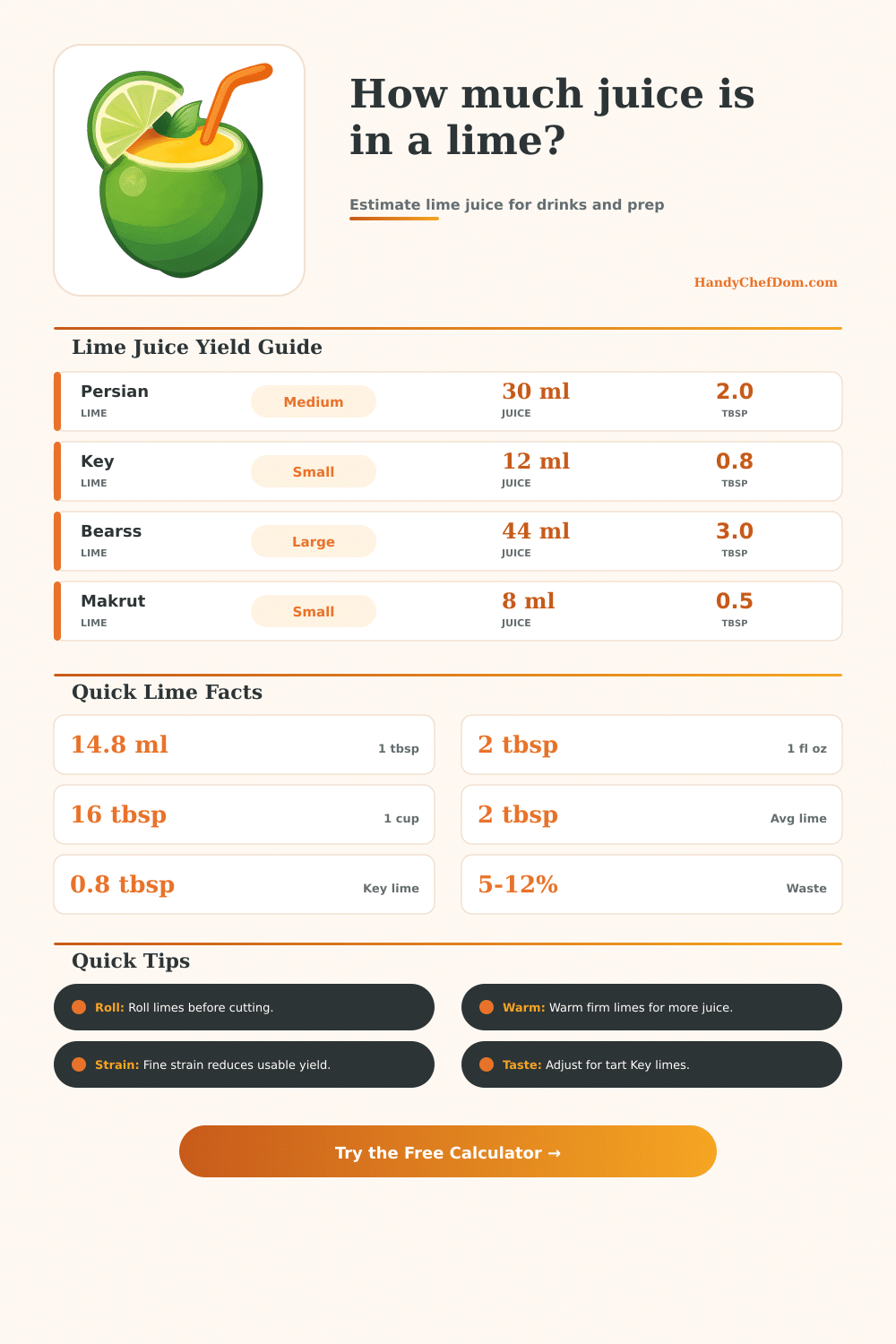
| Persian lime, small and firm | 22 ml | 1.5 tbsp | When fruit feels dense but not heavy |
| Persian lime, medium grocery size | 30 ml | 2.0 tbsp | Default bar and kitchen estimate |
| Persian lime, large heavy fruit | 38 ml | 2.6 tbsp | Good for ripe bags and bulk prep |
| Bearss lime, jumbo | 44 ml | 3.0 tbsp | Large mild lime with generous yield |
| Key lime, small and tart | 12 ml | 0.8 tbsp | Use for tart desserts and bright drinks |
| Mexican lime, medium | 18 ml | 1.2 tbsp | Smaller tart limes with punchy flavor |
| Makrut lime, small aromatic | 8 ml | 0.5 tbsp | Low juice, aromatic citrus note |
| Finger lime, pulp pearls | 8 ml | 0.5 tbsp | Use when pearls are folded in whole |
| Juicing method | Yield factor | Waste note | When to choose it |
|---|---|---|---|
| Hand squeeze only | 0.86x | Leaves juice in membranes | Fast garnish or wedge squeezing |
| Fork twist after squeezing | 0.95x | Better extraction from halves | Small batches without a press |
| Hinge citrus press | 1.00x | Reliable bar baseline | Most cocktail and prep batches |
| Hand reamer | 1.08x | More pulp and seed handling | When maximum fresh yield matters |
| Electric citrus juicer | 1.12x | More foam and fine pulp | Large bowls, pitchers, and service |
| Warm and roll, then press | 1.15x | Best for firm refrigerator limes | When limes feel tight or cold |
| Ripeness or handling | Yield factor | Texture cue | Calculator note |
|---|---|---|---|
| Hard green, low give | 0.82x | Very firm skin | Expect less juice and sharper bite |
| Firm but juicy | 0.95x | Some weight, little give | Useful conservative grocery estimate |
| Heavy glossy, slight give | 1.08x | Heavy for size | Best everyday yield assumption |
| Yellowing ripe, high juice | 1.12x | Softer peel, pale patches | Higher juice, slightly rounder acidity |
| Wrinkled or drying | 0.72x | Light and loose peel | Add more fruit or reduce target |
| Cocktail or prep measure | Lime juice volume | Metric equivalent | Medium Persian limes |
|---|---|---|---|
| 1 tablespoon | 0.5 fl oz | 14.8 ml | About 1/2 lime |
| 1 ounce pour | 2 tbsp | 29.6 ml | About 1 lime |
| 1/4 cup | 4 tbsp | 59 ml | About 2 limes |
| 1/2 cup | 8 tbsp | 118 ml | About 4 limes |
| 1 cup | 16 tbsp | 237 ml | About 8 limes |
| 1 liter | 67.6 tbsp | 1000 ml | About 34 limes |
The yield of lime juice is a variable amount due to the fact that the amount of lime juice that exists within a lime can vary depending upon several different factors. The amount of lime juice that exist within a lime can depend upon the size of that lime, the variety of lime that is being used, how ripe the lime is, and even the method that is used to extract the juice from the lime. Each of these factors have the potential to change the amount of lime juice that are extracted from the lime, which can have a positive or negative impact upon the flavor of the recipe that utilize that lime juice.
For instance, if the recipe require a specific amount of lime juice, using too little lime juice will make the drink or dessert too sour, while using too much lime juice will make the drink or dessert too sour. One of the factors that can impact the yield of lime juice is the variety of the lime that is being used. For instance, Persian limes tend to contain more juice than Key limes, and the Persian limes that is heavy with juice tend to contain more juice than smaller Persian limes.
Why the Amount of Lime Juice Varies
Depending upon the variety of the lime, the amount of lime juice that is yielded can vary by as much as thirty percent. Thus, the variety of the lime can have a major impact upon the amount of lime juice that is available for a recipe. The method in which the juice is extracted from the lime can also have an impact upon the amount of juice that is collected.
If the hand squeeze the juice rapidly from the lime, some of the juice can become trapped within the membranes of the lime. However, if the lime is pressed with a hinge press or a reamer, more juice will be collected from the lime. Additionally, rolling a lime on the counter prior to cutting will warm the membranes of the lime, and allow for the juice to be released more easy from the lime.
Thus, the method for extracting the juice can have an impact upon the total volume of lime juice that can be collected. Other factors that may impact the amount of lime juice that can be collected from a lime include the ripeness of the lime and the way in which the lime is stored. For instance, limes that feel heavy for there size typically contain more juice than limes that feel light for there size, and limes that yield slightly under pressure will contain more juice than rock-hard limes.
Additionally, limes that have been stored for extended periods in the refrigerator may have dry peels from exposure to the cold temperatures, which can reduce the amount of juice that is yielded from the lime. Thus, the ripeness of the lime can also have an impact upon the amount of juice that is extracted. The acidity of the lime and the way in which the juice is strained can also have an impact upon the amount and the way in which the lime juice interacts with the recipe.
For instance, Key and Mexican limes tend to be more acidic than Persian limes. Additionally, using a fine mesh strainer will remove some of the juice from the lime, as it will remove the solids and the foam that is produced from the lime. Thus, both acidity and straining can have an impact upon the flavor of the recipe.
In addition to these factors, it is also important to account for any waste of lime juice that may be lost during the extraction process. For instance, some of the juice will always remain within the halves of the lime, especially if the limes is dry, or if the lime press from which the juice is extracted is becoming old. Thus, accounting for potential waste from the process allow for the recipe to include a buffer for the juice that may be lost.
Finally, another factor that should of been accounted for is the fact that lime juice can lose its aroma over time. Freshly squeezed lime juice will be aromatic and have an appealing scent, but after one or two hours of standing, the aroma of the juice will have dissipated. For recipes that require large amounts of lime juice, it may be necessary to squeeze additional limes periodically throughout the cooking process.
Thus, accounting for these other factors will allow for the correct amount of lime juice to be provided for the recipe.