🧈 Salt in a Stick of Butter Calculator
Estimate butter sodium, salt equivalent, and recipe salt reduction for salted, unsalted, reduced-salt, and custom-label butter.
Use the sodium listed on your butter label when available. The style menu gives practical estimates by tablespoon so the calculator can convert sticks, tablespoons, grams, cups, and recipe scaling into salt equivalents.
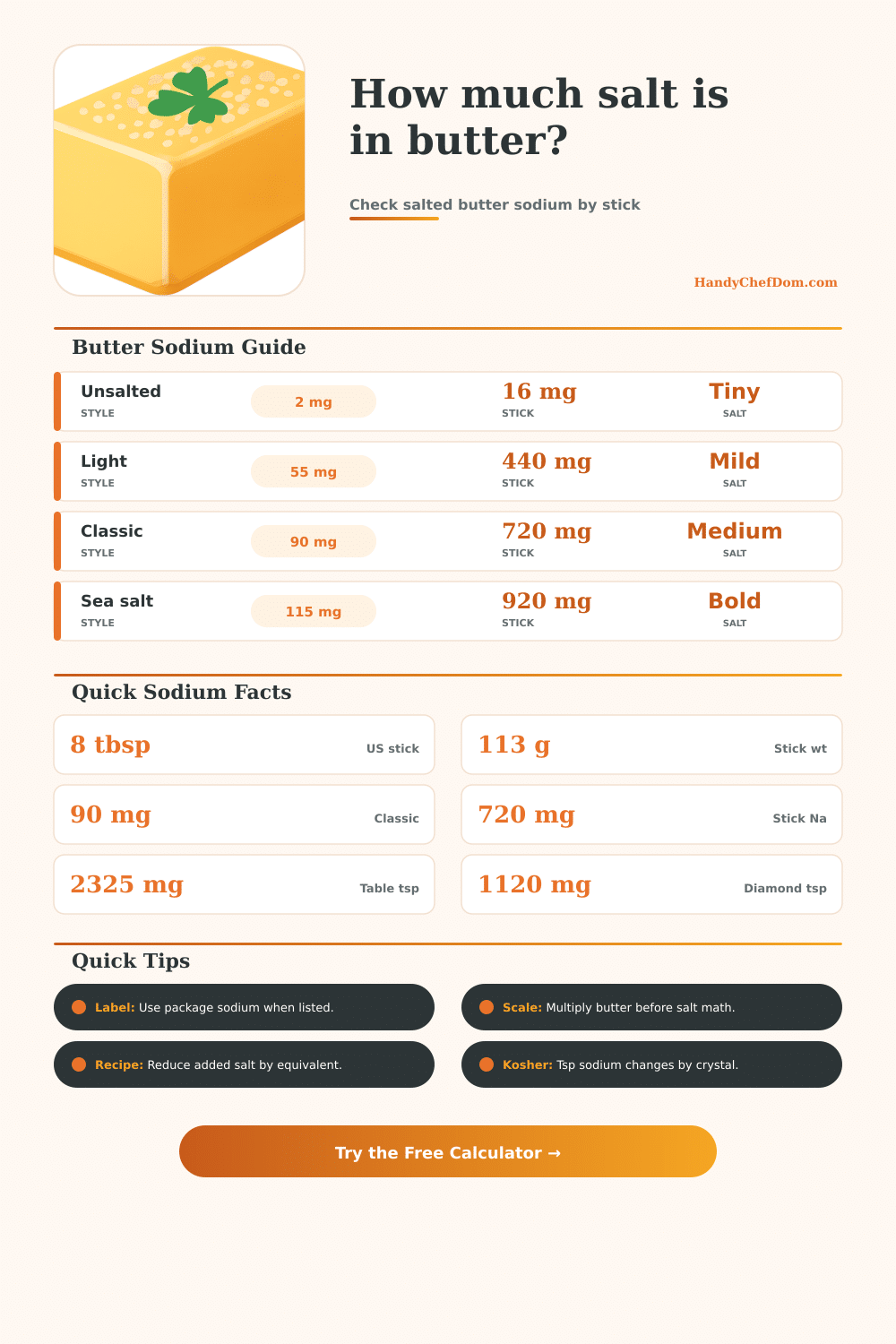
| Butter label style | Sodium per tbsp | Sodium per stick | Best calculator use |
|---|---|---|---|
| Unsalted baseline | 2 mg | 16 mg | Trace sodium only |
| Reduced sodium spread | 45 mg | 360 mg | Lower salt adjustment |
| Lightly salted bakery | 55 mg | 440 mg | Mild salted recipes |
| Classic salted label | 90 mg | 720 mg | Default salted stick |
| Cultured salted block | 95 mg | 760 mg | Richer dairy style |
| European salted style | 105 mg | 840 mg | Higher butterfat blocks |
| Sea salt premium style | 115 mg | 920 mg | Bold salted flavor |
| Restaurant toast style | 125 mg | 1000 mg | Strong table butter |
| Butter amount | Classic sodium | Table salt equivalent | Diamond kosher equivalent |
|---|---|---|---|
| 1 tablespoon | 90 mg | 0.04 tsp | 0.08 tsp |
| 2 tablespoons | 180 mg | 0.08 tsp | 0.16 tsp |
| 1/2 stick | 360 mg | 0.15 tsp | 0.32 tsp |
| 1 stick | 720 mg | 0.31 tsp | 0.64 tsp |
| 2 sticks | 1440 mg | 0.62 tsp | 1.29 tsp |
| 4 sticks | 2880 mg | 1.24 tsp | 2.57 tsp |
| Salt style | Approx sodium per tsp | Approx grams per tsp | Why it matters |
|---|---|---|---|
| Table salt | 2325 mg | 6.0 g | Dense small crystals |
| Fine sea salt | 2300 mg | 5.9 g | Close to table salt |
| Morton kosher | 1920 mg | 4.8 g | Lighter spoon measure |
| Diamond Crystal kosher | 1120 mg | 2.8 g | Very fluffy crystals |
| Pickling salt | 2300 mg | 5.8 g | Fine, clean measure |
| Recipe scenario | Butter amount | Style estimate | Salt offset to consider |
|---|---|---|---|
| Cookie dough | 2 sticks | Classic salted | About 0.62 tsp table salt |
| Buttercream | 2 sticks | Unsalted | Keep recipe salt as written |
| Mashed potatoes | 1.5 sticks | Lightly salted | About 0.28 tsp table salt |
| Pan sauce | 2 tbsp | European salted | About 0.09 tsp table salt |
| Garlic spread | 1/2 stick | Sea salt style | About 0.20 tsp table salt |
| Dinner rolls | 2 scaled sticks | Classic salted | About 0.62 tsp table salt |
Salted butter contains salt because salt crystals is added to the cream before it gets churned into butter. The amount of salt contained in salted butter can vary depending on the brand of salted butter that you use. Differently brands of salted butter may contain various amount of sodium.
For instance, one stick of salted butter may contain twice as much sodium then another stick of salted butter, even if the two sticks of butter appear to be the same. Salted butter not only affect the taste of a recipe, but it also affects how that recipe perform in the cooking process. A salt calculator can help you to understand how much salt the salted butter in a recipe contains.
How to check salt in salted butter and adjust recipes
Using the salt calculator, you will input the amount of salted butter that you will use in your recipe. You will also have to select whether the butter that you will use is salted or a blend. Additionally, you will have to specify the type of salt that you will use for seasoning the butter.
Based off the information that you enter into the calculator, it will calculate the total amount of sodium that the salted butter will contain. Furthermore, the calculator will also calculate the amount of table salt or kosher salt that the sodium content are equal to. By understanding these measurements, you can determine whether you need to reduce the amount of salt that is called for in your recipe.
The salt calculator is helpful because the scales of recipes may change from time to time. For instance, if you double the ingredient in a recipe, you will have to double the amount of salted butter that is required. You will also have to adjust the amount of salt that you use to account for the additional salt that is contained in the doubled amount of salted butter.
Some type of butter contain more sodium than other types of butter. For instance, European butter block may contain more sodium than American butter sticks. Additionally, reduced sodium butter spreads may contain less sodium than salted butter sticks.
By selecting the type of butter that you will use in your recipe, the salt calculator will provide you with more accurate measurement of the amount of salt that your recipe will contain. The salt calculator can provide you with several type of information. For instance, it can tell you the total amount of sodium that the butter that you use will contain.
The salt equivalent will show you how many teaspoon of salt the sodium content in the butter is equal to. Per-serving sodium will show you the amount of sodium that each serving of the food will contain. The reduced-added-salt figure will allow you to see how much salt you should add to your recipe after you remove the salt that is already contained in the salted butter.
People may make mistakes when using salted butter if they treat all brands of salted butter as if they are the same. For instance, one stick of salted butter may contain 90 milligrams of sodium per tablespoon. However, another brand of salted butter may contain 115 milligrams of sodium for the same amount of butter.
By using the salt calculator, you can change the sodium rate for the butter to see how the sodium content in different amounts of salted butter can change your recipe. People may also make mistake by not adjusting the amount of salt in their recipe when they adjust the amount of salted butter. If you adjust the amount of salted butter but do not adjust the amount of salt that is called for in the recipe, the salt and ingredient ratio in your recipe will not be balance properly.
By understanding the salt content of salted butter, people can make better decisions in the kitchen. One stick of classic salted butter contain roughly the same amount of salt as one-third of a teaspoon of table salt. This amount of salt is significant in baking bread, but it may not be significant in recipes for savory stews.
If you know the amount of salt that is contained in salted butter, you can adjust the recipe to account for the salt appropriate. Additionally, if you understand the different amounts of sodium that are contained in different brands of salted butter, you can choose a specific brand of salted butter that will best suit the needs of your recipe.