🍚 Carbs in Rice Calculator
Estimate total carbs, net carbs, cooked portions, dry rice equivalents, serving carbs, and target fit by rice type, amount unit, meal role, and cooled-rice setting.
Choose whether your rice amount is dry or cooked, then enter cups or grams. The calculator converts the portion into cooked cups before estimating carbs and servings.
| Rice type | Cooked cup | Gross carbs | Net carbs |
|---|---|---|---|
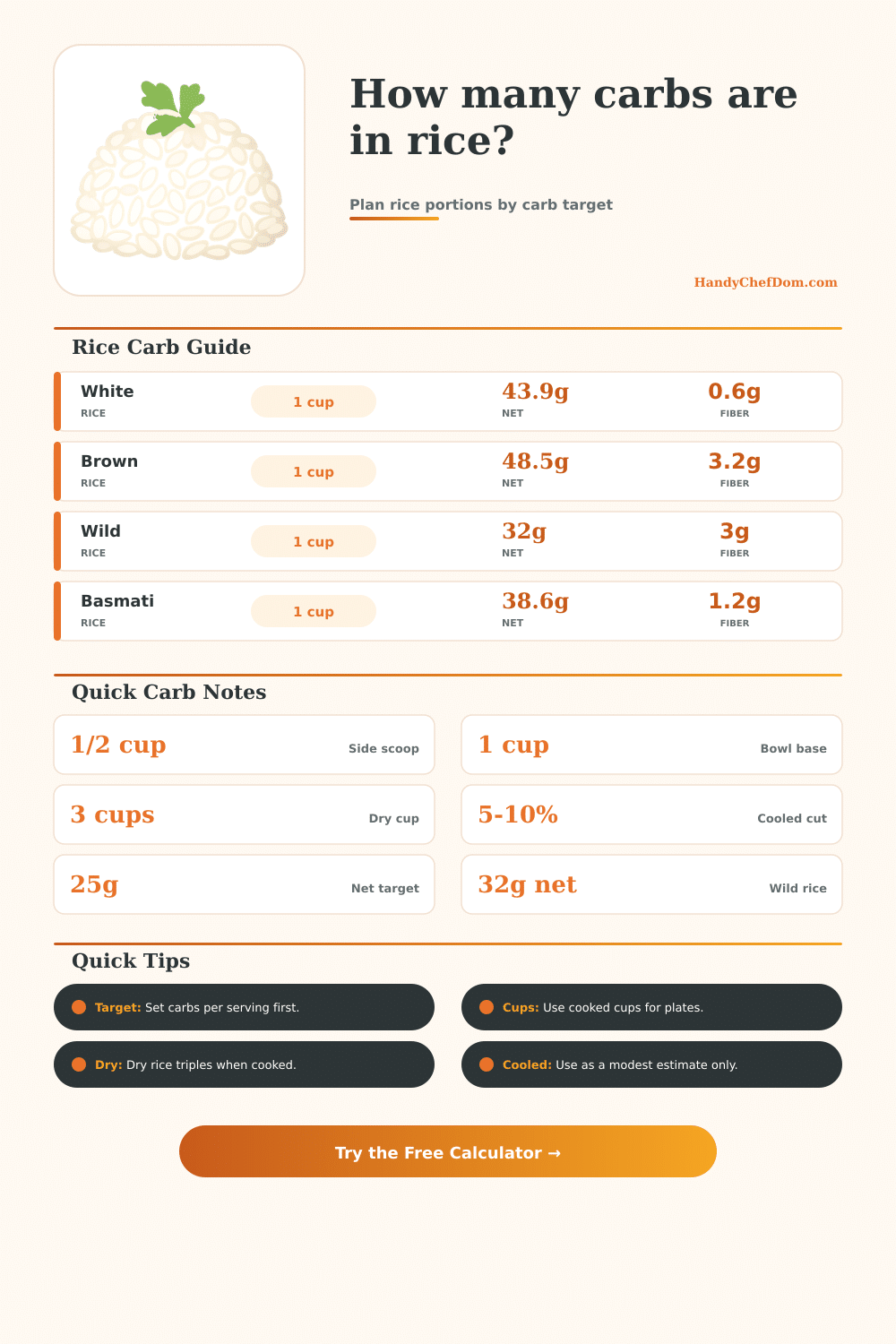
| Long-grain white rice | 158 g | 44.5 g | 43.9 g |
| Jasmine rice | 158 g | 45.0 g | 44.4 g |
| Basmati rice | 158 g | 39.8 g | 38.6 g |
| Sushi or short-grain rice | 186 g | 53.4 g | 51.8 g |
| Brown rice | 195 g | 51.7 g | 48.5 g |
| Wild rice blend | 164 g | 35.0 g | 32.0 g |
| Black forbidden rice | 172 g | 34.0 g | 31.0 g |
| Parboiled rice | 175 g | 41.0 g | 39.6 g |
| Rice type | Dry cup weight | Cooked yield | Net per dry cup |
|---|---|---|---|
| White long-grain | 185 g | 3.0 cooked cups | 131.7 g |
| Jasmine | 185 g | 3.0 cooked cups | 133.2 g |
| Basmati | 180 g | 3.1 cooked cups | 119.7 g |
| Sushi rice | 200 g | 2.6 cooked cups | 134.7 g |
| Brown rice | 190 g | 3.5 cooked cups | 169.8 g |
| Wild rice blend | 160 g | 3.8 cooked cups | 121.6 g |
| Black rice | 190 g | 3.2 cooked cups | 99.2 g |
| Arborio | 195 g | 3.0 cooked cups | 159.0 g |
| Meal role | Cooked portion | Typical net range | Use when |
|---|---|---|---|
| Lower-carb tasting portion | 1/4 cup | 8 to 13 g | You want rice flavor only |
| Light side scoop | 1/3 cup | 11 to 17 g | Plate has beans or bread too |
| Standard side | 1/2 cup | 16 to 26 g | Rice supports protein and vegetables |
| Rice bowl base | 1 cup | 32 to 52 g | Rice is the main starch |
| Training-day plate | 1 1/2 cups | 48 to 78 g | Higher-carb meal planning |
| Meal-prep container | 3/4 cup | 24 to 39 g | Balanced lunches for the week |
| Cooled rice option | Planning credit | Best use | Calculator effect |
|---|---|---|---|
| Freshly cooked | 0% | Same-day rice straight from pot | No net-carb adjustment |
| Cooled and reheated | 5% | Leftover rice served warm | Small resistant-starch credit |
| Chilled overnight | 8% | Cold rice bowls and salads | Moderate planning credit |
| Chilled then reheated | 10% | Meal-prep rice reheated later | Largest optional estimate |
| Target planning | Use caution | Health or medical carb tracking | Prefer measured nutrition labels |
| Restaurant rice | 0% | Unknown cook and cooling history | Count without adjustment |
Rice is a food that contains many carbohydrate, and rice is a food that many individual consumes in large amount. Rice contains carbohydrates, but most individuals is unaware of the amount of carbohydrates that are contained within a serving of rice. The amount of rice that is consume will have a determining effect upon the total carbohydrate that are consumed with the meal that contains the rice.
The measurement of the rice is one of the primary factor that will help determine the carbohydrate count of the meal that contains rice. The measurement of the rice can change according to whether the rice being measured is dry rice or cooked rice. Dry rice will expand when it is cooked, which will increase the portion of rice that is contained within the meal.
How to Count Carbs in Rice
Cooked rice will contain the same portion of rice as is measured, but will not indicate the original dry weight of the rice that was cooked. Thus, the type of measurement is a critical factor in determining the carbohydrate count of meals that contain rice. The type of rice that is consumed can also impact the carbohydrate count of the meal that contains that type of rice.
Rice type like white and brown rice contain carbohydrates; however, brown rice contain more fiber than white rice. Therefore, the net carbohydrate count of brown rice will be less than the net carbohydrate count of white rice. Additionally, rice types like wild and black rice contain high amounts of fiber, which indicates that the net carbohydrate count of these type of rice will be less than rice with lower fiber count.
The way in which the rice is cooled and stored may also impact how the body process the rice. If the refrigerator cools the rice overnight, the starch in the rice will convert to a form that the body will digest more slow. This process will slightly reduce the net carbohydrate count of the rice; however, the reduction of the net carbohydrate count will not be assumed to be significant.
Thus, the calculator allow for the conservative estimate of the reduction of the starch count within the rice when it is cooled. One of the most common reason that individuals consume carbohydrates beyond their targets is due to the portion of rice that is consumed. Rice portions can be difficult to measure visually.
The scoop of rice may appear to be a small portion of rice; however, increasing the scoop of rice will increase the amount of carbohydrates that an individual consumes. The meal-role setting will allow individuals to compare their portion of rice to a standard portion of rice to ensure that they are consuming an appropriate amount of rice to they’re body carbohydrate needs. The fiber and resistant starch within rice is a factor that reduces the net carbohydrate count of that rice.
The net carbohydrate count is the amount of carbohydrates that the body processes and have an impact upon the blood sugar level of an individual that consumes the rice. The calculator of the carbohydrate content of rice will automatically subtract the fiber from the total carbohydrate count and also account for the cooling of the rice to allow for the reduction of carbohydrates that the body processes. An individual’s carbohydrate target for that day can change according to their activity level and the meal that is consumed alongside the rice.
For instance, an individual that is resting all day may require a different amount of rice than an individual that is to participate in physical activity. The calculator will indicate the target gap of an individual’s carbohydrate intake for that day, which will allow them to understand the distance between their rice portion and their daily carbohydrate goal. Using the rice carbohydrate calculator prior to cooking the rice is the most effective method of managing the carbohydrate count of an individual’s diet.
The calculator allows individuals to test different type of rice and to adjust the amount of rice that will be cooked. The comparison that individuals can make with the calculator will allow individuals to understand the carbohydrate count of the rice prior to consuming it as part of a meal. Thus, the rice carbohydrate calculator allows individuals to make the carbohydrate count of rice visible to the individual, thus avoiding any surprise as to the carbohydrate content of the rice after it has been consumed.