🍅 Sugar in Ketchup Calculator
Estimate added sugar from ketchup tablespoons, cups, grams, packets, servings, and recipe batches with a brand-specific sugar override.
Use the measurement mode that matches your meal: spooned ketchup, measured cups for a recipe, grams from a label, or packet count from takeout.
| Ketchup amount | Tablespoons | Ketchup weight | Added sugar |
|---|---|---|---|
| Small dip | 1 tbsp | 17 g | 4 g |
| Fries side | 2 tbsp | 34 g | 8 g |
| Burger spread | 1.5 tbsp | 26 g | 6 g |
| Quarter cup | 4 tbsp | 68 g | 16 g |
| Half cup | 8 tbsp | 136 g | 32 g |
| Full cup | 16 tbsp | 272 g | 64 g |
| Brand sugar label | Sugar per tbsp | Sugar per 2 tbsp | Best calculator use |
|---|---|---|---|
| No sugar added style | 1 g | 2 g | Lower-sugar bottle check |
| Reduced sugar style | 2 g | 4 g | Lunchboxes and kids plates |
| Regular ketchup | 4 g | 8 g | Default burger and fries math |
| Sweeter tomato sauce | 5 g | 10 g | Imported or sweetened sauces |
| Thick glaze mix | 6 g | 12 g | Meatloaf and barbecue glaze |
| Custom label entry | Manual | Manual | Use the override field above |
| Conversion | Imperial measure | Metric estimate | Sugar at 4 g/tbsp |
|---|---|---|---|
| 1 teaspoon ketchup | 0.33 tbsp | 5.7 g | 1.3 g |
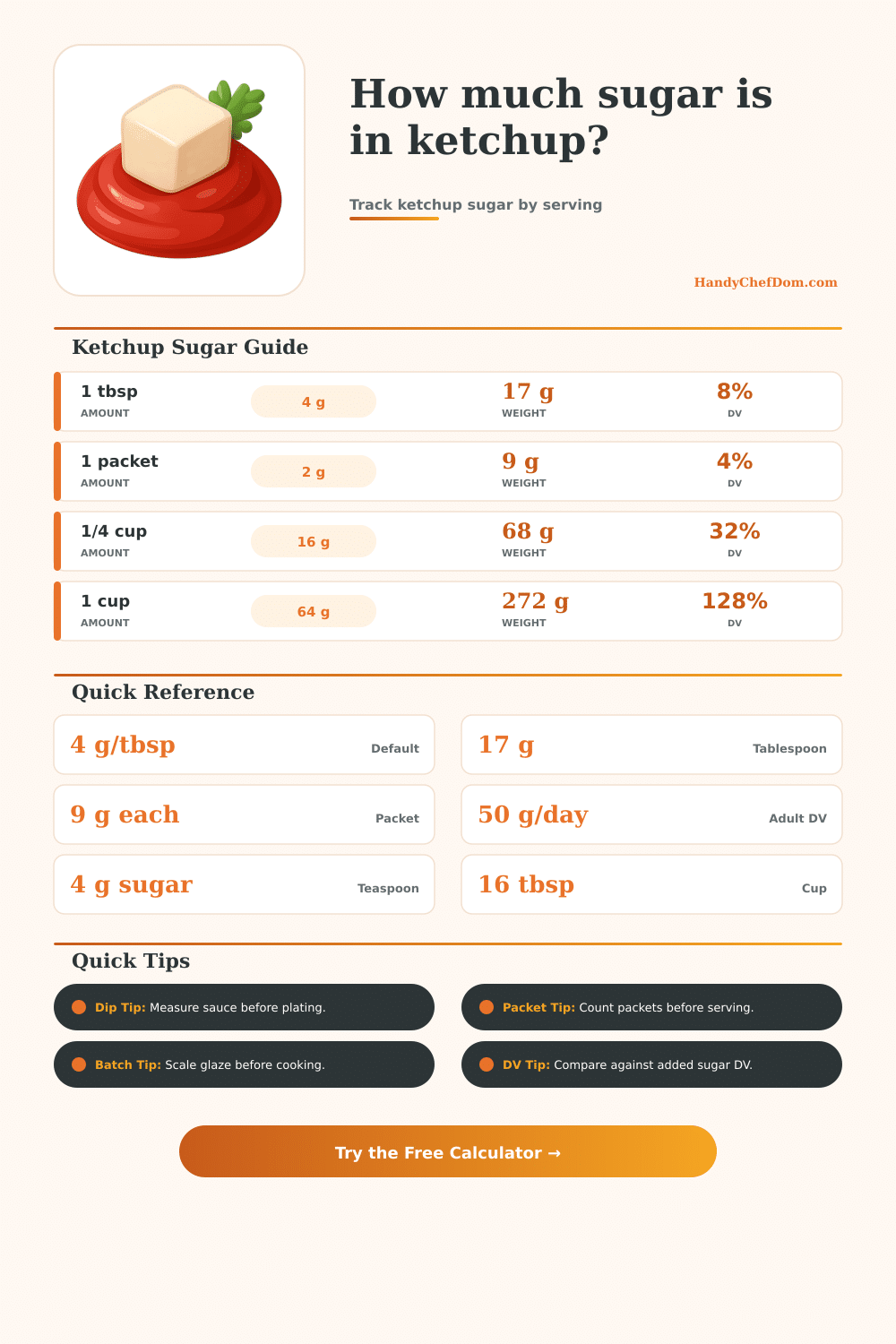
| 1 tablespoon ketchup | 1 tbsp | 17 g | 4 g |
| 1 fluid ounce ketchup | 2 tbsp | 34 g | 8 g |
| 1/4 cup ketchup | 4 tbsp | 68 g | 16 g |
| 1/2 cup ketchup | 8 tbsp | 136 g | 32 g |
| 1 cup ketchup | 16 tbsp | 272 g | 64 g |
| Meal context | Typical ketchup | Typical sugar | Adult DV share |
|---|---|---|---|
| Burger plate | 1.5 tbsp | 6 g | 12% |
| Fries and dipping | 2 tbsp | 8 g | 16% |
| Nuggets or tenders | 3 tbsp | 12 g | 24% |
| Hot dog picnic | 1 tbsp | 4 g | 8% |
| Meatloaf glaze | 4 tbsp | 16 g | 32% |
| Takeout packet | 1 packet | 2.1 g | 4% |
Although ketchup does contain added sugar, the amount of added sugar that can significently increase from ketchup is based off the amount of ketchup that a person consume. One tablespoon of ketchup contains 4 grams of added sugar, but a person may consume more then one tablespoon of ketchup with one meal. Because there are various method to measure the amount of ketchup that a person uses, the person must select the correct method in order to ensure the sugar calculation is correct.
For example, a person can measure the amount of ketchup in tablespoons, cups, grams on a scale, or by counting the number of takeout packet of ketchup that are used. The brand sugar field allows a person to input the amount of sugar that is present in the ketchup brand that is being use. Inputting the amount of sugar that is specific to the brand of ketchup that is being consumed is important because different brands of ketchup contain different amount of sugar.
How to measure sugar in ketchup
For instance, some brands of ketchup may contain reduced sugar compared to other brands of ketchup. By ensuring that the brand sugar field accurately represent the sugar content of the brand of ketchup that is consumed, the calculation will also be accurate. Even though the amount of sugar that is contained in ketchup may be higher than other condiments, the amount of sugar that is contained in ketchup is lower than barbecue sauce.
For instance, plain yellow mustard contains very little sugar, but ketchup contain a notable amount of added sugar. Thus, the more sauces that are consumed with one meal, the higher the total amount of added sugar that enters the body. For instance, if a person places ketchup on both there fries and nuggets, they will consume more added sugar than if they only placed ketchup on there fries.
The waste field affects the total amount of ketchup that enters the body. For example, the individual does not consume any ketchup that is left on the side of the plate or within the dipping cup. The percentage field for waste allows a person to account for the amount of ketchup that the individual wasted so that the total amount of ketchup and sugar that entered the body is only of the amount that was consumed.
The number of servings that the people eating the meal consume can impact the sugar content per person. For example, if a person divides a batch of ketchup among eight people rather than four, the amount of sugar that each person consume will be less. Thus, the servings field allows the sugar content to be distributed among the number of people who will eat the meal.
The density of the ketchup can change the number of gram of ketchup that is contained within a unit of measurement. For example, some brands of ketchup are thicker than other brands of ketchup. Additionally, some brands of ketchup that contain reduced sugar may have a different density than brands of ketchup that contain regular amounts of sugar.
Thus, the grams per tablespoon field allows for the density of the ketchup to be accounted for in order to accurately calculate the amount of sugar that is contained in the amount of ketchup that is consumed. The daily-value comparison field displays the amount of sugar that is consumed in relation to the daily value for added sugar. The daily value for added sugar for adults is 50 grams per day, but many adults would like to consume less than 50 grams of added sugar per day.
Thus, the percentage field within the daily-value comparison field allows an individual to see what percentage of their daily sugar limit is taken up by the ketchup that they consumed. This percentage allows an individual to easily understand how much sugar from ketchup that they consumed each day without having to perform calculation in their mind. Some of the most common mistake with ketchup and sugar are treating every tablespoon of ketchup as if it is the same, and forgetting to account for the number of people who will eat the meal that contains the ketchup.
These mistake can lead to under or overestimations of the total amount of sugar that is consumed with the meal. To avoid these mistakes, it is important to use the label of the bottle of ketchup and the actual number of people who will eat the meal. By setting these field to the appropriate values, the calculation will provide the total amount of sugar that is contained in the ketchup that the individuals in the meal consumed.