Pot Size Calculator
Choose the right pot volume for soups, stews, stocks, and sauces without guesswork.
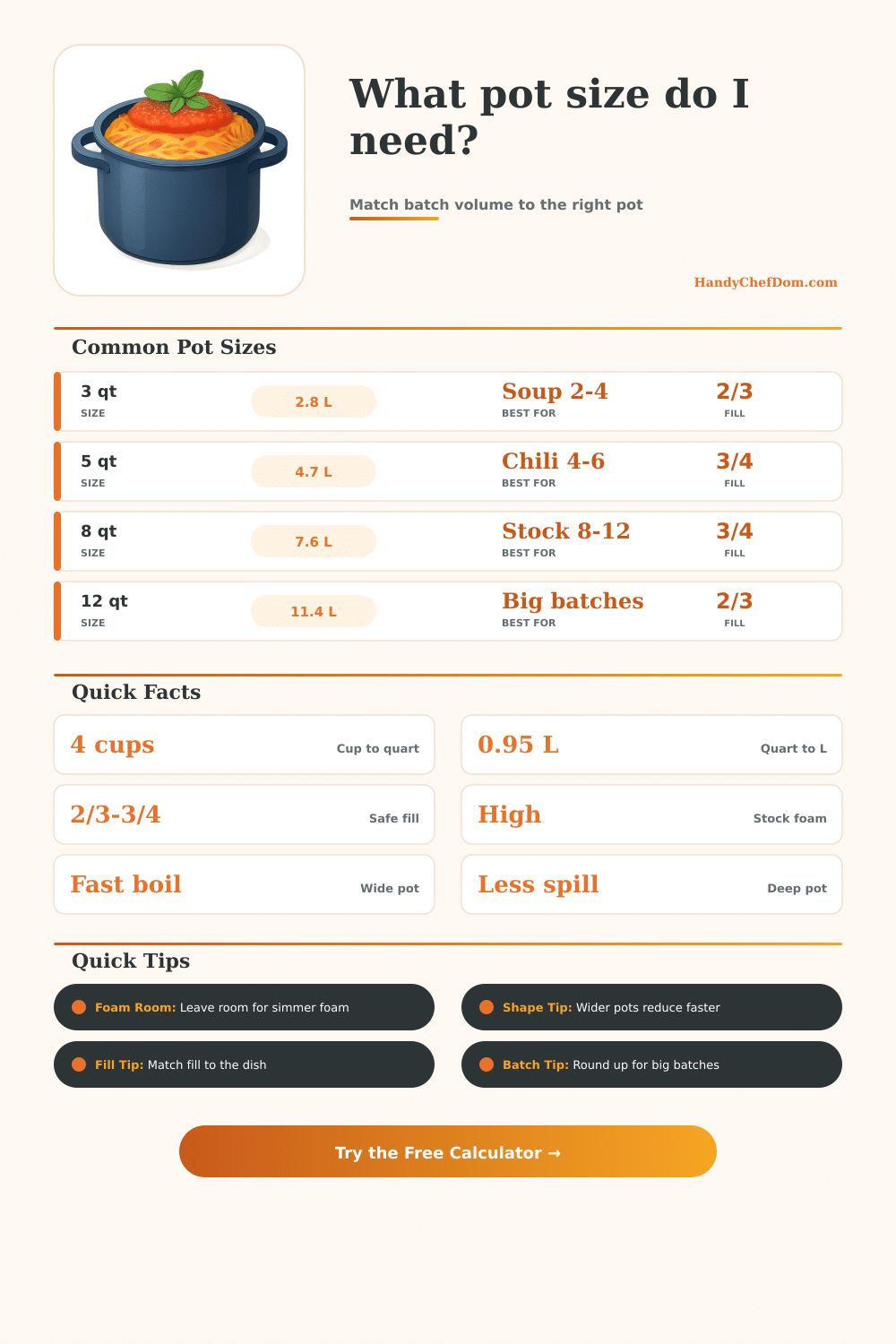
| Pot Size | Liters | Best For | Fill |
|---|---|---|---|
| 3 qt | 2.8 L | Soup 2-4 | 2/3 |
| 5 qt | 4.7 L | Chili 4-6 | 3/4 |
| 8 qt | 7.6 L | Stock 8-12 | 3/4 |
| 12 qt | 11.4 L | Big batches | 2/3 |
| 16 qt | 15.1 L | Stock 14+ | 3/4 |
| 20 qt | 18.9 L | Boils | 1/2 |
| Method | Safe Fill | Why | Watch |
|---|---|---|---|
| Soup | 75% | Foam | Simmer |
| Stock | 65% | Boil | Skim |
| Sauce | 70% | Reduce | Splash |
| Stew | 70% | Chunks | Stir |
| Braise | 60% | Shallow | Watch |
| Boil | 55% | Surge | Use tall |
| Volume | Imperial | Metric | Notes |
|---|---|---|---|
| 1 cup | 1 cup | 236.6 ml | Small add |
| 1 qt | 4 cups | 0.95 L | Base size |
| 1 L | 4.23 cups | 1 L | Metric pot |
| 1 gal | 16 cups | 3.79 L | Big stock |
| 1 cup | 8 fl oz | 236.6 ml | Recipe cup |
| 1 pt | 2 cups | 0.47 L | Half qt |
| Dish | Per Serving | Base | Pot |
|---|---|---|---|
| Soup | 1.5 cups | 4 cups | Stock pot |
| Chili | 1.5 cups | 5 cups | Dutch oven |
| Stew | 1.25 cups | 5 cups | Dutch oven |
| Stock | 1.75 cups | 8 cups | Stock pot |
| Sauce | 1 cup | 4 cups | Saucepan |
| Oatmeal | 0.75 cup | 3 cups | Saucepan |
When selecting the correct size for a pot, there are two different reasons why the size of the pot is important: the correct size prevents the foods from boiling over and it will even ensure that the heat is distributed even throughout the pot. If the size of the pot is too small in relation to the amount of food that is being cooked, the foam and liquids can boil over out of the pot. However, if the size of the pot is too large in relation to an amount of food that is being cooked, then the liquid will be too shallow for the food to be heated even.
The size of the pot that is needed to cook the food can be determined by calculating the total volume of the ingredients that will be used in the cooking process. The cook will have to calculate the volume of the liquid to be cooked, as will the volume of the solid ingredient for the food. The volume of the food that will foam when boiled will also have to be accounted for; many food recipes including stocks or oatmeal creates foam when boiled.
How to Choose the Right Pot Size
A percentage can be added to the total volume of the food to account for the liquid that will become foam when boiling. The volume of the food that will evaporate during cooking will also have to be accounted for; the larger the surface area of the pot, the more the liquid evaporate during cooking. Other factors that will affect the size of the pot that is needed to cook the food includes the depth of the pot and the type of food that is to be prepared.
For example, a deep stock pot is often used to make broth. Another example include the use of a Dutch oven to make stews; however, the stew should only be filled to seventy percent of the capacity of the Dutch oven. Wide pots are used to boil seafood; however, again, the seafood should only be added to fifty-five percent of the capacity of the wide pot.
Braisers are used to sear the food; however, braisers have a shallow depth, so the food should only be filled to sixty percent of the depth of the braiser. Many individuals will make the mistake of attempting to estimate the amount of food necessary to fill the pot by sight alone. However, it is best not to estimate the amount of food necessary to fill the pot by sight alone.
In each case, it is always best to use a larger size for the pot than estimated. For example, if preparing oatmeal, the saucepan should be filled to eighty percent of its capacity; oatmeal will foam when boiled. For stocks, the amount of stock should be filled to sixty-five percent of the depth of the pot; this allows for skimming of the impurities that may appear in the stock.
For seafood boiled in a tall pot, only fifty percent of the pots capacity should be filled with the seafood; boiling will create bubbles that will lift the shell of the seafood. Beyond the type of food that is to be prepared, other factors will impact the amount of space that should be provided within the pot. The heat output of the stove upon which the pot will be placed will impact how quickly the liquid in the pot will expand with heat.
The altitude at which the food will be cooked will impact the evaporation of the liquid from the food; at higher altitudes the air is drier and will remove more moisture from the food being cooked. Additionally, the number of people that are to be fed will impact the size of the pot that is needed. More people to be fed means more food to cook, meaning a larger size for the pot.
Understanding how to convert different volumes can be challenging for many cooks. For instance, one quart is equal to four cups, and one quart is approximately equal to one liter. A three-quart pot can hold two to four servings of soup.
An eight-quart pot can hold eight to twelve servings of stock. Finally, a twelve-quart pot is useful for preparing large batches of food. However, the twelve-quart pot should only be filled to two-thirds of its capacity; the depth of the liquid will create a surge of foam when boiling the food.
The materials out of which the pot is made also has an impact upon how the food is cooked in the pot. Cast iron pots, such as Dutch ovens, retain heat well. Additionally, if the pot is slightly too large for the food being cooked, it is forgiving.
Stainless steel pots heat quickly but also lose heat quickly. Therefore, the size of the pot must be more precise when using stainless steel pots. Finally, nonstick pots are useful for cooking sauces that splash when boiling.
However, wide steel pots are the best for reducing the liquid in a sauce. It is also important to test the fit of the pot that will be used to prepare the food. The capacity of the pot can be entered into a calculator to determine the amount of headroom that will be provided for the food within the pot.
If plenty of space is calculated, then there will be enough headroom for the food within the pot. However, if there is very little headroom within the calculated capacity of the pot, then a larger size of pot should be used. By using the correct size for the pot, whether for chili, stocks or stew, the food will even cook and the food will not boil over the sides of the pot.