🧁 Baking Powder Per Cup Of Flour Calculator
Dial in teaspoons of baking powder for cakes, muffins, biscuits, pancakes, and quick breads with altitude, acid, rise, and batch scale adjustments.
Use cups or grams of flour, then adjust the leavening ratio for recipe style, acid load, altitude, baking powder type, desired rise, and batch scale.
Spoon-and-level cups are assumed.
Used when flour entry is grams.
Use 0.5 for half batch, 2 for double batch.
Soda is noted separately; it does not replace all baking powder.
| Recipe Type | Starter Ratio | Typical Flour | Rise Goal | Calculator Use |
|---|---|---|---|---|
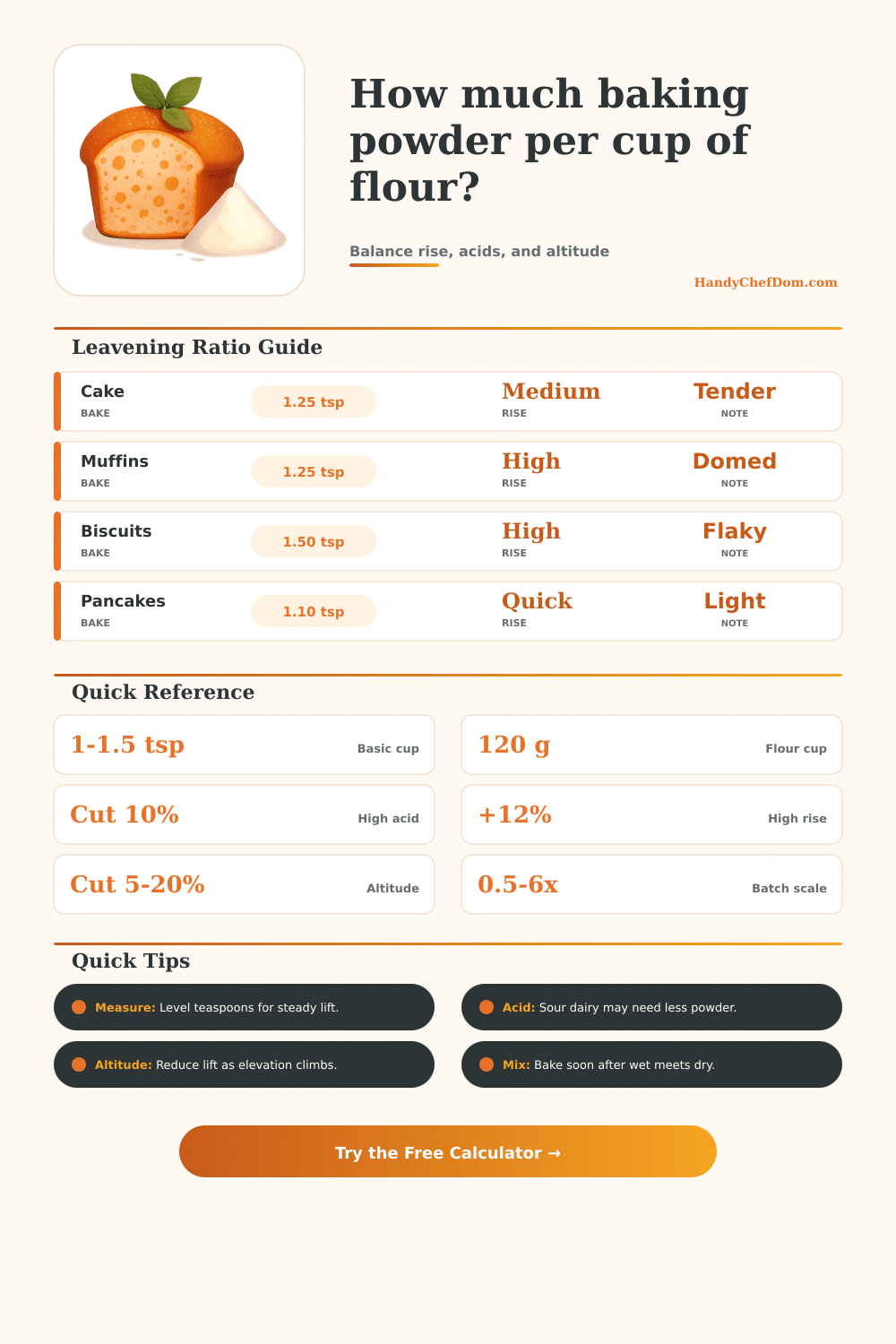
| Layer cake | 1 to 1.25 tsp/cup | Cake or AP flour | Even and tender | Good base for frosted cakes |
| Muffins | 1.25 to 1.5 tsp/cup | AP flour | Domed top | Add more for fruit-heavy batter |
| Quick bread | 0.9 to 1.15 tsp/cup | AP or whole wheat | Stable loaf | Reduce if banana or yogurt is very acidic |
| Pancakes | 1 to 1.25 tsp/cup | AP flour | Fast griddle lift | Cook soon after mixing |
| Biscuits | 1.25 to 1.75 tsp/cup | AP or pastry | High and flaky | Best with cold fat and quick bake |
| Scones | 1.25 to 1.5 tsp/cup | AP flour | Split and rise | Use medium-high ratio for cream scones |
| Cornbread | 1 to 1.35 tsp/cup | Cornmeal plus flour | Open crumb | Balance with buttermilk or sour cream |
| Soft cookies | 0.25 to 0.6 tsp/cup | AP flour | Light puff | Use less than cake batter |
| Acid Level | Common Ingredients | Powder Change | Soda Relationship | Texture Cue |
|---|---|---|---|---|
| Neutral | Milk, water, cream | No reduction | Powder carries the lift | Clean crumb |
| Light acid | Fruit, cocoa, honey | Reduce about 4% | Small soda amount can help browning | Softer crumb |
| Moderate acid | Yogurt, sour cream | Reduce about 8% | Soda can neutralize tartness | Tender and moist |
| Strong acid | Buttermilk, molasses | Reduce about 12% | Soda often joins powder | Fast early rise |
| Very strong acid | Citrus plus cultured dairy | Reduce about 16% | Check for too much soda flavor | May brown quickly |
| Altitude Band | Typical Change | Why It Matters | Batter Cue | Recipe Note |
|---|---|---|---|---|
| Sea level to 1,999 ft | Keep base ratio | Standard pressure | Expected rise | No altitude cut |
| 2,000 to 3,499 ft | Cut about 5% | Gas expands sooner | Slightly quicker dome | Watch muffins |
| 3,500 to 5,999 ft | Cut about 10% | Less pressure support | Center may set late | Helpful for cakes |
| 6,000 to 7,999 ft | Cut about 15% | Over-leavening risk | Coarse crumb risk | Use stable batter |
| 8,000 ft or higher | Cut about 20% | Rapid expansion | Collapse risk | Consider smaller pans |
| Measuring Target | Teaspoon Equivalent | Approx Grams | Best For | Practical Note |
|---|---|---|---|---|
| 1/4 tsp | 0.25 tsp | 1 g | Small cookie lift | Use a level spoon |
| 1/2 tsp | 0.50 tsp | 2 g | Small batch cakes | Easy to scale |
| 3/4 tsp | 0.75 tsp | 3 g | Light quick breads | Round carefully |
| 1 tsp | 1.00 tsp | 4 g | Base cup ratio | Common recipe anchor |
| 1 1/4 tsp | 1.25 tsp | 5 g | Cakes and muffins | Balanced lift |
| 1 1/2 tsp | 1.50 tsp | 6 g | Biscuits and scones | High rise target |
Baking powder is used to create the gas that will make the baked good rise. Baking powder are used in cakes, biscuits, and breads to create an proper texture. The amount of baking powder that is required for any given recipe is important because the amount of baking powder will ultimately determine the texture of the baked good.
If too much baking powder is use, the texture of the baked good may be coarse and it may have a metallic taste. Too little baking powder will result in the baked good being dense or, worseer yet, not rising at all. The amount of baking powder required for a recipe can change depending on a variety of factors.
How Much Baking Powder to Use
The type of recipe that you are to prepare is one of the factors that will influence the amount of baking powder that you should use in the recipe. For instance, cakes require less baking powder then biscuits. This is because cakes require a fine crumb while biscuits should rise to create a flaky texture.
Baking powder is also a necessity for muffins though only in moderate amounts since muffins should rise to create a crown yet not rise too much that they begin to crack. Quick breads, however, require less of the baking powder because their batter is dense with moisture and sugar. The second factor that you should consider is the acidity of the ingredients in the recipe.
Baking powder reacts to acidity in the ingredients. Ingredients like buttermilk, yogurt, molasses, and cocoa contains acidity that will cause the baking powder to react. Because of this, less baking powder should be used in recipes with acidic ingredients.
Using too much baking powder in an acidic environment can cause the batter to lose all of it lift before it enters the oven and also can impart a metallic taste to the batter. Using a calculator for baking powder can automatically reduces the baking powder if acidity is selected as one of the recipe variables. The third factor that you should consider is the altitude at which the recipe is to be prepared.
The air pressure at different altitudes can drastically impact the baking process. At high altitudes the air pressure is lower. With lower air pressure more gases escapes from the baked good faster.
This can cause baked goods to rise too quickly and then subsequently collapse. Using less baking powder prevents this type of collapsing since the center of the baked good will remain stable. Using a baking powder calculator allows for the amount of baking powder to be adjusted according to the selected altitude.
The fourth factor that can impact the amount of baking powder that is required is the weight of ingredients like fat and sugar. Lean batters, like pancake batter, will rise more easily than heavy batters like banana bread batter. Banana bread contains heavy ingredients that require more baking powder to enable the batter to rise.
In general, the richer the batter the more baking powder that should be used in the recipe. The fifth and last factor to consider is the batch size. When people use baking powder calculators, it is common for an entire recipe to be doubled.
This can make it difficult for individuals to measure baking powder in amounts that are not whole number. The baking powder calculator will adjust for this amount so that you can double the batch size and the baking powder will be a whole number. The baking soda will be separated from the baking powder since baking soda and baking powder are both leavening agent.
Reference tables list the amount of baking powder that will work well in various situations. The baking powder calculator can refer to these tables to determine baking powder requirements for different recipes. These tables include information about how baking powder requirements change with type of recipe, acidity, altitude, and other variable.
Many people make mistakes when adding baking powder to their recipes. Most commonly, they use the same amount of baking powder for each type of recipe without considering any of the factors discussed above. For instance, many individuals will use the amount of baking powder listed in a recipe that was published in a magazine recipe without considering the acidity of the ingredients or the altitude where the recipe is prepared.
The amount of baking powder should of been calculated according to the recipe in question to ensure that the baked good will not sink due to too much baking powder. The primary goal of adding baking powder to baked goods is to create the desired texture. This can only be accomplished if the baker use the baking powder in the correct amount so that the gas is released at the right time to create the proper texture yet not too much that a metallic taste is created.
The baking powder calculator can do the math for the baking powder yet it is up to the baker to determine what type of rise is desired for the recipe and to observe the results of the baking.