Kefir Calculator
Scale milk, grains, and ferment timing for smooth, tart, repeatable batches.
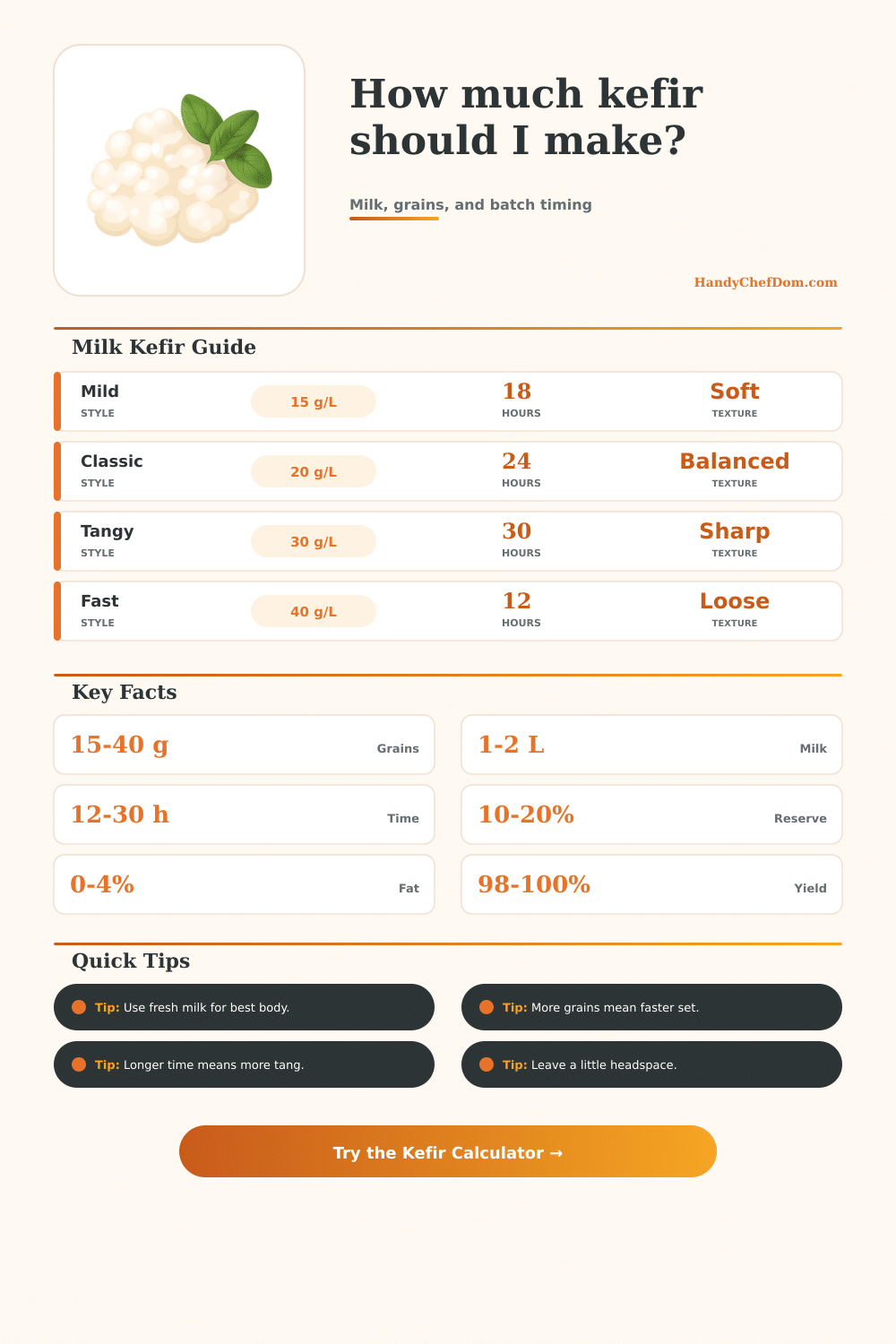
| Style | Grains | Hours | Texture |
|---|---|---|---|
| Mild | 15 g/L | 18 | Soft |
| Classic | 20 g/L | 24 | Balanced |
| Tangy | 30 g/L | 30 | Sharp |
| Fast | 40 g/L | 12 | Loose |
| Milk | Factor | Fat | Note |
|---|---|---|---|
| Whole | 1.00 | 3.5% | Round body |
| 2% | 0.97 | 2% | Lean balance |
| Skim | 0.92 | 0% | Light finish |
| Goat | 0.98 | 3.5% | Clean tang |
| Batch | Milk | Grains | Reserve |
|---|---|---|---|
| Small | 1 L | 20 g | 120 ml |
| Family | 2 L | 40 g | 240 ml |
| Party | 4 L | 80 g | 480 ml |
| Large | 8 L | 160 g | 960 ml |
Making kefir require a balance of the correct ingredients and measurements because the quality of the kefir rely upon the ratio of kefir grains to the milk. Most individuals that begin to make kefir will guess at the amount of kefir grains that should be use in the milk. However, guessing at the amount of kefir grains often lead to kefir that is either too thin or too sour.
In order to make kefir that is balanced and easily digested by the body, it is necessary to use scaling in the recipe in order to control the amount of kefir grains in relation to the amount of milk and the amount of time it ferment. Kefir grains are the symbiotic culture of bacteria and yeast that performs the fermentation of milk. These kefir grains transform the lactose within the milk to lactic acid and carbonations.
How to Make Good Kefir Every Time
Using more kefir grains than recommended per liter of milk will cause the kefir grains to ferment the milk faster. However, using too many kefir grains can result in kefir that has a thin texture and an overly sharp taste. The standard amount of kefir grains to use per liter of milk is between 15 and 40 gram.
For individuals that prefer a milk that ferment to a less sharp taste, using fewer kefir grains and allowing the milk to ferment for approximately 18 hours is recommended. For individuals that desire a kefir that ferment in 12 hours, using 40 grams of kefir grains per liter of milk is recommended. However, using an increased amount of kefir grains may result in a thinner kefir.
Since the kefir grains will multiply during the fermentation period, it is essential to use the appropriate amount of kefir grains initially to allow for the kefir to remain healthy. The type of milk that is used will impact the texture and flavor of the resulting kefir. Whole milk contains approximately 3.5 percent fat.
Skim milk contains less fat than whole milk, and will therefore ferment at a faster rate. Goat milk will ferment in a clean and tangy manner and is often easier to digest by some individual. The fat content of milk can play a role in the sharpness of the flavor of the resulting kefir.
Low fat milk will create a sharper kefir than high fat milk. It is also essential to reserve 10 to 20 percent of the amount of kefir that is produce to be used in the next batch of kefir that is produced. Using this reserve kefir will help to initiate the kefir grains and reduce the amount of time that it take for the kefir to begin fermenting.
The amount of time that the kefir ferment will impact the amount of tartness that is present in the kefir. Fermenting the kefir for 18 hours will result in a soft and subtle kefir. Fermenting the kefir for 24 hours will result in a classic flavor of kefir.
After 30 hours of fermentation the kefir will take on a sharp taste. The time that it take for the kefir to ferment impacts the amount of kefir grains that must be use for large batches of kefir. For instance, large volumes of milk require large amounts of kefir grains to ensure that the fermentation process does not occur too slow.
After the initial fermentation of the milk and kefir grains, a second fermentation can be performed in bottles to increase the amount of carbonation in the kefir and to mellower the flavors of the kefir. The ideal temperature range for the production of kefir is between 68 and 85 degrees Farenheit. If the temperature of the area in which the kefir is produce is below 68 degrees Farenheit, the kefir will take longer to ferment.
However, if the temperature of the area in which the kefir is produce is above 85 degrees Farenheit, the kefir will ferment at a faster rate. Using pasteurized milk for the production of kefir is recommended. However, it is important to avoid using ultra-pasteurized milk, as the high heat used to sterilize ultra-pasteurized milk will denature the proteins of the milk.
Additionally, it is recommended to use fresh milk rather than old milk for the production of kefir. Using old milk will lead to thin texture of kefir. There are a few mistakes that can be committed when producing kefir at home.
One of the most common is over-fermenting the kefir, which will lead to the kefir containing the same flavor as vinegar. Another of the most common mistakes is using insufficient milk for the kefir grains. For an 8-liter batch of kefir, 160 grams of kefir grains should be use.
However, care must be taken when brewing large batches of kefir of using large jars to brew the kefir, as the kefir grains may become too hot in certain area of the jar. Finally, to keep the kefir grains healthy, they should be rinsed with cool water once a week to remove the dead yeast that accumulate each week. Through the control of the kefir grains, the type of milk that is used, the amount of time that the kefir ferment, and the amount of kefir that is reserved for the next batch, individuals can ensure that each batch of kefir that is produce contains the same flavors and textures of kefir.