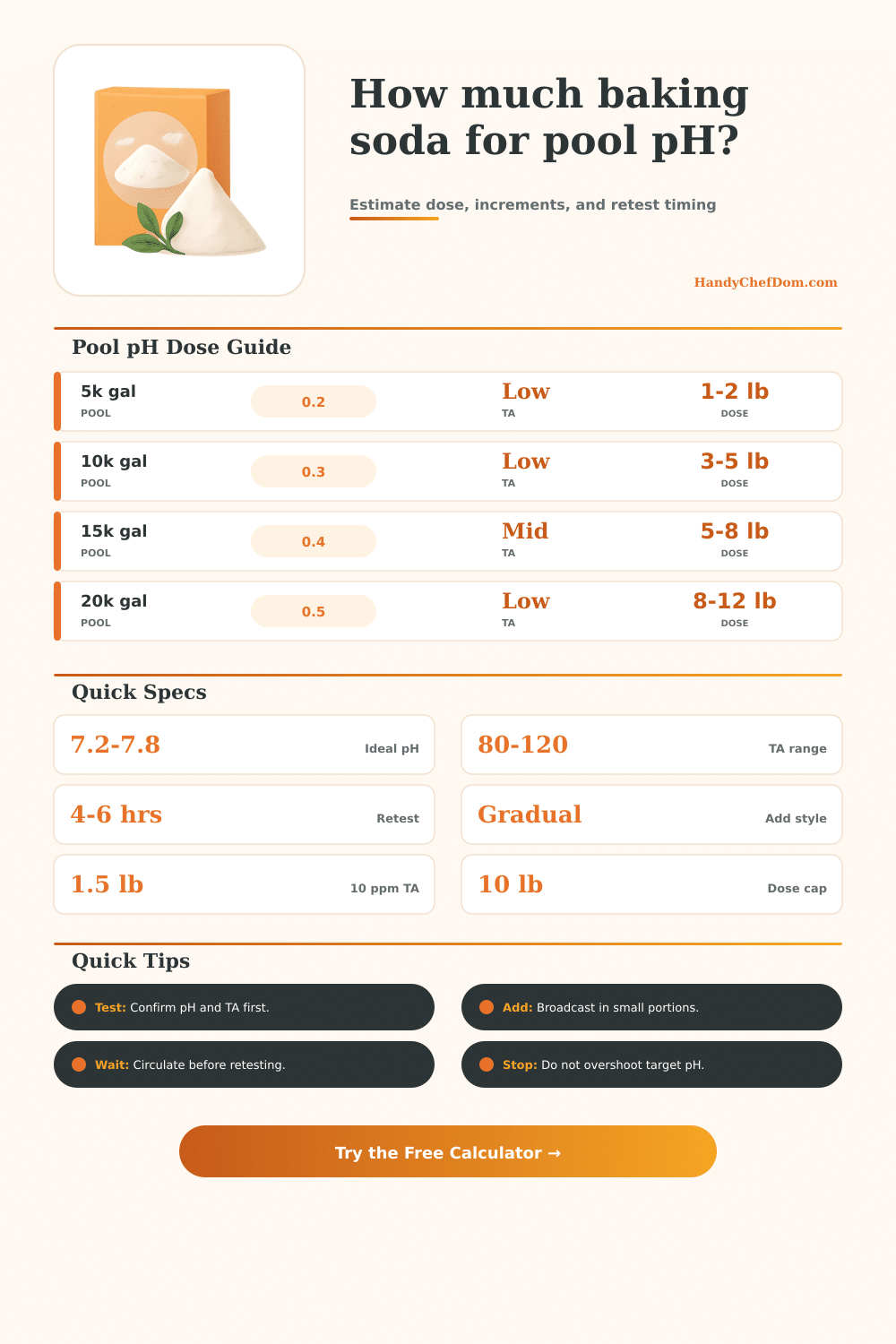
🏊 Baking Soda to Raise pH in Pool Calculator
Estimate a conservative sodium bicarbonate dose from pool volume, current pH, target pH, alkalinity, purity, and planned test timing.
Safety first: Test the water with a reliable kit before dosing, add baking soda gradually with the pump running, brush any settled powder, and retest after circulation before adding more. Baking soda mainly raises total alkalinity and only nudges pH.
This calculator is an estimate for sodium bicarbonate dosing. If pH is very low, very high, or swimmer safety is involved, follow your test kit, local code, or pool professional guidance.
| Reading | Low Concern | Comfort Range | Action Note |
|---|---|---|---|
| pH | Below 7.2 may feel sharp and corrosive | 7.2 to 7.8 for many pools | Baking soda gives a modest upward nudge, not a fast pH jump. |
| Total alkalinity | Below 70 ppm can allow pH bounce | 80 to 120 ppm is common | Baking soda is mainly used to raise this value. |
| Calcium hardness | Low CH can affect plaster balance | Often finish-dependent | Do not use baking soda to correct hardness. |
| Cyanuric acid | Too low loses chlorine to sunlight | System-dependent | Baking soda does not correct stabilizer. |
| Free chlorine | Low sanitizer is unsafe | Depends on CYA and rules | Balance sanitizer separately from pH dosing. |
| Baking Soda Dose | 10,000 gal Effect | 37,850 L Effect | Best Use |
|---|---|---|---|
| 0.75 lb / 0.34 kg | About 5 ppm TA rise | About 5 ppm TA rise | Small adjustment or cautious first addition. |
| 1.5 lb / 0.68 kg | About 10 ppm TA rise | About 10 ppm TA rise | Common reference dose for alkalinity. |
| 3.0 lb / 1.36 kg | About 20 ppm TA rise | About 20 ppm TA rise | Split if pH is already near target. |
| 6.0 lb / 2.72 kg | About 40 ppm TA rise | About 40 ppm TA rise | Large correction; add in stages and retest. |
| 10 lb / 4.54 kg | About 67 ppm TA rise | About 67 ppm TA rise | Usually too much for one addition in many pools. |
| Starting TA | pH Behavior | Baking Soda Role | Dosing Approach |
|---|---|---|---|
| Under 50 ppm | pH can swing quickly | Strong alkalinity support | Split additions and retest every stage. |
| 50 to 70 ppm | Low buffer, pH may drift | Helpful for TA and slight pH lift | Moderate staged correction works well. |
| 80 to 120 ppm | Usually steadier | Only small pH effect expected | Use small doses; avoid pushing TA too high. |
| Over 120 ppm | pH may rise or resist control | Usually not preferred | Stop and evaluate the full water balance. |
| Pool Type | Target Style | Dose Pace | Extra Check |
|---|---|---|---|
| Vinyl liner | Gentle pH and TA movement | Small to moderate additions | Brush settled powder away from liner folds. |
| Plaster or pebble | Balance with hardness and CSI | Moderate additions after testing | Watch calcium and saturation balance. |
| Fiberglass | Avoid overshoot and clouding | Conservative additions | Keep circulation strong while broadcasting. |
| Saltwater pool | Control pH drift and TA together | Usually smaller pH nudges | Aeration and cell operation can raise pH. |
| Small pool or spa | Very responsive water | Tiny increments only | Measure carefully because errors magnify. |
Baking soda is one of the chemical that is used to treat swimming pool water. Baking soda is primarily used to raise the total alkalinity of the pool water. When you add baking soda to a swimming pool, the baking soda will raise the total alkalinity of the water from the pool first, and it will raise the pools pH level secondary.
Many individuals uses baking soda when the water in their swimming pool is sharp to the skin. Additionally, individuals will use baking soda if the pH and alkalinity levels of their pool water refuse to remain stable. In determining how much baking soda to add to the swimming pool, it is also important to ensure that there isnt too much baking soda added to the pool water as this could lead to alkalinity issue in the pool.
How to Add Baking Soda to Your Swimming Pool
The amount of baking soda that will be needed for the pool is dependent upon several factor. Factors to consider include the alkalinity level of the pool water, the target alkalinity level of the pool water, the total volume of the swimming pool, and the current pH level of the pool water. The calculator that is provided to determine how much baking soda to add to a swimming pool will automatically calculate these values for the individual after they have entered the volume of the pool, as well as the current and target pH and alkalinity levels for the pool.
Each of these factor is important to consider in that pools with low levels of alkalinity will experience significant change to there pH levels with the addition of baking soda. Baking soda has a significantly blunted effect on pools with high levels of alkalinity. Thus, the baking soda calculator consider the alkalinity level of the pool prior to providing an estimate for how much baking soda should be added to the pool.
The type of swimming pool finish will also impact how baking soda is used in that pool. Swimming pools with vinyl liner can better tolerate the addition of baking soda than pools that have plaster or pebble surface for their pools. Additionally, saltwater system will exhibit different result from the addition of baking soda as the saltwater cells within the pool can raise the pool’s pH level over time.
As such, pools with saltwater systems may require smaller quantity of baking soda to be added to the pool with greater frequency. The baking soda calculator also allows for the individual to select the type of swimming pool in order to provide the individual with an accrate estimate of the amount of baking soda that should be added to the pool. The amount of baking soda that is added to the swimming pool should be done in portion as the baking soda will dissolve slowly in the cooler water within the pool.
Additionally, if you add all of the baking soda to the pool at once, it may settle in the low spot within the pool. Thus, by adding only a portion of the baking soda to the pool, allowing the water to circulate through the filtration system, and testing the water again, the individual will be able to ensure that they dont add too much baking soda to the pool. By providing a field for the individual to enter how often they will retest the pool water, baking soda dosage amount can be provided that allow for these periodic water test to ensure that the pool pH and alkalinity balance is maintained.
While baking soda is often thought to have pH raising property, baking soda is primarily used to create a buffer in the pool water. A buffer is beneficial in maintaining the pH level of the pool after it rain, or if other chemical are added to the pool. Therefore, baking soda is beneficial in that after adding baking soda to a pool to even out the pool alkalinity levels, it will be easier to make small correction to the pH level of the pool water, and those correction will last longer.
For these reason, each baking soda calculator will evaluate both pH and alkalinity levels rather than only evaluating the gap between the current and target pH level. No matter how precise the baking soda calculator is, no swimming pool will behave in exactly the same manner as the mathematical spreadsheet upon which the baking soda amount is calculated. Water chemistry can be impacted by the temperature in the pool, the number of swimmer that are using the pool, and many other factor.
Thus, the baking soda estimate provided to an individual will be used as a starting point for adding baking soda to the pool water. Additionally, the individual should add the first portion of baking soda, allow the water to circulate, and then test the pH and alkalinity level of the pool water. Based off the test result, the individual can decide whether additional baking soda should be added to the pool to even out the pH and alkalinity levels of the pool water.
If the pH and alkalinity levels are even out, no more baking soda should be added to the pool. If the levels are not even out, the process of adding baking soda to the pool can be continued. In order to properly manage the pH and alkalinity level of the pool water, the individual that manages the pool should form certain habit.
One habit that should of been formed is to test the pool water prior to adding baking soda to it. After the baking soda has been added to the pool, the water should be tested again before the process is repeated. By establishing this habit, an individual will better manage both the alkalinity and pH level of their swimming pool water, and the pool water will remain both clear and comfortabley for the swimmer that use the pool.