🥘 Cornstarch to Thicken Sauce Calculator
Measure cornstarch slurry for glossy pan sauces, gravies, reductions, glazes, and stir-fry sauces using nappe thickness, sauce style, and finishing volume.
Enter the sauce volume before the final simmer. The calculator thickens the reduced volume, then adjusts for sauce type, nappe target, acidity, sugar, and fat.
| Nappe target | Cornstarch per cup | Spoon test | Sauce examples |
|---|---|---|---|
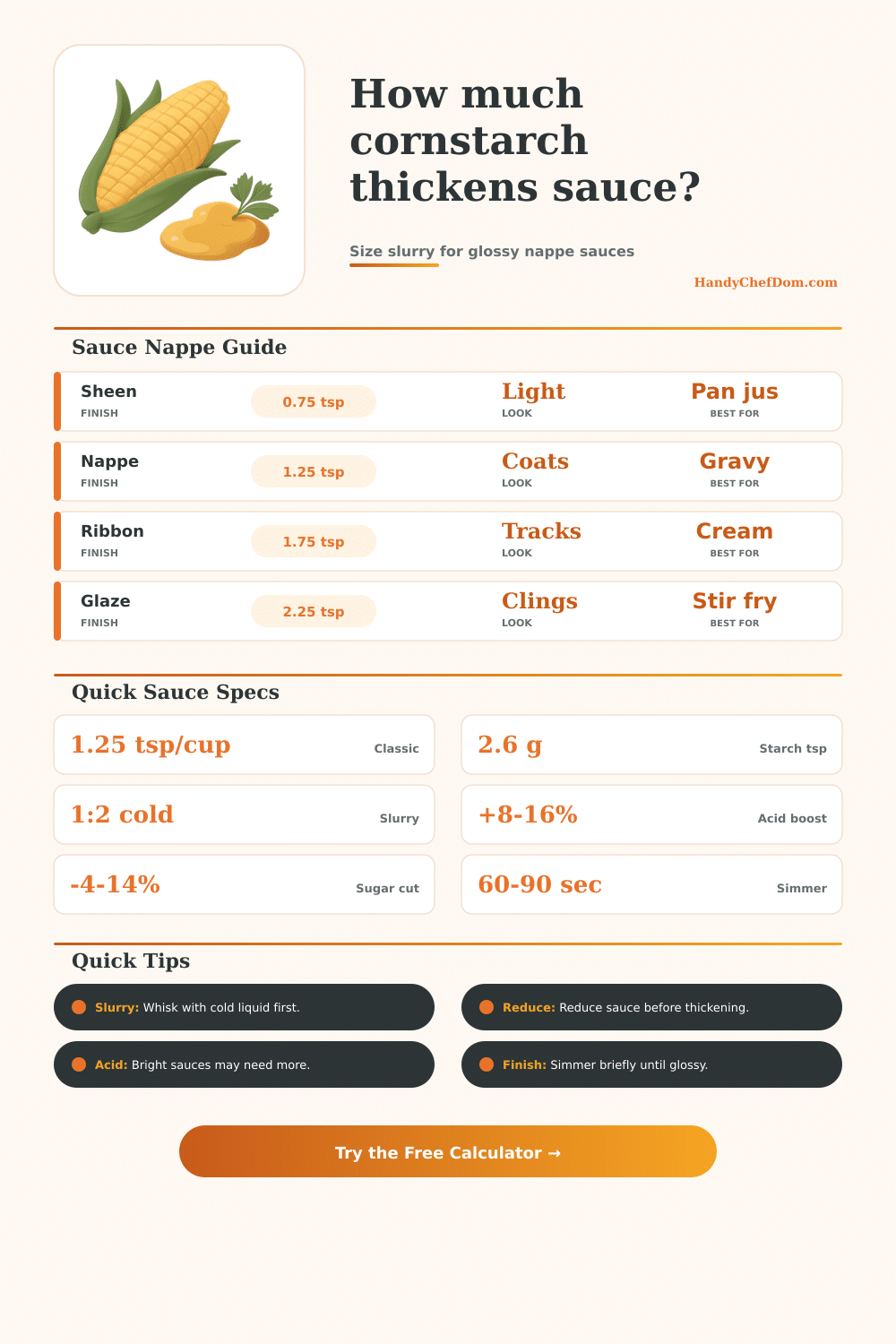
| Light spoon sheen | 0.75 tsp | Leaves a thin glossy film | Pan jus, light seafood sauce |
| Classic nappe coat | 1.25 tsp | Coats spoon and wipes clean | Gravy, wine pan sauce, dairy sauce |
| Ribbon gravy trail | 1.75 tsp | Slow ribbon holds a short track | Skillet gravy, cream sauce, pot pie sauce |
| Sticky glaze cling | 2.25 tsp | Clings firmly to food surface | Teriyaki, fruit glaze, stir-fry sauce |
| Sauce type | Modifier | Why it changes | Best nappe target |
|---|---|---|---|
| Pan jus or drippings | 1.00x | Stock-based sauces hydrate starch predictably. | Light sheen to classic nappe |
| Brown or poultry gravy | 1.08x | Fat and roast solids need a little more grip. | Classic nappe to ribbon |
| Cream or dairy pan sauce | 0.95x | Dairy body already gives some viscosity. | Classic nappe |
| Soy-sugar teriyaki glaze | 0.88x | Sugar reduction thickens as it cools. | Glaze cling |
| Fruit coulis or dessert sauce | 1.12x | Acidic fruit can weaken starch thickening. | Ribbon to glaze |
| Wine reduction sauce | 1.15x | Acid and alcohol reduction can thin the gel. | Light sheen to classic nappe |
| Wok stir-fry sauce | 1.05x | Fast heat and tossing need extra cling. | Glaze cling |
| Slurry ratio | Liquid amount | Texture before adding | When to use it |
|---|---|---|---|
| 1:1 | 1 tsp liquid per 1 tsp starch | Thick paste | Small sauces with very little extra liquid |
| 1:1.5 | 1.5 tsp liquid per 1 tsp starch | Smooth spoonable slurry | Pan sauces and gravy touch-ups |
| 1:2 | 2 tsp liquid per 1 tsp starch | Pourable classic slurry | Most nappe sauces and glazes |
| 1:3 | 3 tsp liquid per 1 tsp starch | Thin drizzle slurry | Wok sauces or cautious finishing |
| Reference measure | Imperial amount | Metric equivalent | Kitchen note |
|---|---|---|---|
| Level cornstarch teaspoon | 1 tsp | About 2.6 g | Level the spoon for consistent thickening. |
| Level cornstarch tablespoon | 1 tbsp | About 7.8 g | Equals 3 level teaspoons. |
| Cold slurry tablespoon | 1 tbsp | About 15 ml | Use water, stock, wine, juice, or milk cold. |
| Finished sauce cup | 1 cup | About 237 ml | Base starch on the volume after reduction. |
Achieving the correct consistency in a sauces is a necessary skill in the kitchen because the consistency of a sauce affects how the sauce interact with the food. If a sauce is too thin, it will run off the food that the sauce is poured over. Conversely, if a sauce is too thick, the sauce will become a paste.
Many cooks use cornstarch to thicken their sauces, since cornstarch produces a glossy finish with which the sauce coats the food, as opposed to using flour, which require long periods of simmering to achieve the same result. Furthermore, the amount of cornstarch that the cook must use to achieve the perfect thickness for the sauce depends upon the type of sauce that is being made. The specific characteristics of the sauce that is to be made will determine the amount of cornstarch that must be added to achieve the correct thickness of the sauce.
How to Thicken Sauces with Cornstarch
Stock based pan sauces tend to naturally thicken as the sauce cooks, as the stock contains mostly water and dissolved proteins. Cream sauces contain fat from dairy product, which naturaly thickens the sauce and requires less cornstarch than a stock-based sauce. Sauces that contain alot of vinegar or acidic ingredients require more cornstarch to thicken than sauces that are more high in sugar, because acidity naturaly weakens the starch gel within the cornstarch.
Conversely, sugar has the opposite effect upon the starch gel, causing it to help the sauce cling to the food items upon which it is poured when cooled. In order to ensure that the cornstarch evenly disperse within the sauce, it is necessary to create a slurry, a mixture of cornstarch and a cold liquid. You must create the slurry prior to adding the cornstarch to the sauce that simmer on the stove.
It isnt recommended to add dry cornstarch powder to the simmering sauce, as this will cause the formation of lumps within the sauce. Instead, the cook should mix the cornstarch with a cold liquid, such as stock, wine, or water at a ratio of one part cornstarch to two parts liquid. Using a slurry will ensure that the cornstarch disperses evenly within the sauce, and will prevent the formation of potentially noticeable lumps.
Additionally, other factor related to the sauce will impact the thickness of the sauce. For instance, if a sauce sits on a heat source for a long period of time, the sauce will continue to thicken. A sauce that reaches the proper thickness when cooked upon the stove may become too thick for the desired consistency of the sauce by the time it is served to the individuals eating the dish.
Thus, if a sauce is known to sit on a heat source for a long time, an amount of cornstarch that is lower than the amount required to thicken the sauce to the proper thickness when cooked will ensure the sauce doesnt become too thick when served. Furthermore, the cook can test the sauce to determine if the cornstarch has thickened the sauce to the proper level. One way of performing the spoon test is to coat the back of a spoon with the sauce, and then use the back of the spoon to push the sauce along the spoon with the tip of one’s finger.
If the sauce leave a clear trail along the back of the spoon, the sauce is too thin and more cornstarch slurry should be added. If the trail along the back of the spoon is matte and thick, the sauce is too thick and a splash of stock or water should be added. The different types of dishes require different thicknesses of sauce.
For example, light pan jus sauces should only be thick enough to allow the sauce to naturally cling to the meat. Conversely, gravy should leave a slow ribbon trail on the plate when sliced with a knife. Stir-fry sauces contain a thicker consistency than pan jus sauces because they must naturally coat the ingredient in the stir-fry without allowing the sauce to slide off the food.
Thus, the cook should select the desired thickness of the sauce prior to adding cornstarch to the sauce, allowing the cook to adjust the amount of cornstarch to achieve the desired thickness. Finally, the best method to add cornstarch to a sauce is to calculate the amount of cornstarch required prior to beginning the cooking of the sauce. Adding too much cornstarch to a sauce that has simmered for a long time is difficult to fix, and will alter the flavor of the sauce.
However, by calculating the amount of cornstarch that the cook should add to the sauce based off the type of sauce to be made, the acidity of the sauce, the sugar content, the fat content of the sauce, and the amount of time the sauce will sit on the heat source, the cook will ensure that the sauce possesses the correct consistency.