🌱 Omega 3 in Chia Seeds Calculator
Estimate plant omega-3 ALA from chia seeds by tablespoons, grams, whole or ground form, soaked gel, serving count, recipe use, and daily target.
Choose how you measured the chia. Soaked gel entries are converted back to dry seed equivalent before estimating ALA and nutrition.
| Chia Amount | Dry Weight | ALA Estimate | Kitchen Note |
|---|---|---|---|
| 1 teaspoon | 4 g | 0.7 g | Small topper |
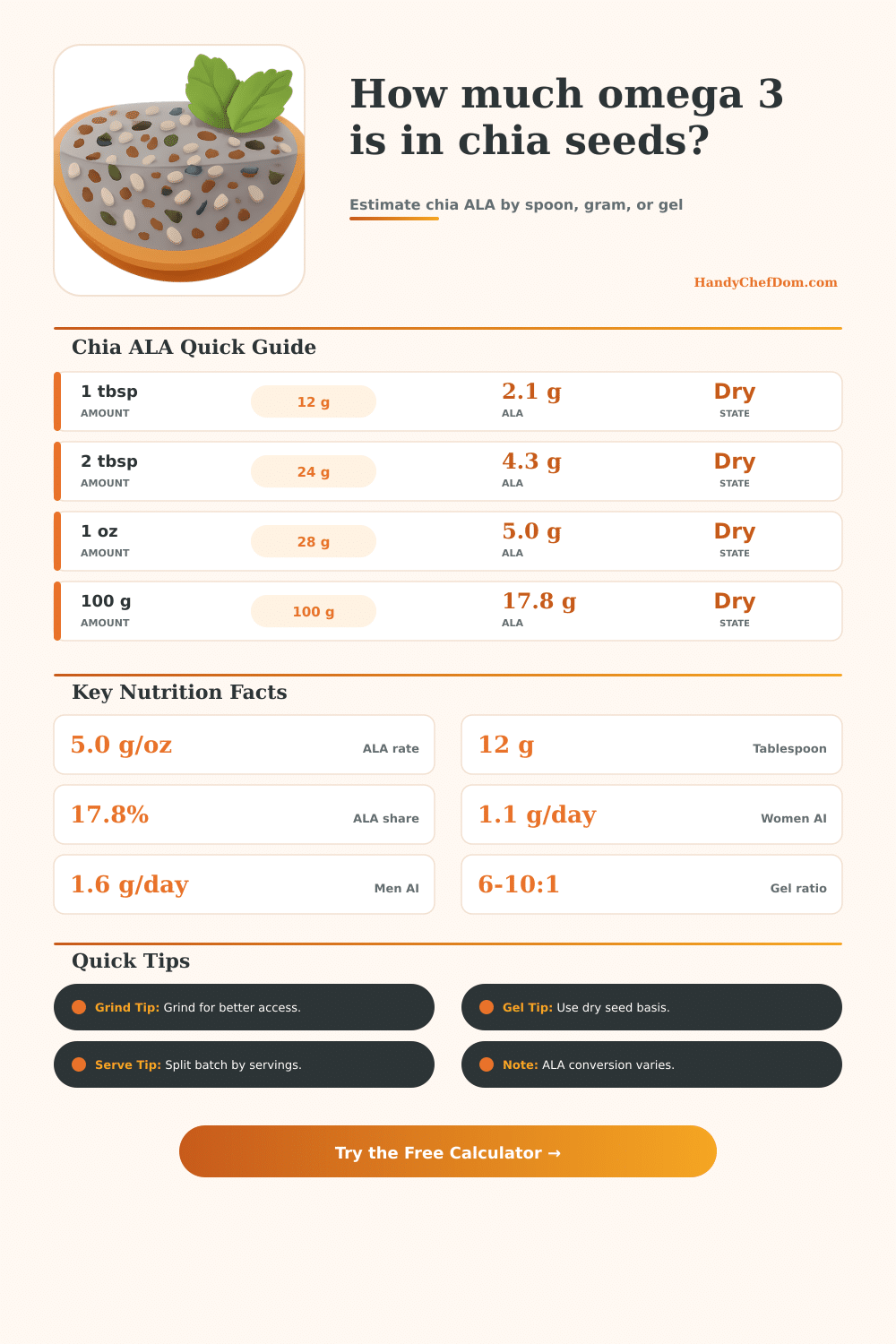
| 1 tablespoon | 12 g | 2.1 g | Common bowl add-in |
| 2 tablespoons | 24 g | 4.3 g | Standard pudding scoop |
| 1 ounce | 28.35 g | 5.1 g | Label serving size |
| 1/4 cup | 48 g | 8.6 g | Multi-serving batch |
| 100 grams | 100 g | 17.8 g | Reference basis |
| Seed Form | ALA Label | Access Factor | Best Use |
|---|---|---|---|
| Whole dry chia | Same seed ALA | 0.90 | Crunchy toppings |
| Lightly cracked | Same seed ALA | 0.96 | Mixed bowls |
| Freshly ground | Same seed ALA | 1.00 | Smoothies and oats |
| Fine milled | Same seed ALA | 1.00 | Batters and blends |
| Soaked whole gel | Dry basis ALA | 0.94 | Pudding or drinks |
| Blended gel | Dry basis ALA | 1.00 | Thick smoothies |
| Recipe Use | Use Factor | Serving Style | ALA Note |
|---|---|---|---|
| Overnight oats | 0.98 | Hydrated jar | Dry seed equivalent |
| Blended smoothie | 1.00 | Cracked by blending | Best access estimate |
| Chia pudding | 0.96 | Soaked gel | Divide by servings |
| Yogurt topping | 0.92 | Whole sprinkle | Chewing varies |
| Energy bites | 0.95 | Mixed dough | Even batch split |
| Baked muffins | 0.94 | Heated batter | Estimate only |
| ALA Target Reference | Daily ALA | Chia Needed | Calculator Use |
|---|---|---|---|
| Adult women AI | 1.1 g | 6.2 g dry | Set target to 1.1 |
| Adult men AI | 1.6 g | 9.0 g dry | Set target to 1.6 |
| Half target check | 0.8 g | 4.5 g dry | Small topping |
| Two-serving recipe | 3.2 g | 18.0 g dry | Recipe target basis |
| Four-serving batch | 6.4 g | 36.0 g dry | Meal prep basis |
| Custom goal | User value | Calculated | Enter your target |
Chia seeds contains a source of alpha-linolenic acid, which is an type of plant-based omega-3. The amount of alpha-linolenic acid that your body absorb from chia seeds can change based off the way that you prepares the chia seeds. The way that you prepare the chia seeds will determine the amounts of alpha-linolenic acid that is available for your body to use from those chia seeds.
For instance, if you eat the chia seeds in there whole form, your body may not be able to extract all of the alpha-linolenic acid from those whole seed. However, if you grind or blending the chia seeds prior to consuming them, you will be able to break down the seed coat of those chia seeds, making more alpha-linolenic acid available to your body. The calculator allow you to enter different measurements for the chia seeds.
How you prepare chia seeds changes how much omega‑3 you get
For instance, you can enter the weight of the chia seeds that you intend to consuming. Alternatively, you can enter the number of scoops of chia seeds that you plan to use, or you can enter the amount of chia seeds that you will consume when they has been soaked in water to form a chia seed gel. If you enter the amount of chia seeds that you intend to consume in the form of a chia seed gel, the calculator can convert the weight of that chia seed gel back into the weight of dry chia seeds that would have been required to create that gel.
The weight of chia seeds gel include the weight of water that has been soaked into the chia seeds, and water does not contain the alpha-linolenic acid that is contained within chia seeds. Therefore, the dry weight of the chia seeds is the measurement that represents the amount of alpha-linolenic acid that your body will consume. The way in which you eat the chia seeds can also impact the amount of alpha-linolenic acid that your body can access from those seeds.
For instance, if you blend the chia seeds prior to eating them, your body will be able to access the majority of the alpha-linolenic acid that is contained within the seeds. However, if you add the chia seeds to a salad, your body will only be able to effective absorb the alpha-linolenic acid from the portion of the chia seeds that you chew. Additionally, baking the chia seeds into baked goods like muffins will expose the seeds to heat, which may affect the alpha-linolenic acid content of the chia seeds.
The calculator account for these different preparation methods for chia seeds. Many people use chia seeds to help even their daily intake of alpha-linolenic acid. The target amount of alpha-linolenic acid for adults is between 1.1 and 1.6 gram per day.
This calculator will allow you to see whether one serving of chia seeds will meet your daily target for that nutrient, saving you the effort of having to perform the math yourself. If you prepare a large batch of a recipe that contains chia seeds, you will need to divide the total number of chia seeds by the number of serving that you would like to prepare. The figure of grams of alpha-linolenic acid per serving will allow you to compare the nutritional content of chia seeds to your daily target for that nutrient.
In addition to alpha-linolenic acid, chia seeds also contain fiber, protein, and fat. These nutrient are also displayed on the calculator alongside the amount of alpha-linolenic acid that is contained within the chia seeds. Each of these nutrients can have an impact upon how full your body feel after consuming chia seeds.
Therefore, it is helpful to be aware of the amount of each of these nutrients that is contained within chia seeds. Chia seeds contain alpha-linolenic acid, which the body can convert to EPA and DHA. However, the body does not efficienty convert alpha-linolenic acid to EPA and DHA.
The efficiency of this process may vary from individual to individual due to genetic and dietary differences. Because of the inconsistency with which individuals can perform this conversion of alpha-linolenic acid to EPA and DHA, the calculator provides estimates of the amount of alpha-linolenic acid that is contained within chia seeds. It should be noted, then, that this calculator is not providing information regarding EPA and DHA content of chia seeds.
Additionally, this calculator should not be used in place of medical advice and blood test. By utilizing this calculator, individuals can make better decision regarding their diets. For instance, you could use the calculator to compare the amount of alpha-linolenic acid from a recipe that utilized whole chia seeds to the same recipe that utilized ground chia seeds.
Additionally, you could compare the amount of alpha-linolenic acid contained within a single serving of chia seeds to the amount of alpha-linolenic acid that a large batch of chia seeds would provide if they were to be divided into several servings over a multi-day period. By determining the amount of alpha-linolenic acid that is contained within your portion of chia seeds, you can make an informed decision regarding whether you need to add more chia seeds to your diet, or whether you should change the form of chia seeds that you consume.