🫙 Canning Headspace Calculator
Plan jar fill room by food profile, method, and pack style so your batches stay consistent across pints, quarts, and larger prep runs.
Use a profile to estimate recommended headspace, fill volume, and batch yield. Manual mode lets you test a custom headspace target for planning.
| Jar Size | Nominal | Usable @ 0.5 in | Metric | Typical Use |
|---|---|---|---|---|
| Half pint | 8 oz | 7.0 oz | 236 ml | Jams, jellies |
| Pint | 16 oz | 14.5 oz | 473 ml | Fruits, salsa |
| Quart | 32 oz | 29.0 oz | 946 ml | Tomatoes, stock |
| Liter | 33.8 oz | 30.5 oz | 1000 ml | Soup, broth |
| Group Size | Fruit (pt) | Salsa (pt) | Stock (qt) | Note |
|---|---|---|---|---|
| Dinner for 4 | 4 jars | 3 jars | 2 jars | Weeknight prep |
| Family of 6 | 6 jars | 5 jars | 3 jars | Mixed pantry |
| Party of 12 | 10 jars | 8 jars | 5 jars | Shared spread |
| Gathering 25 | 18 jars | 15 jars | 10 jars | Large session |
| Event for 50 | 35 jars | 30 jars | 20 jars | Two-run day |
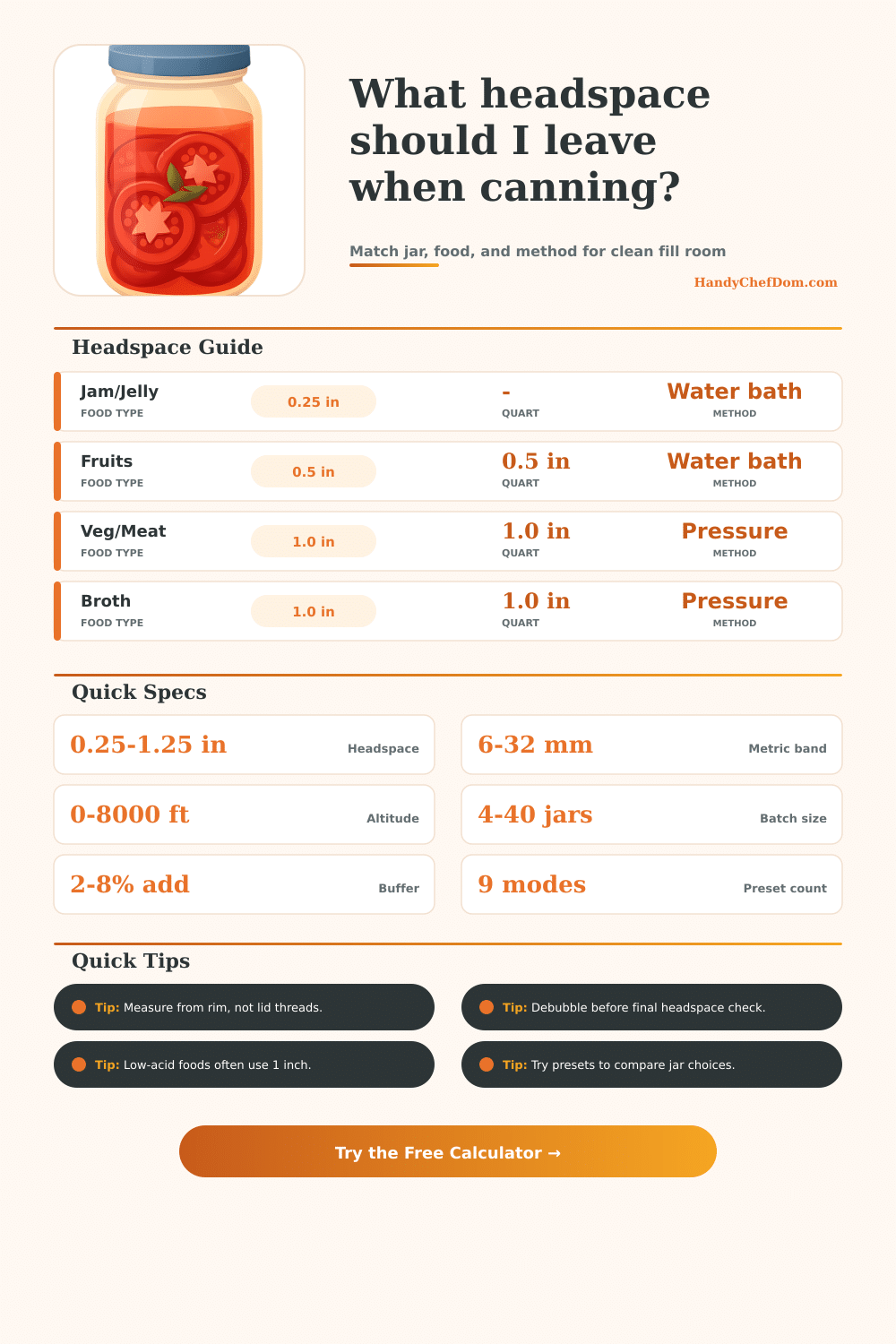
Headspace refer to the gap between the food in the jar and the lid of the jar. Headspaces is important for preserving food because the headspace will determine whether or not the jars will seal proper and whether or not the food will remain safe to eat. If there is to little headspace, the food will push against the lid, forcing some of the liquid out of the jar and preventing the lid from properly sealing the jar.
However, if there is too much headspace, the extra air in the jars will prevent the food from reaching the proper temperature to kill spoilage organisms. Thus, it is critical to measure the headspace proper to ensure that the jars will seal and that the food will remain safe for consumption. The type of food in the jars will determine the amount of headspace that is required in each jar.
How Much Headspace Do Jars Need
High acid foods, such as fruits, require less headspace because these types of foods will expand less when heated. On the other hand, low-acid foods, like vegetables and meats, will expand more in the hot environment of the jars, thus requiring more headspace when pack into the jars. The way that the food is pack into the jars will impact the amount of headspace that is needed for those jars.
For instance, hot-packed foods will require less headspace than raw-packed foods because raw-packed foods will settle in the jars during the packing process. The altitude at which the food is prepared will also play a role in the amount of headspace. At higher altitudes, the boiling point of the water will be lower, which will allow the foods to expand more in the jars.
The headspace calculator provide specific measurements of headspace for different food group, jar sizes, pack styles, and altitudes. Additionally, the calculator adjust for pack methods to account for the different amounts of air in hot-packed and raw-packed jams and sauces. Furthermore, the calculator also provides some extra headspace for jams and sauces to ensure that there is enough food to fill the last jar of sauce.
This calculator allow the canning enthusiast to determine the amount of headspace that should be allowed in each jar, the amount of food that can be pack into each jar, and the total amount of food that will be required for the batch of jams or sauces that will be prepared. When measuring the headspace, it is important to measure from the rim of the jar, not from the threads. If one measure from the threads of the jar, that measurement could introduce an error of 1/8 of an inch.
Additionally, measuring from the rim will ensure that each jar have the same amount of headspace. Consistently having the same amount of headspace in each jar will ensure that each jar contains the same amount of jam or sauce, which is essential in preserving recipe. Many canners use a ruler to measure the headspace in the jars.
The serving grid and reference table will assist the home canner in planning the use of the prepared jams and sauces. The serving grid will show the number of servings that are contained in each jar of jam or sauce. The serving grid will allow the home canner to determine the number of servings that will be obtained from preparing a batch of jams or sauces.
Additionally, the reference tables will show how many ounce of jam or sauce can be obtained from a jar of a specific size after accounting for the required headspace. A person can use these tables to determine whether they would like to make pint jar or quart jars of jams and sauces. The size of the jars of jams and sauces will impact the amount of headspace that must be allowed in each jar and the number of servings of jam that could be obtained from each jar.
Common errors include leaving the headspace at a set amount rather than adjusting the headspace for the type of jam or sauce that is to be prepared. For instance, preserving green bean in jam with half an inch of headspace will cause those jars of jam to siphon. Furthermore, another common error is to leave too much headspace in jam recipes which will lead to a more shortened shelf life of those jams.
You’ll avoid these errors by using the headspace calculator since the recommendation for headspace will be tied to the type of jam or sauce that will be prepared and the preserving method for the food. The batch size of jams and sauces will also have an impact on the results of the jam making process. The larger the batch of jams and sauces that is prepared, the more critical the importance of the small headspace buffer that is provided by the calculator.
Should the batch be too large, it is possible that there will not be enough jam to fill the last jar. The headspace calculator allow for the addition of this buffer to the total volume of jams that will be prepared since some jam recipes will require that some of the jam stick to the pot when heated and some jam will evaporate during the cooking process. By accounting for the evaporation of the jam and the portion of the jam that will stick to the pot, the headspace calculator ensure that enough jam will be prepared to fill all jar with the correct amount of headspace.
You should of checked the recipe first. It is alot of work to do it twice.