🍪 Cup of Brown Sugar Weight Calculator
Convert brown sugar cups and tablespoons into reliable grams and ounces for packed, loose, sifted, humid, or clumpy kitchen measurements.
Enter the cups and tablespoons from your recipe, then choose how the brown sugar is measured. Packed sugar weighs much more than loose or sifted sugar.
| Measuring Style | Light Brown | Dark Brown | Best Recipe Match |
|---|---|---|---|
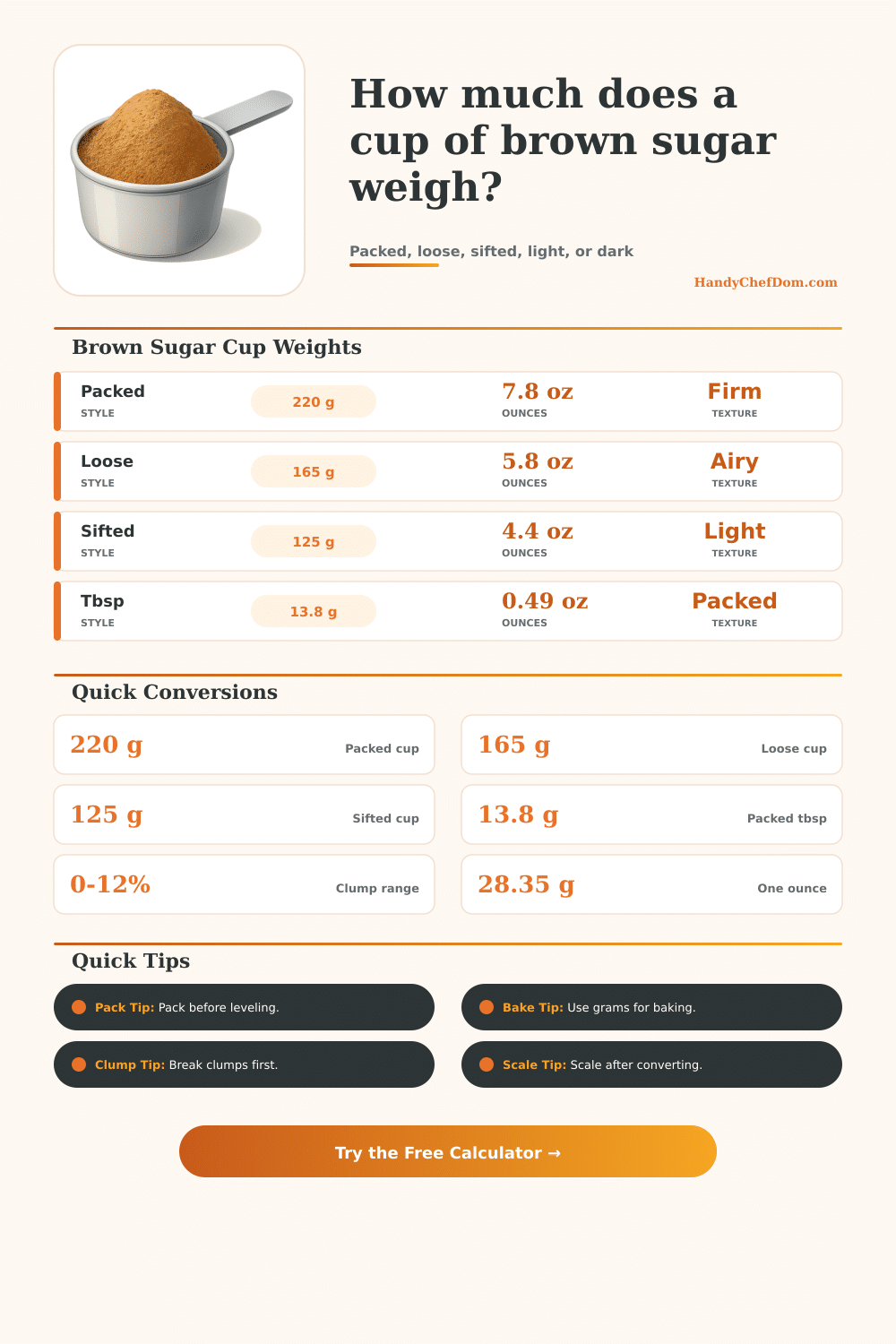
| Firmly packed cup | 220 g / 7.76 oz | 225 g / 7.94 oz | Cookies, bars, muffins |
| Lightly packed cup | 205 g / 7.23 oz | 210 g / 7.41 oz | Crumbles, quick breads |
| Spooned loose cup | 165 g / 5.82 oz | 170 g / 6.00 oz | Dry mixes, rubs, toppings |
| Sifted then spooned cup | 125 g / 4.41 oz | 128 g / 4.52 oz | Fine dusting or delicate batters |
| Clumpy scoop cup | 232 g / 8.18 oz | 238 g / 8.40 oz | Sticky pantry sugar before breaking up |
| Brown Sugar Amount | Packed Grams | Packed Ounces | Tablespoon Equivalent |
|---|---|---|---|
| 1 tablespoon | 13.8 g | 0.49 oz | 1 tbsp |
| 2 tablespoons | 27.5 g | 0.97 oz | 1/8 cup |
| 4 tablespoons | 55 g | 1.94 oz | 1/4 cup |
| 8 tablespoons | 110 g | 3.88 oz | 1/2 cup |
| 16 tablespoons | 220 g | 7.76 oz | 1 cup |
| Recipe Scale | Starting Measure | Scaled Cups | Packed Light Weight |
|---|---|---|---|
| Half batch | 1 cup | 0.50 cup | 110 g / 3.88 oz |
| Double batch | 1 cup | 2.00 cups | 440 g / 15.52 oz |
| Triple batch | 1 cup | 3.00 cups | 660 g / 23.28 oz |
| Pantry refill | 4 cups | 4.00 cups | 880 g / 31.04 oz |
| Large bake | 6 cups | 6.00 cups | 1320 g / 46.56 oz |
| Brown Sugar Type | Firm Cup | Loose Cup | Flavor Weight Note |
|---|---|---|---|
| Light brown sugar | 220 g | 165 g | Balanced molasses, standard density |
| Dark brown sugar | 225 g | 170 g | More molasses, slightly heavier |
| Golden brown sugar | 205 g | 154 g | Dryer, lighter scoop weight |
| Muscovado brown sugar | 240 g | 182 g | Moist and sticky, densest option |
| Organic brown sugar | 215 g | 160 g | Medium crystals with moderate density |
| Panela-style brown sugar | 218 g | 168 g | Irregular grains pack unevenly |
Brown sugar contains moisture from the molasses that is within the sugar. Because brown sugar contains moisture from the molasses, the crystals can clumps together or stick to the measuring cup. In addition, the weights of the brown sugar can change with the same volume of brown sugar due to the moisture content in the brown sugar.
Furthermore, the weight of the brown sugar change with the amount of pressure that you apply to the brown sugar when you pack it into the measuring cup. The more that you pack the brown sugar into the measuring cup, the more that the brown sugar will weigh. However, if you scoop the brown sugar into the measuring cup without pack it, it will weigh less.
Why Brown Sugar Weight Changes and How to Measure It
The weight of the brown sugar can have an impact on the texture of the baked goods that are made with the brown sugar. For instance, if there is too much brown sugar in the baked goods, the baked goods may feel heaviness. Additionally, if there is too many brown sugar in the cookies, they may feel dry.
The brown sugar calculator allow people to account for the different weights of brown sugar. The calculator allows individuals to enter the type of brown sugar that you will use in the baking recipe. Additionally, the calculator also allows individuals to pick the way that the brown sugar will be packed into the measuring cup.
The calculator also allows individuals to pick the humidity of the environment in which the recipe will be prepared and whether or not there will be clump in the brown sugar. After these values are entered, the calculator will provide an outcome in the amount of grams or ounces of brown sugar that will be required for the recipe. Converting the volume of brown sugar to grams or ounces with the calculator will allow the weight of the brown sugar to be consistencies when the baking recipe is prepared.
Individuals may understand that a packed cup of brown sugar will weigh more than a cup of scooped brown sugar. However, there are other factors that may play into the weight of the brown sugar in the recipe. For instance, if the environment is humid, the moisture in the air can make the brown sugar weigh more without changing the volume of the brown sugar.
However, if the environment is dry, the brown sugar will weigh less. These variables affects the weight of the brown sugar, but the calculator can account for this so that individuals dont have to memorize these variable. Furthermore, there are different variety of brown sugar.
For instance, dark brown sugar contains more molasses than light brown sugar. Thus, the dark brown sugar will weigh more than the light brown sugar. Another reason that the weight of the brown sugar could be problematic is if there are scaling issues of the brown sugar recipe.
For instance, if the recipe is to be doubled or triple, the small error in the weight of the brown sugar will be multiplied by the scale factor. Thus, small errors in the weight will have a more larger impact on the recipe. The brown sugar calculator accounts for this by using a scale factor for the weight of the brown sugar, which does not get multiply by the initial errors in the recipe.
Additionally, the weight of brown sugar may change with the number of clumps in the brown sugar. For instance, a clump in the scoop of brown sugar will weigh more than if that scoop of brown sugar did not contain a clump. Thus, the humidity setting on the calculator allows individuals to account for these clumps so that the weight of each scoop can be accounted for without having to scoop each clump of brown sugar by hand with an spoon.
Measuring brown sugar by weight can provide consistency in the recipe. For instance, different brand of brown sugar can contain different amounts of moisture. Thus, it is possible that even brown sugar from the same brand from two different bags may weigh differently.
However, if you measure the brown sugar in grams, the weight will be the same in each bag. Therefore, the weight of brown sugar should be considered a variable in the recipe, rather than a fact. Thus, if you measure the gram amount of each scoop of brown sugar, rather than estimate the scoop of brown sugar, the inconsistencies in the brown sugar will be reduced.