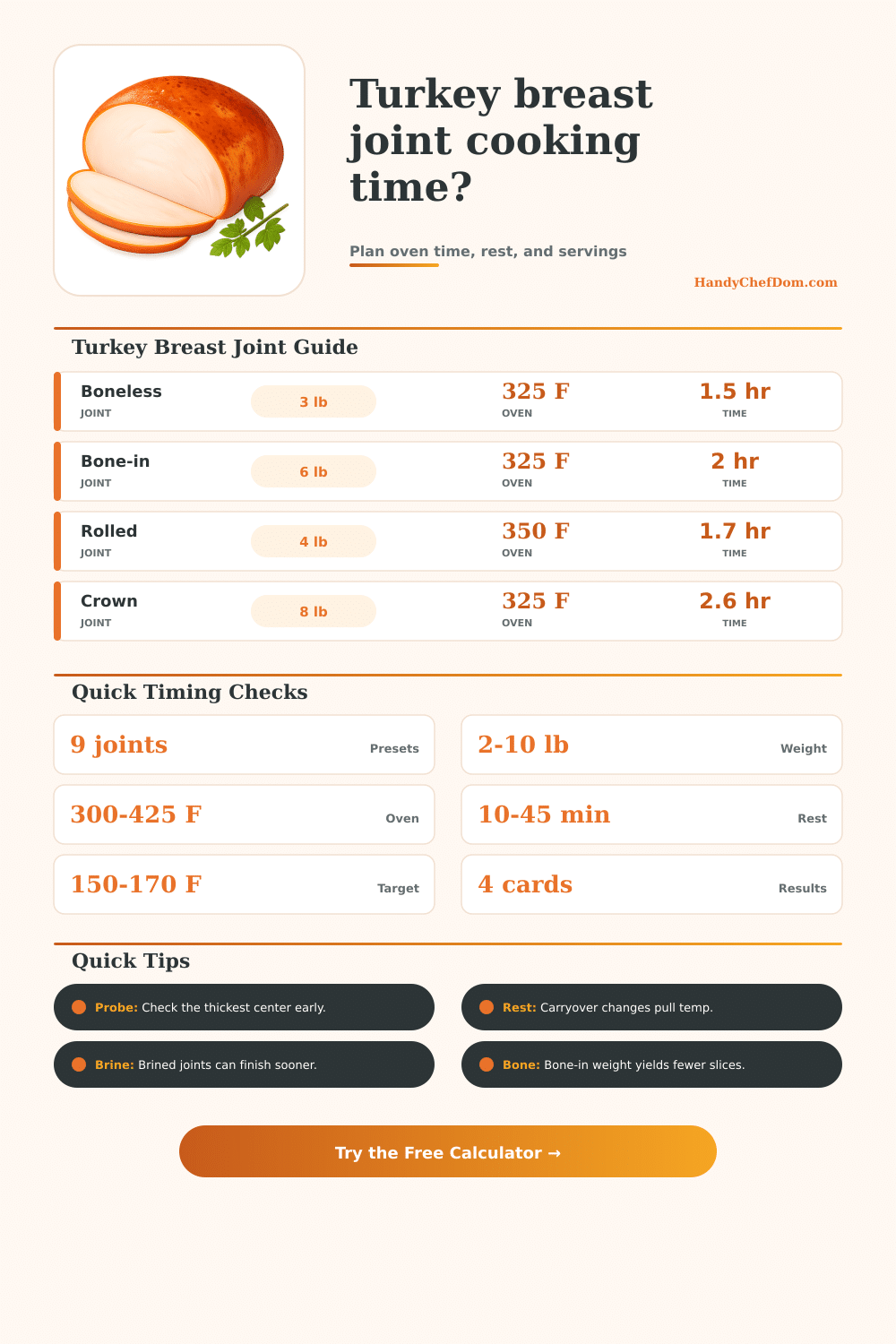
🦃 Turkey Breast Joint Cooking Time Calculator
Estimate turkey breast joint roasting time from bone-in or boneless style, weight, oven temperature, convection, brining, target internal temperature, rest time, and planned servings.
Choose a starting point, then adjust the joint style, oven, brine, target temperature, rest, and servings to match your kitchen plan.
Higher edible yield and even slices, but the center can overshoot quickly.
The bone slows the estimate and lowers edible serving weight.
Fan heat shortens timing, so start checking earlier than standard bake.
Minutes of rest can raise the final center temperature after pulling.
| Breast joint | Typical weight | 325 F estimate | First check |
|---|---|---|---|
| Boneless tied breast joint | 2.5 to 4 lb | 1 hr 10 min to 1 hr 35 min | At 60 to 75 minutes |
| Rolled boneless breast joint | 3 to 5 lb | 1 hr 25 min to 2 hr | At 70 to 95 minutes |
| Bone-in turkey breast joint | 5 to 7 lb | 1 hr 45 min to 2 hr 25 min | At 90 to 115 minutes |
| Turkey breast crown | 6 to 9 lb | 2 hr to 3 hr | At 1 hr 45 min |
| Split breast half | 2 to 3.5 lb | 1 hr to 1 hr 30 min | At 50 to 70 minutes |
| Oven setting | Timing factor | Best for | Planning note |
|---|---|---|---|
| 300 F | About 1.18x | Gentle large joints | Add more clock time and check near the end. |
| 325 F | 1.00x baseline | Most breast joints | Balanced estimate for standard roasting. |
| 350 F | About 0.90x | Boneless and rolled joints | Good for moderate browning and shorter time. |
| 375 F | About 0.82x | Small joints | Check early because lean breast changes quickly. |
| Convection fan | About 0.86x to 0.92x | Even airflow | Use a lower estimate for strong fan ovens. |
| Rest and target choice | Carryover estimate | Pull temperature example | Use case |
|---|---|---|---|
| Short 10 minute rest | 3 to 5 F | 160 F pull for 165 F final | Small boneless joints sliced soon. |
| Standard 20 minute rest | 5 to 8 F | 158 F pull for 165 F final | Most family turkey breast joints. |
| Long 30 minute rest | 7 to 10 F | 156 F pull for 165 F final | Larger bone-in joints and side-dish timing. |
| Brined breast joint | Often 1 F more | Check 5 to 10 min early | Dry, wet, or injected preparations. |
| Very cold center | Less predictable | Use normal pull temp | Add time and check more than once. |
| Serving plan | Cooked serving | Boneless raw need | Bone-in raw need |
|---|---|---|---|
| 4 light servings | 4 oz each | 1.5 to 2 lb | 2.5 to 3 lb |
| 6 standard servings | 5.5 oz each | 2.5 to 3 lb | 4 to 4.5 lb |
| 8 dinner servings | 5.5 to 6 oz each | 3.5 to 4.5 lb | 5.5 to 6.5 lb |
| 12 buffet servings | 4 oz each | 4 to 5 lb | 6.5 to 8 lb |
| 16 slice platter servings | 3.5 to 4 oz each | 5 to 6.5 lb | 8 to 10 lb |
Cooking a turkey breast joint require that you account for many different variable that will impact the total time required to cook the turkey breast joint. Many of the variables to consider include the size of the turkey breast joint, whether the turkey breast joint contain a bone, the temperature of the turkey breast joint, and the shape of the roasting pan in which the turkey is cook. If these variables isnt accounted for when roasting a turkey breast joint, the turkey may become dry or the center of the turkey may remain underdone.
The turkey breast joint calculator allow for the cooking times to be mathematically estimated based off the specific features and features of the turkey breast joint that will be cooked. Features that may influence the cooking time of the turkey include the style of the turkey cut, the weight of the turkey, the cooking temperature, whether convection is used in the roasting process, whether the turkey was brined prior to cooking, and whether the turkey was obtained from the refrigerator while raw. Each of these feature can have an impact upon cooking time, so they are required features to be entered into the calculator.
How to Find Cooking Time for a Turkey Breast
Other features that the calculator provide include a comparison of how many serving that the turkey will produce after it is roasted. Bone-in turkey breast joint will take longer to cook than boneless turkey breast joints due to the influence of the bone upon the even-cooking of the turkey. The bone will act as a heat sink that will reduce the rise in the temperature of the thickest part of the turkey, creating a margin of error within the cooking time.
Additionally, because the bone is not edible, there are fewer servings of turkey that will be produced from a bone-in turkey breast joint than from a boneless turkey breast joint of the same size and weight. Boneless turkey breast joints will cook more fast than bone-in turkey breast joints due to the lack of a bone that may act as a heat sink for the turkey. Additionally, because the center of the boneless turkey will reach high temperatures quickly during roasting, it is important to utilize the suggested time to check the turkeys internal temperature to ensure that the turkey is moist and not cook too long.
Boneless turkey breast joints are considered a feature of turkey dishes prepared in advance due to the fact that the cooked breast joints will produce more even slices of turkey. Brining the turkey joint will alter the cooking process of the turkey. Brining the turkey will add moisture to the turkey and may allow for the turkey to cook faster due to the loosening of the muscle fibers.
Both factor influence the cooking time of the turkey, so the turkey breast joint calculator can make adjustments to the cooking time based upon the brining process. Additionally, the calculator will adjust the pull temperature for the turkey due to the effect of brining upon the turkey allowing for more carryover cooking during the resting period of the turkey after cooking. The cooking temperature and the use of convection will impact the cooking process of the turkey.
Typical cooking temperatures are 325 degrees as this heat allow for the turkey to cook through without the outside of the turkey cooking too fast. However, cooking temperatures above this will reduce the cooking time for the turkey but also reduce the window of time between cooking the turkey and removing it from the oven to prevent overcooking the turkey. Convection ovens circulate the heat around the turkey, thus allowing for the turkey to cook in less time.
As such, the turkey breast joint calculator may reduce the estimated cooking time for turkeys roasted in a convection oven. The starting temperature of the turkey may also have an impact upon cooking time. If the turkey is obtained from the refrigerator, the turkey will take longer to cook to the proper internal temperature.
If the center of the turkey is very cold or if the turkey is partially frozen, cooking time will need to be increased. These different starting temperature can be entered into the turkey breast joint calculator to prepare the time necessary to check the internal temperature of the turkey. After the turkey is removed from the oven it is important to allow the turkey to rest as the internal temperature may rise to the target cooking temperature.
This process is referred to as carryover cooking. Carryover cooking is stronger in larger joint of turkey and in bone-in turkey breast joints. To account for this cooking, the target temperature for pulling the turkey from the oven should of be a few degree lower than the target cooking temperature.
The turkey breast joint calculator will provide a target pulling temperature to account for carryover cooking. Prior to cooking the turkey it is important to consider how many servings the roasted turkey will produce. Turkey that is bone-in will have fewer servings due to the impossibility of eating the bone.
Turkey that is boneless will have more servings of edible turkey. By considering this feature of the turkey breast joint calculator, cooks can determine if the roast will provide enough servings of turkey for the number of individual that will eat. Additionally, the turkey breast joint calculator allow cooks to create a plan for roasting the turkey that accounts for the time necessary to check the turkeys internal temperature and how many serving the turkey joint will produce when roasted.