🥜 Salt to Boil Peanuts Calculator
Build a brine for green or raw peanuts by peanut weight, water volume, salt type, target salt percent, boil time, soak time, and seasoning add-in.
Enter the raw peanut weight and water covering the pot. The calculator treats brine percent as salt weight divided by water weight, then converts grams into the selected salt's spoon and cup measures.
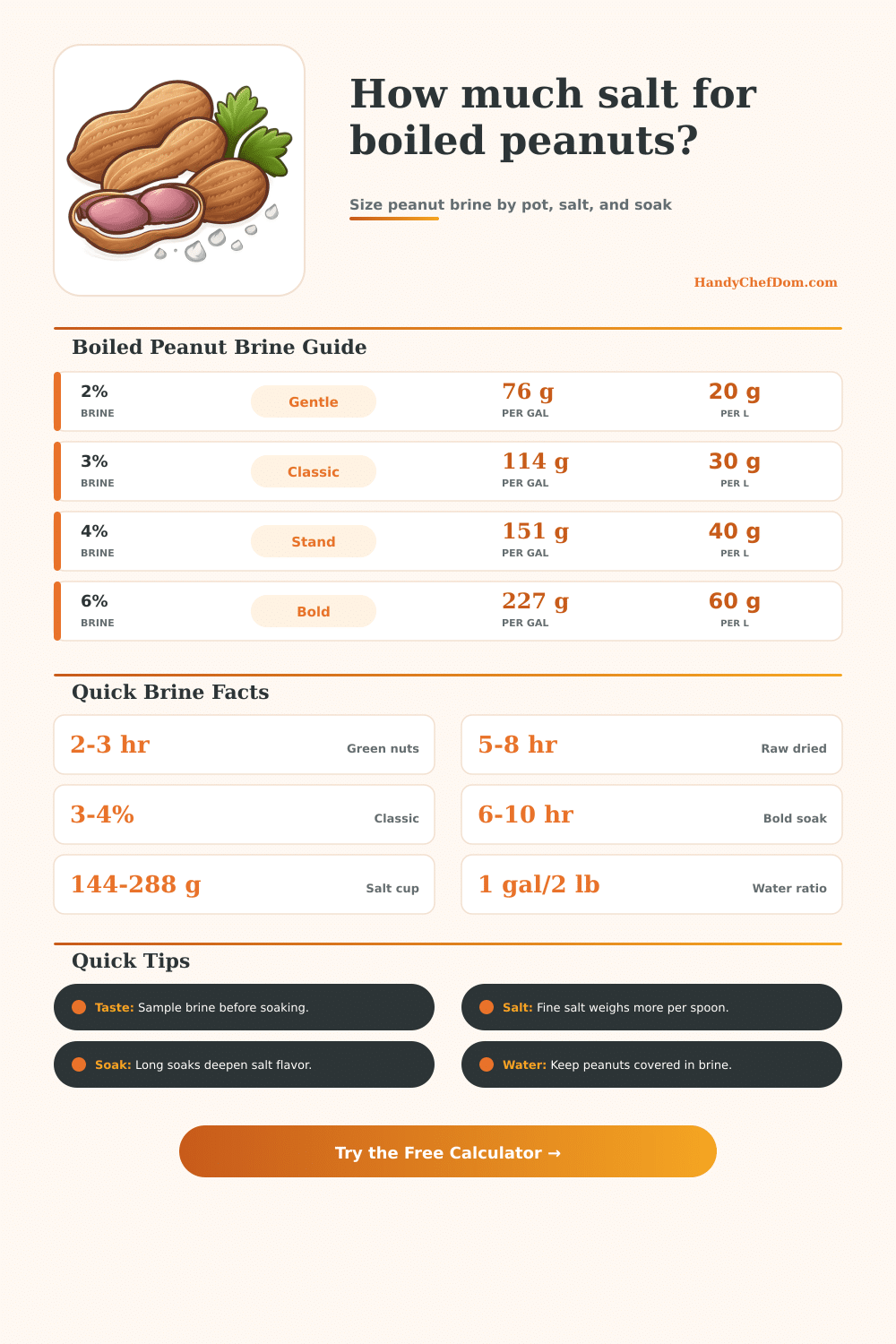
| Brine Target | Flavor Level | Salt Per Gallon | Salt Per Liter |
|---|---|---|---|
| 2% | Gentle porch snack | 76 g | 20 g |
| 3% | Classic peanut stand | 114 g | 30 g |
| 4% | Salty roadside pot | 151 g | 40 g |
| 5% | Bold game day batch | 189 g | 50 g |
| 6% | Deep soak festival pot | 227 g | 60 g |
| 8% | Very salty snack bowl | 303 g | 80 g |
| Salt Type | Approx g/Tbsp | Approx g/Cup | Measure Note |
|---|---|---|---|
| Kosher flake salt | 9 g | 144 g | Large airy flakes need more volume |
| Coarse kosher salt | 15 g | 240 g | Good all-purpose peanut brine |
| Fine table salt | 18 g | 288 g | Dense crystals make spoons saltier |
| Fine sea salt | 17 g | 272 g | Close to table salt by volume |
| Pickling or canning salt | 18 g | 288 g | Dissolves cleanly in brine |
| Coarse sea salt | 13 g | 208 g | Measure a little fuller than fine salt |
| Smoked finishing salt | 12 g | 192 g | Use when smoke flavor is part of the batch |
| Peanut Load | Minimum Water | Comfortable Pot Water | Brine Note |
|---|---|---|---|
| 2 lb raw peanuts | 1 gal | 1.25 gal | Small stovetop pot |
| 5 lb raw peanuts | 2.25 gal | 2.5 to 3 gal | Family porch batch |
| 10 lb raw peanuts | 4.5 gal | 5 to 6 gal | Market bag kettle |
| 15 lb raw peanuts | 7 gal | 8 to 9 gal | Cooler or stockpot batch |
| 25 lb raw peanuts | 12 gal | 13 to 15 gal | Festival size pot |
| 40 lb raw peanuts | 19 gal | 21 to 24 gal | Large outdoor kettle |
| Peanut Style | Typical Boil | Typical Soak | Texture Cue |
|---|---|---|---|
| Fresh green peanuts | 2 to 3 hr | 1 to 4 hr | Tender shell, creamy nut |
| Raw dried small peanuts | 4 to 6 hr | 4 to 8 hr | Soft center after resting |
| Raw dried jumbo peanuts | 6 to 8 hr | 6 to 12 hr | Longer soak for salt pickup |
| Mixed market-size peanuts | 4 to 7 hr | 4 to 10 hr | Check several shell sizes |
| Split-shell snack peanuts | 2 to 4 hr | 1 to 3 hr | Salt enters quickly |
| Extra jumbo long-soak peanuts | 7 to 10 hr | 8 to 16 hr | Best with patient soaking |
To cook boiled peanuts corectly, you must understand the two functions of salts. Salt season the peanuts and opens the shells and softens the kernels within the shells. Using too little salt will make the boiled peanuts taste flat regardless how long you cook them.
Using too much salt will give the peanuts a harsh, one-note flavor that most people will find difficulty to eat. Because there is an narrow window for the salt level, many people under-season or over-season the peanuts without knowing why they taste bad. Next, understanding the importance of the volume of water to be used in preparing the peanuts.
How to use salt, water and time for boiled peanuts
The water must cover the peanuts while boiling. Water will evaporate throughout the boiling process. Therefore, you must use enough water to account for the evaporation.
Green peanuts will release their moisture into the water while boiling, but raw dried peanuts will absorb the water in the water. Therefore, you must adjust the water and salt levels based off whether you are using green or raw dried peanuts. The type of salt you use will also change the outcome of the salt level in the boiled peanuts.
Different types of salt has different densities. For instance, a tablespoon of fine table salt contains more sodium than a tablespoon of large kosher salt flakes. Therefore, if you change the type of salt, the salt level will change.
You can adjust for this by weighing the salt or knowing the density of the salt you are planning to use. Another important step is the soak time of the peanuts after the boiling process. Although the heat from boiling water moves the salt into the peanuts, the peanuts will continue to develop their flavor while resting in the salt water.
If you use a short soak time, the kernels will not be as flavorful as the shells suggests. A long soak time allows the salt to fully move into the kernels of the peanuts and is more suitable for larger or drier peanuts. You can adjust for this by tasting the peanuts at various time intervals rather than just using a clock to time the process.
The type of seasoning you use will alter the salt level of the boiled peanuts. Most seasoning blends contain herbs and peppers that contains salt. To account for this, you will have to use less salt when using a seasoning blend rather than using salt water.
The salt calculator will do the math for you once you have entered the weight of the peanuts, the volume of the water, the type of salt to be used, and the type of seasoning to be used. This will tell you how much salt and how long the peanuts will be in contact with the salt water. Common mistakes will occur when preparing boiled peanuts if you treat the recipe like a formula instead of a series of variables.
For example, using the same percentage of salt for raw dried peanuts as you will for green peanuts is one mistake. Another example is forgetting to use enough water to cover the peanuts. These types of mistakes will change the flavor of the peanuts more than people would imagine.
The salt calculator will help you to avoid these common mistakes as it will show you the relationship between salt, water, and peanuts prior to beginning to cook the peanuts. The two tables on the webpage will allow you to choose the flavor of peanuts you would like your boiled peanuts to have. The tables will show you the percentage of salt in the boiling water and the description of the flavor of the peanuts.
There are also tables that show the different boil and soak times for the different types of peanuts. Using these tables will help you to avoid under boiling large peanuts or over softening small green peanuts. These tables will allow you to understand the different types of flavors and how much salt is needed for each type of peanut.
With the salt calculator used several times, you will have an understanding of the correct percentages of salt and soak time for the different types of peanuts. For example, you will understand that a 4 percent salt level for a four-hour soak time is suitable for standard peanuts, but if you are using a larger percentage of salt, say 6 percent, the soak time may need to be shorter so that the peanuts are not too salty. These numbers will allow you to describe to others the flavor of the peanuts you would like them to have.
Once you can prepare the peanuts to your desired salt level, you can prepare batches of peanuts for others or for yourself.