🍷 Sugar in White Wine Calculator
Estimate residual sugar grams in white wine by style, bottle count, pour size, dilution, servings, and your own daily sugar target.
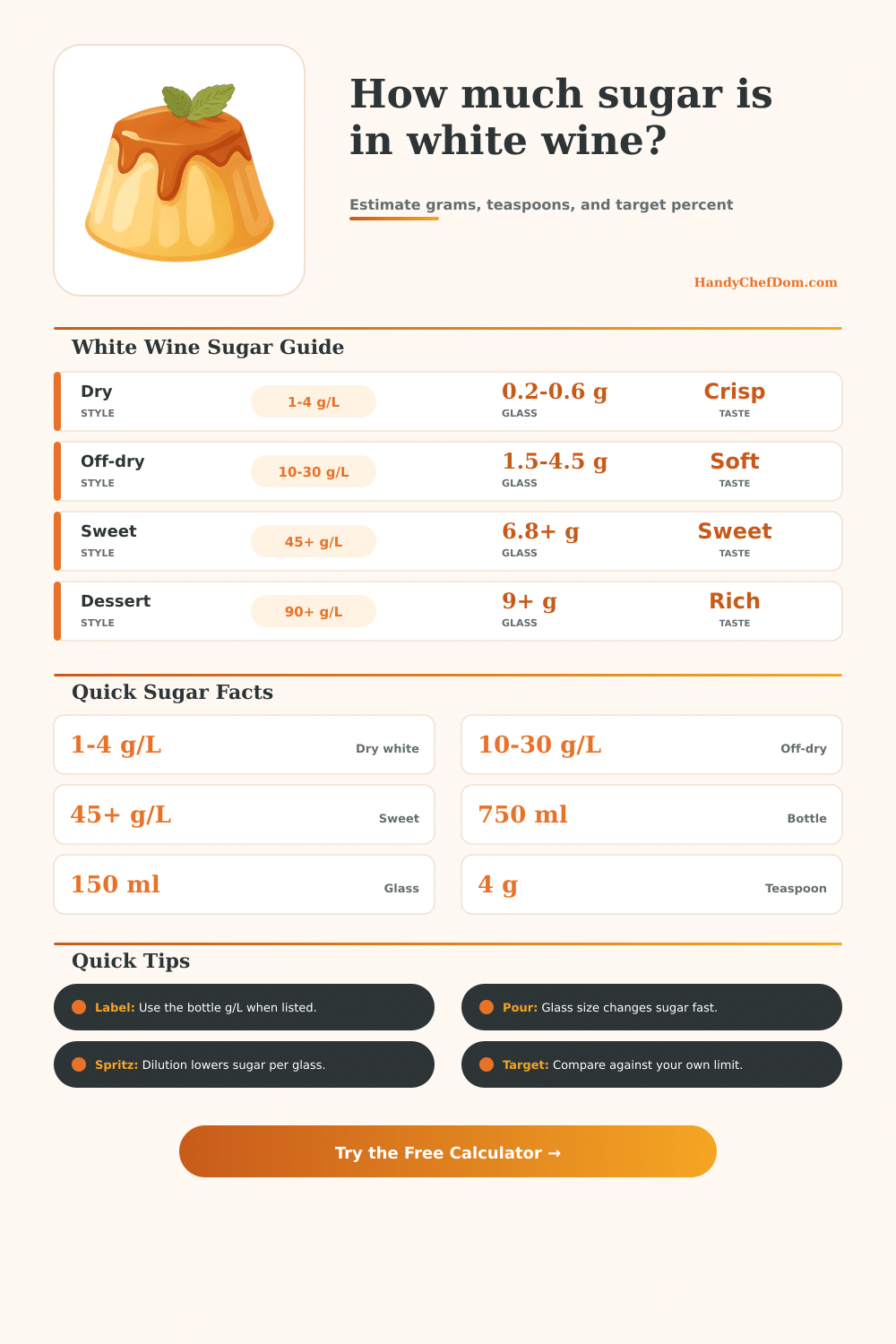
Dry white wines are often around 1-4 g/L residual sugar, off-dry whites are often 10-30 g/L, and sweet white wines can start around 45 g/L or more. Enter a label value when you have one.
| White Wine Style | Typical Residual Sugar | 150 ml Glass Sugar | Calculator Use |
|---|---|---|---|
| Very dry white | About 1 g/L | About 0.2 g | Lean, crisp whites with barely noticeable sweetness. |
| Dry white | About 3 g/L, often 1-4 g/L | About 0.5 g | Common default for dry sauvignon blanc, pinot grigio, and many chardonnays. |
| Off-dry white | About 20 g/L, often 10-30 g/L | About 3.0 g | Useful for riesling, chenin blanc, and whites with light sweetness. |
| Medium-sweet white | About 45 g/L | About 6.8 g | Bridge style between off-dry table wine and sweet wine. |
| Sweet white | About 70 g/L or more | About 10.5 g | Good estimate for moscato-like sweetness when the label is unknown. |
| Dessert white wine | About 120 g/L or more | About 9.0 g in 75 ml | Use smaller pour sizes for dessert wines and late-harvest bottles. |
| Pour Size | Milliliters | Dry White at 3 g/L | Off-Dry at 20 g/L |
|---|---|---|---|
| Tasting pour | 60 ml | 0.2 g sugar | 1.2 g sugar |
| Dessert wine pour | 75 ml | 0.2 g sugar | 1.5 g sugar |
| Small glass | 125 ml | 0.4 g sugar | 2.5 g sugar |
| Standard glass | 150 ml | 0.5 g sugar | 3.0 g sugar |
| Large restaurant pour | 175 ml | 0.5 g sugar | 3.5 g sugar |
| Generous home pour | 250 ml | 0.8 g sugar | 5.0 g sugar |
| Sugar Range | Residual Sugar g/L | 750 ml Bottle Sugar | Best Calculator Choice |
|---|---|---|---|
| Bone-dry | 0-1 g/L | 0-0.8 g | Very dry white or custom override. |
| Dry | 1-4 g/L | 0.8-3.0 g | Dry white style default. |
| Barely off-dry | 5-12 g/L | 3.8-9.0 g | Use override for a label-listed number. |
| Off-dry | 10-30 g/L | 7.5-22.5 g | Off-dry white style default. |
| Sweet | 45-90 g/L | 33.8-67.5 g | Medium-sweet or sweet white. |
| Dessert | 90-180+ g/L | 67.5-135+ g | Dessert white with smaller pours. |
| Beverage Comparison | Typical Serving | Approx Sugar | How It Compares |
|---|---|---|---|
| Dry white wine | 150 ml | 0.2-0.6 g | Usually very low residual sugar per glass. |
| Off-dry white wine | 150 ml | 1.5-4.5 g | Noticeably sweeter but still portion dependent. |
| Sweet white wine | 150 ml | 6.8 g or more | Can exceed one teaspoon per standard glass. |
| Dessert white wine | 75 ml | 6.8-13.5 g | Small pours still carry concentrated sugar. |
| Orange juice | 240 ml | About 21 g | Naturally much higher sugar by serving. |
| Regular soda | 355 ml | About 39 g | Often far above wine on a per-serving basis. |
White wines contains residual sugar. The residual sugar in the wine is the sweetness that are left behind in the wine once the fermentation process is complete. The residual sugar in white wine can affects the taste of the wine.
Additionally, the residual sugar content can also affect the amount of sugar that you consumes from the wine that you drink. Sauvignon blanc wines contains very little residual sugar, while wines like riesling contains alot of residual sugar. Most bottles of white wine does not contain the grams of residual sugar that the wine contains.
How Much Sugar Is in White Wine
Calculators can help you to determine the exact amount of residual sugar in the bottle of white wine that you drink by inputting the style of the wine and the volumes of the wine that you are drinking. The volume of the white wine that you pour can affect the amount of residual sugar that you consume from the wine. If you pour a large volume of white wine into your glass, then you will consume more residual sugar than if you poured a small volume of white wine.
For instance, if you pour a large volume of white wine into a glass at home, then the large volume of white wine will contain more residual sugar than the standard volume of white wine that are featured on many charts. Using a calculator allows you to separate the total amount of residual sugar that is in a bottle of white wine from the amount of residual sugar in a single serving of the wine. The total amount of residual sugar in a bottle will remain the same, no matter how many serving of the white wine that bottle contains.
Adding another liquid to the white wine, such as sparkling water, will not change the total amount of residual sugar in the bottle. However, diluting the wine will reduces the amount of residual sugar per sip that you drink. For example, if you mix sparkling water with your white wine to make a spritz, you are adding more volume to the liquid that you are drinking.
This additional volume will allow the residual sugar in the wine to be more spread out in the liquid that you drink. People often do not remember that adding water to wine does not remove the residual sugar from the wine. Thus, people often do not drink a spritz if they are trying to limit the amount of residual sugar that they consumes from the wine that they drink.
Consider your daily sugar target when drinking white wine. If you have a daily target for the grams of sugar that you consume, then you must keep track of the grams of residual sugar from the white wine that you drink to ensure that you are not exceeding your daily target for sugar consumption. Dry wines often contain less residual sugar than sweeter wines.
Thus, dry white wines are less likely to cause you to exceed your daily sugar target than sweet wines. If you drink sweet wines, however, you are more likely to exceed your daily target. The calculator will allow you to compare the grams of residual sugar in the wine to the grams of sugar in your daily target.
This percentage will allow you to understand the portion of your sugar target that the white wine represents. When calculating the grams of residual sugar in your wine, you might make some errors. For instance, you might not remember whether the wine is dry or whether it contains a significant amount of residual sugar.
Additionally, you might not remember the proper volume of wine to drink. If you use a calculator to account for the type and volume of wine that you drink, you can avoid these error. Using the calculator will ensure that your understanding of the amount of residual sugar in the wine matches the actual amount of that sugar in your glass.