🍞 Sourdough Starter Hydration Calculator
Convert a starter from stiff to liquid, liquid to stiff, or build a levain target after discard by calculating the exact flour and water additions from the starter you already have.
For whole-starter conversion, the calculator finds the minimum flour or water addition. For levain and jar refresh plans, it first keeps your seed amount, discards the remainder, then builds to the target weight and hydration.
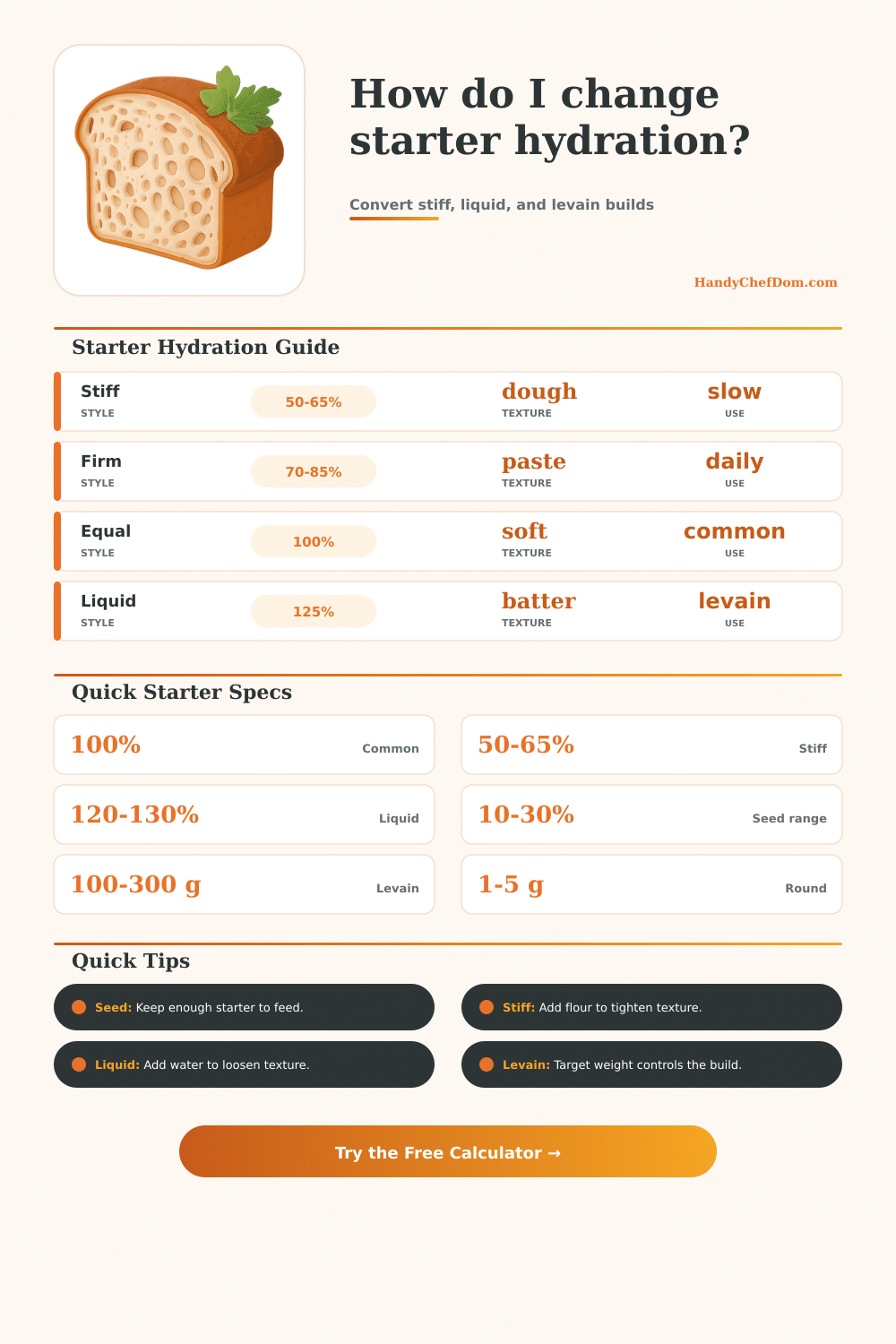
A kneadable starter ball with very firm gluten and slow fermentation.
Dough-like starter that holds its shape and usually needs extra flour.
Spreadable but not pourable, useful for moderate-acid levain builds.
Equal flour and water by weight, the most common home starter format.
Soft and spoonable, with a faster peak than a stiff starter.
Pourable levain style where water addition usually does the work.
Rye absorbs water heavily, so high hydration can still look pasty.
Batter-like starter that ferments quickly and separates more easily.
| Change | What to add | Example from 100 g starter | Texture cue | Planning note |
|---|---|---|---|---|
| 100% to 60% | Flour only | Add about 33 g flour | Stiff dough | Water stays fixed while flour rises |
| 60% to 100% | Water only | Add about 25 g water | Soft paste | Flour stays fixed while water rises |
| 100% to 125% | Water only | Add about 13 g water | Liquid levain | Useful for wetter preferments |
| 125% to 80% | Flour only | Add about 31 g flour | Firm paste | Lower hydration needs more flour |
| 50% to 65% | Water only | Add about 10 g water | Stiff but softer | Common pasta madre adjustment |
| Levain target | Target hydration | Typical seed | Approx flour add | Approx water add |
|---|---|---|---|---|
| 100 g levain | 100% | 20 g at 100% | 40 g | 40 g |
| 150 g levain | 80% | 30 g at 100% | 53 g | 37 g |
| 200 g levain | 100% | 40 g at 100% | 80 g | 80 g |
| 250 g levain | 125% | 50 g at 100% | 86 g | 114 g |
| 1000 g levain | 100% | 150 g at 100% | 425 g | 425 g |
| Current jar | Seed kept | Discard removed | Best target | Seed share |
|---|---|---|---|---|
| 80 g starter | 20 g | 60 g | 100 to 150 g | 13 to 20% |
| 120 g starter | 30 g | 90 g | 150 to 250 g | 12 to 20% |
| 200 g starter | 40 g | 160 g | 200 to 300 g | 13 to 20% |
| 500 g starter | 100 g | 400 g | 600 to 1000 g | 10 to 17% |
| 1000 g starter | 150 g | 850 g | 1000 g plus | 15% or less |
| Starter style | Hydration band | Flour behavior | Conversion direction | Calculator cue |
|---|---|---|---|---|
| Pasta madre | 45 to 50% | Strong and tight | Usually add flour | Use stiff preset and low target |
| Stiff wheat starter | 50 to 65% | Holds a dough shape | Add water to loosen | Target 65% to 85% for firm paste |
| Standard wheat starter | 90 to 105% | Balanced jar texture | Add flour or water | Good baseline for most builds |
| Liquid levain | 120 to 130% | Pourable and fast | Add flour to tighten | Watch seed amount in target mode |
| Rye starter | 110 to 150% | Absorbs water and stays pasty | Often needs more water | Texture may look firmer than the number |
Hydration is a measurement of sourdough starter. The ratio of water weight to flour weight in a sourdough starter are called hydration. The ratio is expressed as an percentage of the flour weight.
For instance, a sourdough starter with 100 percent hydration has equal parts of flour and water by weight. A sourdough starter with 60 percent hydration contains less water than flour; therefore, it is stiff and able to hold it shape. A sourdough starter with 125 percent hydration has more water then flour; hence, it is liquid and pours from one container to next.
Sourdough Starter Hydration Calculator
The hydration percentage of sourdough starters affect the behavior of the starter, the rate of rise of the starter, and the flavor of the resulting bread. The calculator in the article is meant to help sourdough starter bakers calculate the changes in hydration of their starters without having to do the math by hand. By using the calculator, the baker only has to input the amount of starter they have and the amount they would like to have.
The baker can calculate the amount of starter they will discard using the form as well. By using this calculator, you eliminate the need to calculate hydration by hand. Stiff starters with low amount of hydration tend to ferment slowly because of the less water that is present in the starter.
The slow fermentation result in the production of less acids from the starter. However, stiff starters are more challenging to incorporate into dough. Additionally, stiff starters may need feeding more frequently if the environment where the starter is being kept is warm.
In contrast, liquid starters with high hydration ferment quickly because of the high amount of water in the starter. The quick fermentation of the starter means that the starter will reach its peak earlier and produce a bright tang flavor in the sourdough bread. Bakers may want to keep both stiff and liquid starters to cater to the various recipes they may cook and the different weather condition in there area.
The baker can change the hydration of a sourdough starter by adding more flour to the starter or adding more water to the starter. To reduce the hydration level of a sourdough starter, the baker should keep the current amount of water in the starter and add flour until the desired hydration level is reached. In contrast, to increase the hydration level of a sourdough starter, the baker will keep the amount of flour and add the amount of water need for the starter to reach the desired hydration level.
The calculator will help them do these calculations, as it accounts for the small amount of starter that will remain stuck to the bowl after pouring the starter into the container. This small amount of starter is called the loss buffer. The loss buffer is intentionaly small to ensure that there is no shortage of the amount of sourdough starter that is will be used.
Finally, the amount of seed starter that is used in the creation of a new sourdough starter is another factor that can impact the sourdough starter’s fermentation process. Using too much of the old sourdough starter as the seed for a new sourdough starter will create a sourdough starter that is too strong. A sourdough starter that is too strong will ferment quickly and produce acids at a faster rate.
If you use too little old starter in your new build, your levain will be underpowered… Especially if your kitchen is cool. The calculator includes a field for you to enter the number of grams of old starter that you will use as a seed; this displays the percentage of the total weight of the levain that will come from your old starter.
You can adjust both the target weight and the seed weight until the percentage of the levain that come from your old starter is the percentage that you want to use for your levain. The type of flour that you use affect how the levain feels to you when it is made. Whole grain flour and rye flour absorb more water than white flour.
As a result, a levain made with whole grain flour will feel stiffer than a levain made with white flour at the same percentage of hydration. Rye starter will tend to appear more like a paste then a liquid even at a percentage of hydration of 125%. The calculator allows you to select the type of flour that you use to make your levain; this feature allows the tool to provide you with recommendations for the texture of your levain.
The calculator does not change the mathematical calculations that the tool performs, but the calculator helps you to understand the texture that you may achieve with your levain. The levain calculator can be used in two different modes: levain mode and refresh mode. In levain mode, you enter the amount of starter that you will use as a seed.
The remainder of the starter will be discarded. The levain will be built to a specific target weight. This mode can be used only for one recipe, though.
In refresh mode, you enter the amount of starter that will be used as a seed. The remainder of the starter will be discarded. However, the baker will use the levain that is built in this mode as your starter for future recipe.
In both modes, the levain will contain the same amounts of flour and water, but each mode has a different goal for the levain. The levain calculator includes a grid that allows you to determine the texture of levains with different percentages of hydration. For instance, a levain with 50% hydration will be a stiff ball that can be easily knead.
A levain with 80% hydration will be a thick mixture that can be easily spread out but will not pour from the spoon. A levain with 125% hydration will be a liquid that will flow off of the spoon. The grid on this page features these different textures, allowing you to select the texture for your levain and relate that texture to a percentage of hydration.
Given your chosen texture, the levain calculator can tell you how to create a levain with that texture from your current starter. The age of your starter and the temperature of your kitchen will impact the rate at which your levain ferments. Additionally, the amount of oxygen in the levain will depend upon the amount with which you stir it.
These factors are not accounted for in the mathematical calculations of the levain calculator. However, these factors will impact the time at which your levain reaches its peak strength. The levain calculator provides you with a starting point for the mathematical calculations for your levain, but you must rely upon your own experience in managing your levain to determine when to feed it, stir it, or to take it out of your kitchen.
When you have mastered the levain calculator and have experience making different types of bread, you will likely find a range of percentages of hydration that you prefer for your levains. For instance, if you bake country style loaves, you may prefer to maintain a 100% levain. You may use an 80% levain for your levain.
Another baker may prefer to maintain 125% levain but take a portion of that levain and make it stiffer for recipes that require that type of texture. The levain calculator allows for all of these types of baking habit. The levain calculator does not require you to memorize the hydration percentages for different types of recipes.
Additionally, the levain calculator allows you to slow down your levain by adding flour to it or speed up your levain by adding water to it.