🥩 Breadcrumbs For Meatloaf Calculator
Calculate crumb cups, crumb grams, panade liquid, slice yield, and binder percent for sliceable meatloaf using meat weight, pan size, blend, eggs, moisture, firmness, glaze, and batch multiplier.
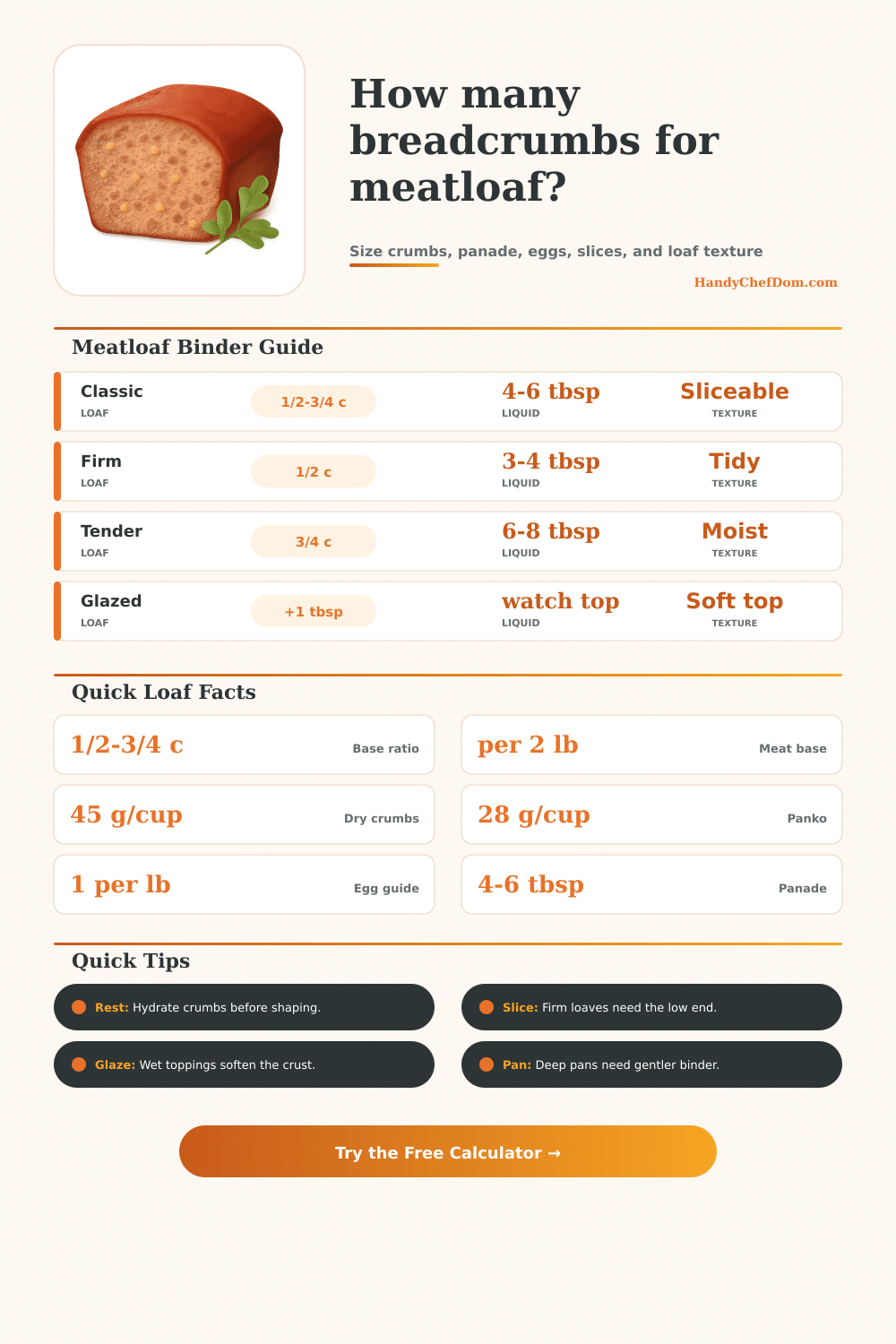
A dependable meatloaf starts at 1/2 to 3/4 cup breadcrumbs per 2 pounds of ground meat. This calculator treats milk, ketchup, and Worcestershire as panade moisture, then adjusts for pan size, firmness, meat blend, glaze moisture, and batch scale.
| Meatloaf Binder Style | Breadcrumbs Per 2 lb | Panade Liquid | Best Loaf Texture |
|---|---|---|---|
| Dry seasoned breadcrumbs | 1/2 to 3/4 cup | 4 to 6 tbsp | Classic sliceable dinner loaf with balanced structure. |
| Fine dry breadcrumbs | 1/2 to 2/3 cup | 4 to 5 tbsp | Firm loaf because fine crumbs absorb quickly and pack tightly. |
| Panko crumbs | 2/3 to 7/8 cup | 5 to 7 tbsp | Lighter crumb with more volume but less weight per cup. |
| Fresh bread crumbs | 1 to 1 1/4 cups | 5 to 8 tbsp | Soft homestyle texture when loaf is gently mixed. |
| Milk-soaked panade | 2/3 to 3/4 cup | 6 to 8 tbsp | Moist, tender loaf that still slices after resting. |
| Oat crumb blend | 2/3 to 3/4 cup | 5 to 7 tbsp | Hearty slices with a slightly firmer bite. |
| Gluten-free dry crumbs | 1/2 to 3/4 cup | 5 to 7 tbsp | Needs resting time so binder hydrates evenly. |
| Pan Size | Usual Meat Range | Slice Pattern | Binder Adjustment |
|---|---|---|---|
| 8 x 4 inch loaf pan | 1.25 to 1.75 lb | 6 to 8 slices | Slightly less crumb because the loaf is compact. |
| 9 x 5 inch loaf pan | 2 to 2.5 lb | 8 to 10 slices | Baseline shape for the calculator ratio. |
| 10 x 5 inch loaf pan | 2.5 to 3.5 lb | 10 to 12 slices | Add a little binder for a longer loaf. |
| Deep narrow loaf pan | 2 to 3 lb | 8 to 10 tall slices | Use balanced binder so the center stays tender. |
| Freeform sheet-pan loaf | 1.5 to 3 lb | 8 to 12 slices | Add crumb for structure because there is no pan wall. |
| Mini loaf pans | 0.5 to 1 lb each | 3 to 5 slices each | Lower binder slightly because smaller loaves set faster. |
| Crumb Type | Approx g Per Cup | Absorption | Calculator Handling |
|---|---|---|---|
| Seasoned dry breadcrumbs | 45 g | Medium | Baseline for classic meatloaf binder calculations. |
| Fine dry breadcrumbs | 50 g | High | Uses slightly fewer cups but similar binder weight. |
| Panko crumbs | 28 g | Low to medium | Shows more cups and lighter total grams. |
| Fresh bread crumbs | 60 g | Medium | Uses more volume for a soft loaf texture. |
| Oat crumb blend | 80 g | High | More weight and chew, so the calculator moderates cups. |
| Gluten-free dry crumbs | 55 g | Variable | Allows extra panade moisture and short rest time. |
| Texture Goal | Crumb Direction | Liquid Direction | Meatloaf Note |
|---|---|---|---|
| Firm sandwich slices | Use low end | Reduce slightly | Best when slices need to hold for leftovers or sandwiches. |
| Balanced dinner slices | Middle of range | Standard panade | Good all-purpose loaf that slices cleanly after resting. |
| Tender moist slices | Upper middle | Add liquid | Useful for lean beef, turkey, or a wider loaf pan. |
| Soft homestyle loaf | High end | Highest panade | Most tender, but rest before slicing so it holds together. |
| Heavy wet glaze | Add small buffer | Do not overfill panade | Wet topping softens the upper crust during cooking. |
Breadcrumbs serve as a binder for meatloaf recipes. The breadcrumbs will absorb the moisture that the meat will release as it cooks. The meat will release moisture as it cooks while the breadcrumbs will absorb this liquid to help the meatloaf retain it’s structure.
Using too few breadcrumbs will cause the meatloaf to fall apart due to insufficient binding properties. Using too many breadcrumb will result in a dense meatloaf as the breadcrumbs have absorbed too much moisture from the meat. The amount of breadcrumbs you need can depend on the type of meat that you use in your meatloaf recipe, the type of pan you use to cook the meatloaf, and the texture of the meatloaf that you would like to create.
How to Use Breadcrumbs in Meatloaf
The amount of liquid that you add to the breadcrumbs will impact the function that the breadcrumbs will have within the meatloaf. Adding milk to the breadcrumbs will allow the breadcrumbs to soften and distribute even throughout the meatloaf. Using ketchup and Worcestershire sauce will add acidity and sweetness to the meatloaf.
These liquids should be mixed with the breadcrumbs prior to add the meat to the mixture with the breadcrumbs. Mixing the liquids with the breadcrumbs first will allow the breadcrumbs to properly hydrate. Properly hydrating the breadcrumbs will prevent the breadcrumbs from extracting moisture from the meat during the cooking process of the meatloaf.
Properly hydrating the breadcrumbs will create a meatloaf that do not have dry streaks throughout the center of the meatloaf. Properly hydrating the breadcrumbs will allow the meatloaf to retain its structure during the cooking process. The size of the pan that you use to cook the meatloaf will impact the cooking of the meatloaf.
Using a standard loaf pan will allow the meatloaf to develop structural support from the sides of the pan. Using these pans, you can use a medium amount of breadcrumbs in the meatloaf. If you use a sheet pan to cook your freeform loaf of meatloaf, the lack of support for the meatloaf will require the use of more breadcrumbs in the meatloaf recipe to assist in the retention of structure of the meatloaf.
Using smaller pans will cook the meatloaf more quick. The rate at which the meatloaf cooks will impact how much moisture that exit the meatloaf. Using a calculator to determine the amount of breadcrumbs to use in the meatloaf will remove the guesswork of adding too much or too little breadcrumbs to the meatloaf recipe.
The fat content of the meat will impact the amount of breadcrumbs and the amount of liquid to be used in the meatloaf. Using lean meats will require the addition of more liquid to the breadcrumbs so as to prevent the meatloaf from drying out during the cooking process. Using fatty meats will allow for the use of a dry breadcrumb mixture when preparing the meatloaf.
The topping of the meatloaf will also impact the amount of moisture that should be contained within the meatloaf. If the meatloaf has a heavy glaze, this will add moisture to the meatloaf. Using a heavy glaze will cause the crust of the meatloaf to soften.
In these situations, you can use a firmer binder for the breadcrumbs within the meatloaf. Although breadcrumbs are one of the components that will assist in the structure of the meatloaf, eggs are another ingredient that will assist in the structure. One egg can be used for each pound of meat that you use in the meatloaf.
The number of eggs that are used in the meatloaf will depend upon the number of binders that is present in the meatloaf. The calculator that you can use to determine the amount of breadcrumbs to use in the meatloaf also includes the impact of the eggs on the structure of the meatloaf. After the meatloaf has finished baking, it must rest.
Allowing the meatloaf to rest is necessary for the proteins that are within the meat to set and for the moisture that is within the meat to redistribute within the meatloaf. If the meatloaf is cut too soon, it will crumble on the plate due to the proteins in the meat not having time to set. The same can be said for meatloaf that is being sliced while still steaming from the range.
Due to the different types of breadcrumbs that can be used, you will need to adjust the amount of breadcrumbs that can be used within the meatloaf. Using larger amounts of panko breadcrumbs can be used due to the fact that they contain less moisture and will absorb less of the liquid ingredients within the meatloaf. Due to the fact that fine dry breadcrumbs will pack together more closely and absorb the liquid more quickly, less of these breadcrumbs should be used within the meatloaf recipe.
Using fresh breadcrumbs introduces moisture to the meatloaf; therefore, the amount of liquid to be used in the meatloaf will need to be adjusted accordingly. The purpose for using breadcrumbs in the meatloaf will create a meatloaf that will slice cleanly and retain its tenderness. Using the breadcrumb calculator will allow you to adjust the amount of breadcrumbs needed in the meatloaf to account for the type of meat to be used, the thickness of the glaze on top of the meatloaf, and the size of the batch of meatloaf to be prepared.
If you understand each of the variables that impact the structure of the meatloaf, the breadcrumbs will be an essential ingredient that you can use as a tool to achieve the texture of meatloaf that you desire to prepare and cook for those you serve.