🐖 Ham Cooking Time Calculator
Plan ham timing by cut, weight, start state, and serving style without guessing the finish window.
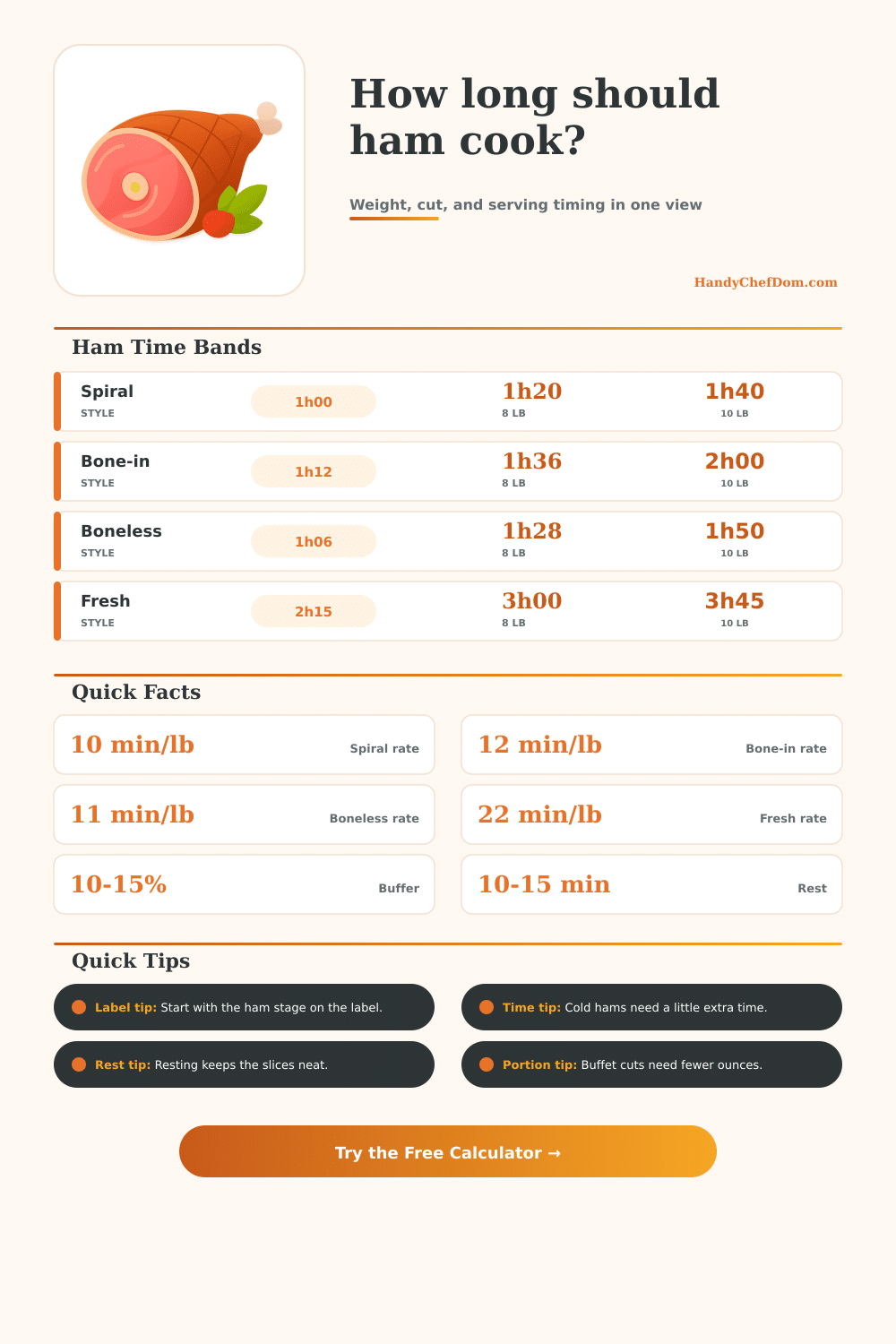
The calculator starts from ham style and weight, then adjusts for start state, buffer, rest, and serving style so the finish window stays grounded.
| Style | 6 lb | 8 lb | 10 lb |
|---|---|---|---|
| Spiral | 1h00 | 1h20 | 1h40 |
| Bone-in | 1h12 | 1h36 | 2h00 |
| Boneless | 1h06 | 1h28 | 1h50 |
| Fresh | 2h15 | 3h00 | 3h45 |
| Style | Oz pp | Lb pp | 8 lb Ham |
|---|---|---|---|
| Dinner | 8 oz | 1/2 lb | 16 serv |
| Buffet | 6 oz | 3/8 lb | 21 serv |
| Sandwich | 4 oz | 1/4 lb | 32 serv |
| Party | 5 oz | 5/16 lb | 25 serv |
| Guests | Dinner | Buffet | Sandwich |
|---|---|---|---|
| 6 | 3 lb | 2.5 lb | 2 lb |
| 8 | 4 lb | 3 lb | 2.5 lb |
| 12 | 6 lb | 4.5 lb | 3 lb |
| 16 | 8 lb | 6 lb | 4 lb |
| Portion | Calories | Protein | Sodium |
|---|---|---|---|
| 3 oz | 120 | 18 g | 110 mg |
| 4 oz | 160 | 23 g | 150 mg |
| 5 oz | 200 | 28 g | 190 mg |
| 6 oz | 240 | 34 g | 220 mg |
When preparing a ham for a meal, it is first important to understand the different type of ham that are available. The type of ham that you use will impact the length of time in which the ham must cook. Many types of ham is pre-cooked in advance so that they only require heating; however, other types of ham are made from fresh, uncooked pork legs.
Ham that is spiral sliced will cook more quickly than ham that is not spiral sliced due to the pre-existing gaps in the ham; ham that contains bone will take longer to cook than ham that does not contain bones due to the fact that the bone will act as a barrier to the cooking process; and ham that is fresh will require the longest cooking time due to the fact that the ham is uncooked when it is first prepared. Beyond the type of ham that is used, the weight of the ham and it’s starting temperature are also important factors to consider when cooking the ham. You should calculate the cooking time according to the weight of the ham that is selected and the type of ham that is being cooked.
How to Cook and Serve a Ham
Spiral sliced ham that is ready to eat will cook for approximately ten minutes per pound of ham when cooked at a low temperature. Bone-in ham will cook for approximately twelve minutes per pound of ham. Cook fresh ham for approximately twenty-two minutes per pound of ham.
If the ham that is being cooked is very cold (as when it is pulled from the refrigerator), the cooking time will be longer then that which is calculated for ham that is of a more even starting temperature. Additionally, it is also important to include a ten percent buffer into the cooking time for the oven temperature may not be even during the cooking process, as well as for the possibility of cooking error that may occur during cooking. Another factor to consider is the amount of ham that each person that will eat the ham will consume.
If the ham will be served on dinner plate, each person will eat approximately a half pound of ham. An eight pound ham will provide enough ham to feed sixteen people. If the ham will be served at a buffet, each person will consume the ham in six ounce portions.
An eight pound ham will provide enough ham for twenty-one people to have a ham portion. If the ham will be served in sandwich or other party trays, the portion sizes will be smaller than six ounces of ham per person. The number of guests that will come to the meal can help determine the weight of the ham that should be purchased.
If the ham is purchased in insufficient amount, there will not be enough ham for each guest. However, if too much ham is purchased, there will be many portion of ham that remain after the meal. In addition to the cooking time, the schedule for preparing the ham for the guests should include time to cook the ham, to allow for a buffer period for cooking errors, and for the ham to rest after cooking.
The cooking schedule should be calculated in reverse from the time that the ham is to be served. The ham should be allowed to rest for at least ten minutes after it is cooked in the oven. During this resting period, the juices that have cooked into the ham will have a chance to settle within the meat portion of the ham.
If you allow the juices to settle within the ham, the ham portions that are sliced will not be dry. If the ham is to be served at six o’clock, the oven should be turned off at five-fifty to allow for the ham to rest. If the ham is a spiral sliced ham, the ham will cook for ninety minutes.
Thus, if the ham is to be served at six o’clock, the ham should be placed into the oven at four-ten. The temperature at which the ham is cooked in the oven will impact the quality of the ham. The cooking temperature should be low, with the oven heated to between three hundred twenty-five and three hundred fifty degrees Fahrenheit.
You should cover the ham with foil during the cooking process to retain the moisture of the ham. A glaze can be coated onto the ham prior to cooking, but you should apply the glaze only in the last portion of cooking, since the sugar content of the glaze would burn if applied too early in the cooking process. An internal thermometer can be used to determine the temperature of the ham and ensure that it is safe to eat.
A warmed and pre-cooked ham should reach an internal temperature of one hundred forty degrees Fahrenheit; however, a fresh ham should reach an internal temperature of one hundred sixty degrees Fahrenheit. The ham should be removed from the oven while the ham is still slightly below the target temperature, as the ham will continue to cook while resting after it is removed from the oven. The amount of usable ham will be less than the total weight of the ham.
Both the bones and the fat trim will reduce the weight of the ham by ten to twenty percent of the total weight. Additionally, the amount of waste in the ham may be greater in the case of a fresh ham than in a pre-cooked ham. The total weight of the ham should be planned for eighty-five to ninety-five percent of the total weight will be usable ham.
Since ham contains a high amount of sodium, ham should be served with other foods, like vegetables or potatoes. Leftover ham can be frozen if the ham is first sliced thin. By following these steps, the ham will be cooked at the correct time and will be suitable for all of the guests that will attend the meal.