🧈 Heavy Cream To Make Butter Calculator
Estimate homemade butter yield from heavy cream, including buttermilk volume, cream needed for a target amount, salt, butterfat, churning method, and batch scaling.
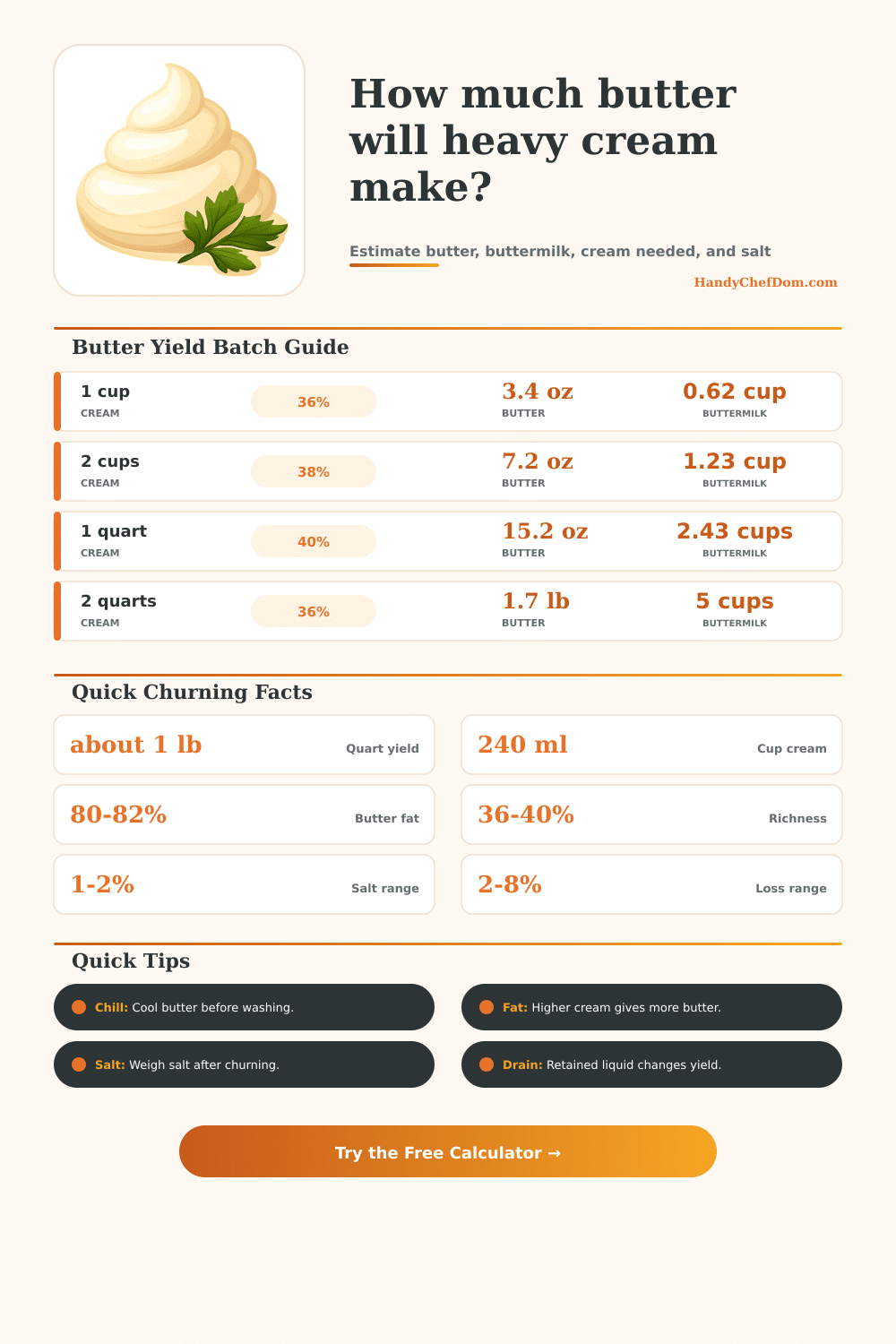
A common kitchen benchmark is that 1 quart heavy cream often makes about 1 pound butter plus buttermilk. This calculator adjusts that benchmark using your cream volume, butterfat percentage, churning method, retained buttermilk, salt, and expected process loss.
| Cream type | Typical butterfat | Butter from 1 quart | Use in calculator |
|---|---|---|---|
| Light whipping cream | 30 percent | About 12 oz | Enter 30 when using lower-fat whipping cream. |
| Standard heavy cream | 36 percent | About 13.7 oz | Good baseline for grocery-store heavy cream. |
| Rich heavy cream | 38 percent | About 14.5 oz | Common for cream that churns a little richer. |
| Very rich cream | 40 percent | About 15.2 oz | Often approaches the 1 pound per quart kitchen rule. |
| Farm cream | 42 percent | About 16 oz | Use if the label or dairy gives a higher fat value. |
| Double cream style | 45 percent | About 17.1 oz | Choose only if the cream is truly that rich. |
| Cream amount | Milliliters | Likely butter | Likely buttermilk |
|---|---|---|---|
| 1 cup cream | 240 ml | 3.4 to 3.8 oz | About 0.6 cup |
| 2 cups cream | 480 ml | 6.8 to 7.6 oz | About 1.2 cups |
| 1 quart cream | 960 ml | 13.7 to 15.2 oz | About 2.4 cups |
| 1.5 quarts cream | 1440 ml | 20.5 to 22.8 oz | About 3.6 cups |
| 2 quarts cream | 1920 ml | 27.4 to 30.4 oz | About 4.9 cups |
| 1 liter cream | 1000 ml | 14.2 to 15.8 oz | About 2.5 cups |
| Batch goal | Cream at 36 percent | Cream at 40 percent | Salt at 1.5 percent |
|---|---|---|---|
| 4 oz butter | 1.18 cups | 1.07 cups | 1.7 g salt |
| 8 oz butter | 2.36 cups | 2.13 cups | 3.4 g salt |
| 12 oz butter | 3.54 cups | 3.20 cups | 5.1 g salt |
| 1 lb butter | 4.72 cups | 4.27 cups | 6.8 g salt |
| 1.5 lb butter | 7.08 cups | 6.40 cups | 10.2 g salt |
| 2 lb butter | 9.44 cups | 8.54 cups | 13.6 g salt |
| Churning method | Recovery factor | Best batch size | Calculator note |
|---|---|---|---|
| Stand mixer | High | 2 to 8 cups cream | Steady churning and easy draining; a strong all-purpose setting. |
| Jar shaking | Medium | 1 to 2 cups cream | Small-batch friendly, but more butterfat may remain in the liquid. |
| Food processor | High | 2 to 6 cups cream | Fast separation with good fat capture when not overfilled. |
| Blender | Medium high | 1 to 4 cups cream | Works quickly, but small flecks can be harder to collect. |
| Hand churn | High | 4 to 12 cups cream | Good for larger batches when worked long enough. |
| Cultured cream | Flavor boost | Any practical size | Use the cream style input for the slight yield and moisture shift. |
To be able to accurately predict the final weight of the butter that can be produced when churning butter at home, an understanding of the various variable that affect the final weight of the butter are required. The final weight of the butter that is produced is dependent upon the butterfat percentage of the heavy cream that you use, the efficiency of the method that is used to churn the cream, the amount of liquid moisture that is retained in the butter, and the amount of salt that is added to the butter. Many individuals understands that one quart of cream will yield one pound of butter when churned; however, this rule of thumb is often inaccurate with respect to the variable that impact the outcome.
An understanding of those specific variable allows for an accurate prediction of the final weight of the butter that will be produced. The butterfat percentage of the heavy cream that is used is one of the main variable to consider in the prediction of the final weight of the butter. The butterfat percentage of heavy cream is between 36 and 40%.
What Affects the Weight of Homemade Butter
Cream that has a lower percentage of butterfat will require a greater volume of that cream to produce the same weight of butter as cream that contains a higher butterfat percentage. The exact percentage of butterfat that is contained in the cream that you will use should be entered into the calculator to determine the expected weight of the butter. The efficiency of the method that is used to churn the cream is another of the main variables to consider in the calculation of the weight of the butter that will be produced.
Methods that are considered to be efficient include the use of a food processor or stand mixer, as these processes release the butter grains from the buttermilk. Less efficient methods include shaking the bottles of cream, which may leave some of the butterfat contain within the buttermilk. The efficiency of hand churning is dependent upon the length of time that the butter grains are worked.
Each of these options for churning can be selected in the calculator to determine the amount of butter that will be produced by each method. The amount of liquid moisture that is retained within the butter is a variable that may impact the final weight of the butter. Butter that is washed thorough will contain less liquid than butter that is not washed as thoroughly.
Because the weight of the liquid is incorporated into the weight of the butter, butter that contains more liquid will weigh more than butter that contains less liquid. The consideration of the amount of moisture that is retained in the butter is required to understand how much buttermilk will be produced during the churning process. The amount of salt that is added to the butter is another variable to consider.
The cook generally adds the salt to the butter after the butter has been drained and washed, as adding salt to the butter during the churning process may cause the butter to lose moisture. The percentage of the salt that is to be added may be entered into the calculator to ensure that the amount of salt that is added to the butter will not be to much. During the churning process, some of the fat that is contained within the heavy cream may be lost.
Some of the fat may remain within the buttermilk, some may remain within the bowl or strainer in which the cream was churned, and some of the fat may evaporate during the process. The loss of this fat to these different locations will reduce the amount of fat that can be expected to be include within the butter. The yield loss is typically between three and six percent.
This percentage can be entered into the calculator to ensure that the weight of the butter that is produced will not be too heavy. The tables included on the page can be used to understand how each of the variables discussed can impact the weight of the butter that is produced. Each table can provide an understanding of how different volumes of cream will produce different weights of butter when churned at varying butterfat percentages.
These tables allow for the understanding of the amount of butter that will be produced without the need to memorize the percentages and variables of butter weight. Each of the variables that can impact the weight of the butter allows for the removal of the guesswork that is typically required in the butter churning process. By comparing the outcomes of two different scenarios, it is possible to understand how each of the variables can change the amount of butter that will be produced.
An understanding of how each of these variables impact the final weight of the butter can help an individual to determine the amount of cream that must be purchased in order to provide the amount of butter that is required. With an understanding of each of the variables that can impact the weight of the butter that is produced, it is possible to prepare the amount of butter that is required for any specific requirements.