Reverse Diet Calculator
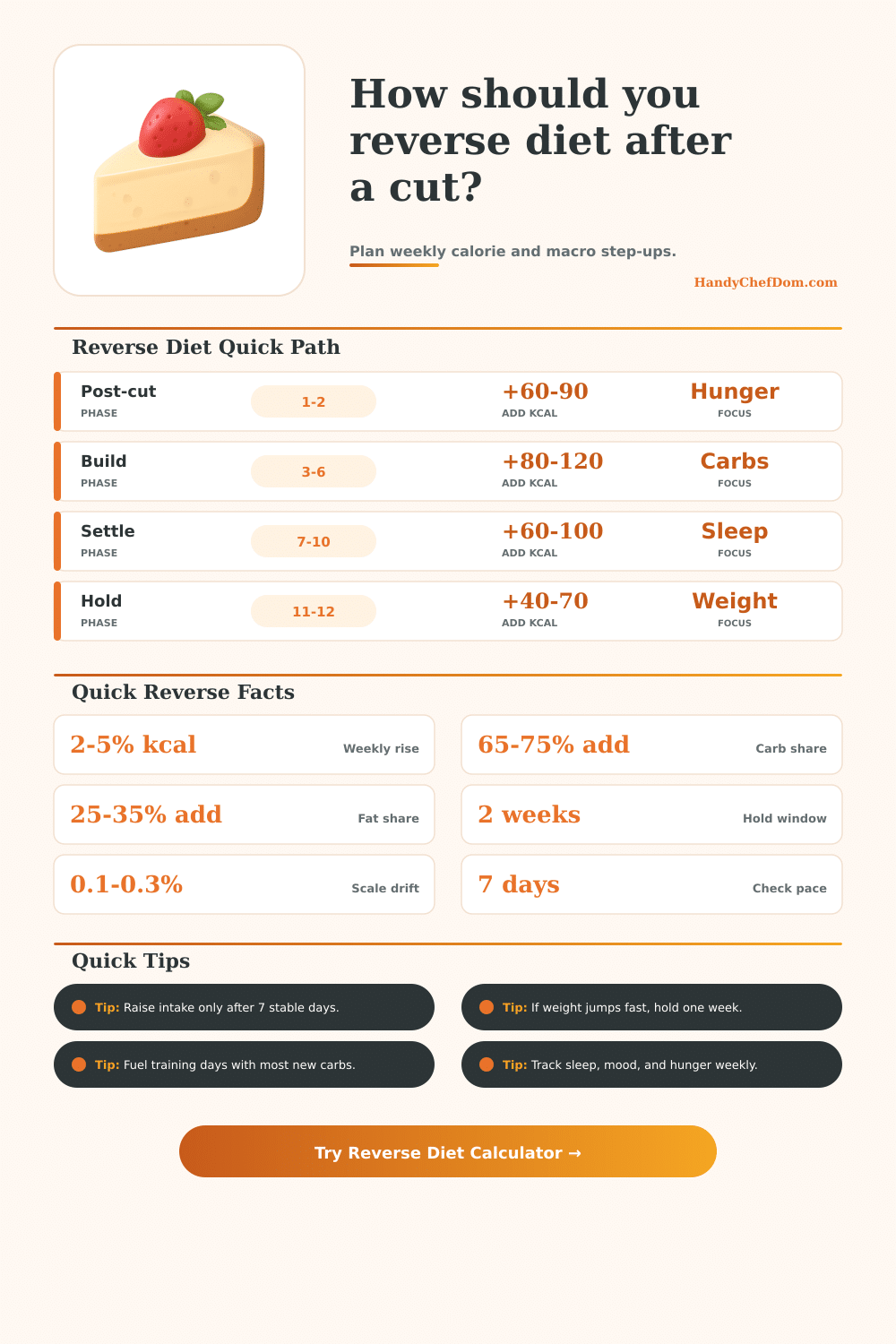
Bridge the gap from a cut to maintenance with deliberate weekly calorie additions, macro split control, and a practical step-by-step progression.
Enter current intake and expected maintenance, then choose a weekly rise pace and macro split style. The calculator shows step size and estimated landing calories.
| Start kcal | 2% rise | 3.5% rise | 5% rise |
|---|---|---|---|
| 1400 | +28 | +49 | +70 |
| 1600 | +32 | +56 | +80 |
| 1800 | +36 | +63 | +90 |
| 2000 | +40 | +70 | +100 |
| 2200 | +44 | +77 | +110 |
| 2400 | +48 | +84 | +120 |
| Style | Carb share | Fat share | Best use |
|---|---|---|---|
| Carb bias | 70% | 30% | Hard lifts |
| Balanced | 60% | 40% | Mixed week |
| Fat bias | 50% | 50% | Low volume |
| Performance | 75% | 25% | Sport prep |
| Signal | Weekly move | Why | Action |
|---|---|---|---|
| Good sleep | Keep pace | Recovery up | Stay plan |
| Flat gym | Rise 10% | Fuel gap | Add carbs |
| Bloat jump | Hold week | Water flux | No add |
| High hunger | Rise 5% | Diet strain | Add split |
| Fast gain | Cut 20% | Pace high | Trim add |
| Days trained | New kcal on train | Rest day add | Pattern |
|---|---|---|---|
| 3 | 70% | 30% | Front load |
| 4 | 72% | 28% | Even split |
| 5 | 75% | 25% | Performance |
| 6 | 78% | 22% | High load |
This reverse diet calculator converts your post-cut numbers into realistic weekly additions, projected end calories, and macro step-ups so your transition to maintenance stays controlled instead of guess-based.
A reverse diet involve increasing the numbers of calories a person consumes after a period of calorie restriction. While many people may have completed a period of calorie restriction to lose weight, they may still experience some challenge after the diet has ended. For example, the body may have experienced lower levels of energy while the person was performing workouts, and the person may have experienced some change in body weight after the period of calorie restriction has ended.
By employing a reverse diet protocol, the body can gradually increase the calories that it consume in a way that will not undo the weight loss that has been achieved during the calorie restriction phase. Furthermore, the calculator that is available will help to ensure that the reverse diet protocol include the correct number of calories for each week. The first step is determining at what starting point the reverse diet will begin.
How to start a reverse diet
For instance, it is necessary for the individual to determine their current number of calories that they consumes each day, the number of calories that are necessary to maintain their body weight, and their current body weight. These calories is used to calculate the number of calories that are needed to provide enough protein for the body and to allow the body to recover from strenuous exercise, as well as the calories that are required for fats and carbohydrate. The protein factor that is chosen should be within the range of 1.6 to 2.2 grams of protein per kilogram of body weight; protein is necessary for maintaining the bodys lean muscle mass, as well as aiding in the recovery of those muscles after strenuous exercise.
Next, it is necessary for the individual to determine at what rate they would like to increase their calories each week, as well as for how many week they would like to continue the reverse diet protocol. For most athlete, increasing the number of calories each week by 3 to 4 percent is recommended. Increasing the calories at a rapid rate may lead the body to store more glycogen and water, both of which may make it more difficult for the body to indicate whether the increase in calories is producing positive results for the body.
Furthermore, allowing time for the body to adjust to these increased calories each week allows for more monitoring of the body’s sleep cycle, mood, and energy levels each week. Finally, the individual can determine the total number of calories that will be added to the individual’s diet each week by dividing the total number of calories that are to be consumed each day by the number of weeks that the diet will last. For the reverse diet to be successful, it is also necessary for the individual to determine in what way the additional calories will be divided between carbohydrates, fats, and proteins.
For instance, the body can follow a carbohydrate-biased split, which allocates 70% of the body’s calories toward carbohydrates, if the individual is performing strenuous exercise session each day. A fat-biased split, in contrast, reduce the number of carbohydrates that are allocated to the body. A fat-biased split may be used by individuals who wish to maintain more stable levels of blood sugar, or by individuals who are not as strenuous active each day.
Furthermore, athletes can use the performance setting for the reverse diet to allocate more calories to carbohydrates to ensure that their bodies has the energy necessary to perform strenuous exercise. In addition to determining in what way the calories will be divided within the body, it is also necessary for the individual to determine when they will add the calories each week. For instance, if the individual has more training day during the week than days off from exercise, more calories will be allocated to those days.
Furthermore, the body’s Non-Exercise Activity Thermogenesis (NEAT) may impact the number of calories that the individual burns each day; while the reverse diet calculator does not account for the individual’s steps or fidgeting each day, it does account for the potential reduction in NEAT if the individual begins to burn fewer calories due to movement. The reverse diet calculator may also allow for the individual to determine their level of sensitivity to water retention. For instance, if the individual has high sensitivity to water retention in their body, they may experience an increase in their body weight, even when their body is gaining no additional weight.
Such sensitivity to body weight can inform the individual about how to adjust the reverse diet; if their body begins to gain weight rapid, for instance, they may be required to hold the increase in calories. In addition, the body may experience certain signals that may indicate that the reverse diet is not working. For instance, if the individual feels bloated, does not sleep well, or experiences a decline in their performance during exercise, they may be required to hold their calories or trim the next increase.
These signals from the body may be informative in determining whether the reverse diet is properly working. The most common error that may be made with a reverse diet may be treating the reverse diet as a race to reach the highest amount of calories that can be consumed each day. Instead, the goal is to reach the calories that are required to maintain the body’s current weight.
Furthermore, another common mistake is allowing the amount of protein that is consumed to increase along with the other component of the diet. The amount of protein that is consumed should remain the same; it is used for the same purpose as the body burns fat and carbohydrates, but in smaller amount than those nutrients. Finally, the protein should remain constant during the reverse diet protocol because it has a critical role in the body’s recovery from exercise.
There are a few different table that can be referenced in the planning of a reverse diet; however, these tables will not replace the individual’s observations of the body. For instance, the calorie step table may allow the individual to determine how many calories should be introduced each week based on the individual’s starting calorie intake. Furthermore, the macro split tables can inform the individual of which split of carbohydrates, fat, and protein is best suited according to their body goals.
For instance, the training day distribution table may allow the individual to redistribute calories according to the number of training days each individual may have each week. These tables will simplify the number of variables that the individual must consider when planning the diet, but they will not replace the individual’s observational skill. In addition to the factors considered by the reverse diet calculator, there are a few variable that may exist in the real world that will impact the individual’s body.
For instance, an individual’s stress at work, sleep cycles, and injuries to the body may impact the effectiveness of the reverse diet. Should any of these issue arise for the individual, they should hold the reverse diet protocol steady. A reverse diet is a tool that can assist an individual in increasing their calorie intake, but it is not a contract that state that the body will experience the same results.
If the individual’s data indicates that the body is not experiencing the same results as those that are projected for the reverse diet protocol, the individual should follow their body data. Finally, once the reverse diet calculator has calculated the target calories for the individual, the individual should hold to that calorie intake for a period of two week. Only after this two-week period can the individual determine whether the calories that are being consumed will allow their body to reach their desired body weight.
While it may appear that the individual will skip this phase of the diet, it is essential to allow the body to reach this stage in order to transform a successful reverse diet protocol into a sustainable phase of weight maintenance. Thus, the reverse diet protocol will work because each stage replace a decision between taking a calorie deficit or surplus diet with a series of steps that can be followed to determine in what way the body responds to increasing calories.