🍮 Gelatin Packet Conversion Calculator
Convert unflavored gelatin envelopes into grams, teaspoons, and liquid-setting capacity, with firmness, bloom strength, dessert style, substitutes, and batch scaling included.
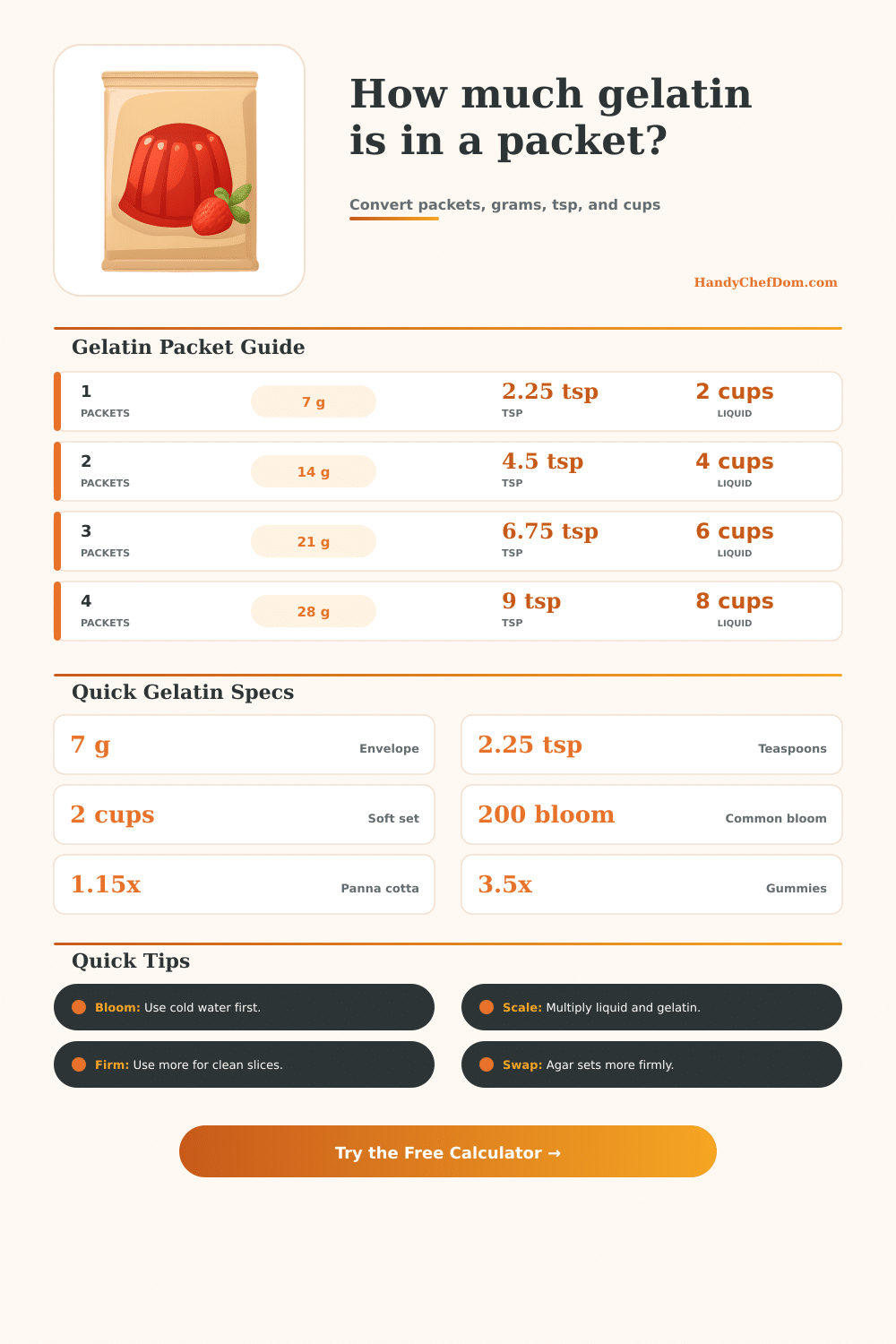
Reference: one envelope of unflavored gelatin is usually 1/4 oz, about 7 grams, about 2.25 teaspoons, and softly sets about 2 cups of liquid.
| Packets | Approx Weight | Approx Teaspoons | Soft Set Liquid |
|---|---|---|---|
| 1/2 packet | 3.5 g | 1.13 tsp | About 1 cup |
| 1 packet | 7 g | 2.25 tsp | About 2 cups |
| 2 packets | 14 g | 4.5 tsp | About 4 cups |
| 3 packets | 21 g | 6.75 tsp | About 6 cups |
| 4 packets | 28 g | 9 tsp | About 8 cups |
| 6 packets | 42 g | 13.5 tsp | About 12 cups |
| Firmness | Packet per Cups | Factor | Best Use |
|---|---|---|---|
| Delicate spoonable | 1 packet per 3 cups | 0.65x | Soft cream desserts |
| Soft standard | 1 packet per 2 cups | 1.00x | Basic chilled dessert |
| Medium sliceable | 1 packet per 1.5 cups | 1.35x | Panna cotta slices |
| Firm mold | 1 packet per 1.15 cups | 1.75x | Aspic or unmolded layers |
| Gummy-style chewy | 1 packet per 0.57 cup | 3.50x | Gummies and fruit snacks |
| Bloom Strength | Typical Label | Calculator Factor | Texture Note |
|---|---|---|---|
| 125 bloom | Bronze or lower | 1.60x | Needs more weight for the same set |
| 160 bloom | Silver | 1.25x | Moderate strength sheets or powder |
| 200 bloom | Common powder | 1.00x | Default packet reference |
| 225 bloom | Gold | 0.89x | Slightly stronger gel strength |
| 250 bloom | Platinum or high | 0.80x | Use less by weight for equal set |
| Dessert Type | Style Factor | Texture Goal | Calculator Note |
|---|---|---|---|
| Mousse | 0.85x | Light support | Whipped volume needs less firmness |
| Panna cotta | 1.15x | Clean spoon set | Slightly firmer than basic soft set |
| Gummies | 1.40x | Chewy concentration | Combines with gummy firmness target |
| Aspic | 1.25x | Stable unmolded gel | Helpful for slices and shapes |
| No-bake cheesecake | 1.05x | Slice support | Balances dairy and crumb base |
| Fruit gel | 1.10x | Layer hold | Useful for fruit and clear layers |
The amount of gelatin that are required for a dessert is dependent on several different variable. Many cooks struggle with determine the correct amount of gelatin to use in their recipe, due to the fact that one packet of gelatin will set a specific amount of liquid to a specific texture, but altering the amount of liquid or the type of dessert that is being made will alter that texture that the gelatin create. In order to account for these different variable, the calculator can make the mathematical calculation necessary to determine the amount of gelatin that is required for a given recipe that is entered into the calculator.
The calculator account for the bloom strength of the gelatin, as different brand of gelatin contain different amount of gel power. The strength of the gelatin will impact the amount of gelatin that is required to set the liquid to the desired texture. The calculator accounts for different style of dessert, as a dessert like panna cotta will require a different level of firmness than a mousse, and the mousse will require a different firmness than a dessert that contain aspic.
How Much Gelatin Do I Need?
The bloom strength and the type of dessert work together to determine the amount of gelatin that the calculator will calculate. Many people believe that each packet of gelatin is the same as each other packet of gelatin, but this is not true. Gelatin packets can have varying bloom strength, which will impact the amount of the ingredient that is required to reach a certain firmness.
A stronger brand of gelatin will require less of that ingredient than brands with lower bloom strength. The calculator can calculate the amount of gelatin that is required by taking into consideration the bloom strengths of the brands of gelatin that is to be used. The firmness of the dessert that is to be created will also impact the outcome of the recipe.
Cream-based desserts will require a lower amount of gelatin than recipes that contains panna cotta, and panna cotta recipes will require a lower amount of gelatin than recipes that contain firm aspic mold. The calculator allow cooks to select the firmness of the dessert that they would like to create, which will allow the calculator to calculate the amount of gelatin to ensure the outcome of the dessert will be as planned. The amount of liquid in the dessert will also impact the amount of gelatin that is required.
The same amount of gelatin will set two cups of liquid to create a soft texture for a dessert, but using the same packets of gelatin will create a firmer dessert if there is less liquid use. The amount of liquid will be held as a constant in the calculator, but the calculator will recalculate the amount of gelatin to ensure that cooks dont attempt to add more packets of gelatin to their dessert without also adding more liquid themself. Vegetarian substitute for gelatin, such as agar, will also have different property to that of gelatin.
For instance, agar will create a firmer dessert by weight than gelatin will, and agar will also react different to dairy products compared to fruit products. The calculator will provide cooks with the amount of agar or other gelling agent that are required for the desserts that they would like to make, allowing cooks to compare the amount of agar that is required to the amount of gelatin that would be required. While the calculator is not a replacement for the directions that are provided on the packages of these ingredient, the calculator will be of assistance to cooks in deciding whether or not to use these substitute.
Finally, another variable that the calculator account for is the batch size. While it may seem simple to double the amount of an ingredient, the texture of the dessert may change with changing batch size. To account for this, the multiplier field allow cooks to adjust the batch size, while ensuring that the ratio of the ingredients remain the same.
These various variable to determining the correct amount of gelatin to be used in a dessert are all accounted for in the calculator. Through understanding the effect that each of these variable will have on the outcome of the dessert, cooks will be able to easily adjust the recipe that they create.