Water to Grits Ratio Calculator
Dial in the right liquid, texture, and yield for creamy breakfast bowls or sturdy dinner grits.
Use the serving count and dry grits portion to size the pot, then the calculator backs into the liquid and yield.
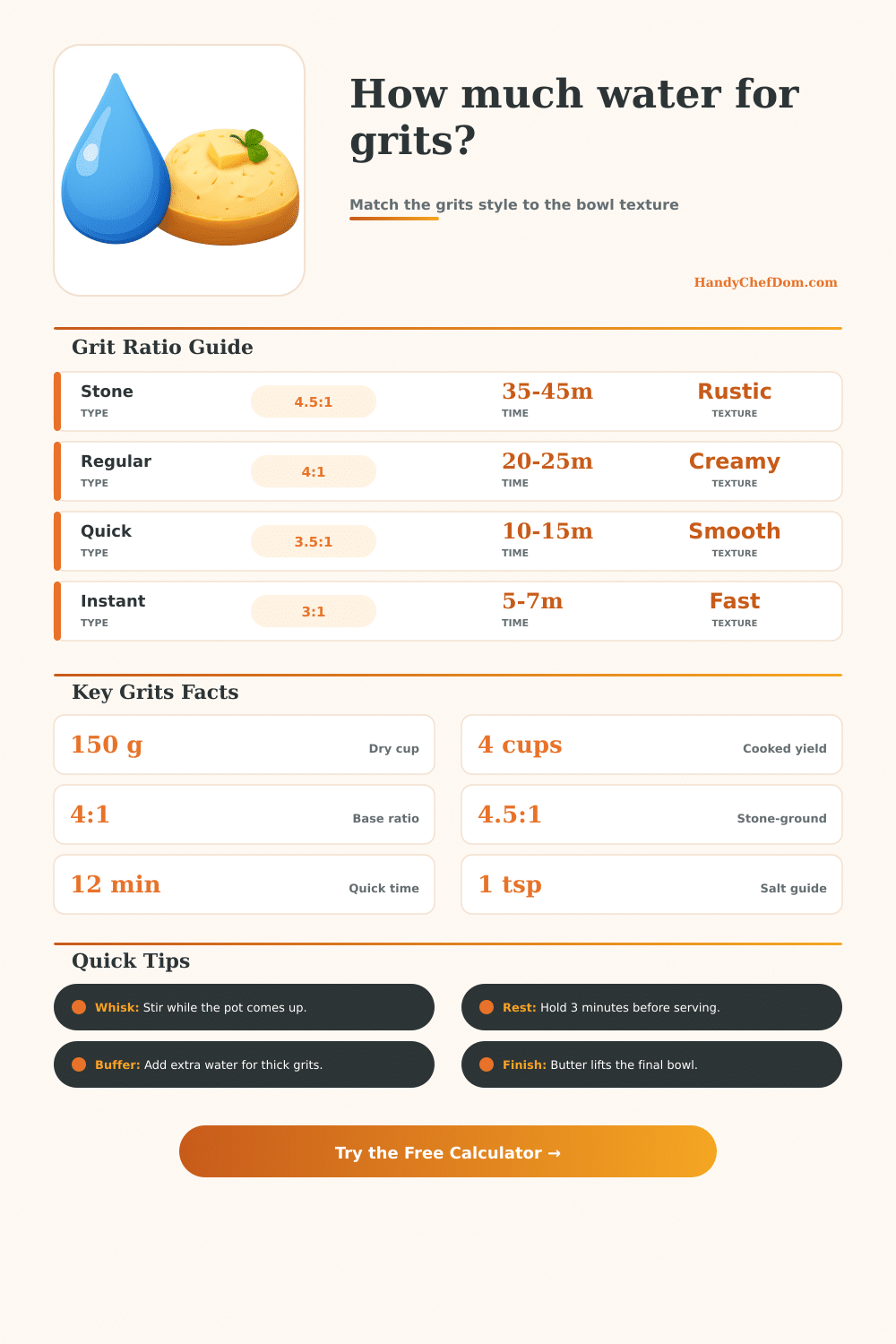
| Grits Type | Liquid | Time | Texture |
|---|---|---|---|
| Stone-ground | 4.5:1 | 35-45m | Rustic |
| Regular | 4:1 | 20-25m | Creamy |
| Quick | 3.5:1 | 10-15m | Smooth |
| Instant | 3:1 | 5-7m | Fast |
| Liquid | Ratio Lift | Time Lift | Use |
|---|---|---|---|
| Water | 1.00x | 0 min | Neutral |
| Milk | 1.08x | 4 min | Richer |
| Broth | 1.02x | 1 min | Savory |
| Half cream | 1.12x | 6 min | Extra rich |
| Texture | Liquid | Yield | Note |
|---|---|---|---|
| Loose | 1.07x | 4.3x | Softer bowl |
| Creamy | 1.00x | 4.0x | Classic |
| Thick | 0.92x | 3.7x | Spoonable |
| Very thick | 0.88x | 3.5x | Slices well |
| Batch Size | Dry Grits | Liquid | Bowls |
|---|---|---|---|
| Small | 1 cup | 4 cups | 4 |
| Family | 2 cups | 8-9 cups | 8 |
| Brunch | 3 cups | 12-14 cups | 12 |
| Party | 4 cups | 16-18 cups | 16 |
Use this water to grits ratio calculator to size a breakfast bowl or party pot, then adjust liquid for texture, source, and cook method.
Because grits requires a specific ratio of liquid to the dry grits, the ratio of the liquid to the dry grits will determine the texture of the grits that is cooked. If too little liquid is use in preparing the grits, the grits will become a stiff mass. Too much liquid will create a thin liquid containing the grits.
The amount of liquid that will be required to cook the grits will depend on the type of grits that are to be prepared. Stone ground grits are the coarsest form of grits, requiring more liquid to cook than other varieties of grits. The reason for the need for more liquid is that the stone-ground grits takes a long time to absorb the liquid.
How Much Liquid to Use for Grits
For this reason, you should use four and a half parts of liquid for each part of stone-ground grits. Regular grits is a fine variety of grits that take less time to absorb the cooking liquid. For this reason, four parts of liquid are used for each part of regular grits.
Quick cooking grits are even finer than regular grits, requiring only three and a half part of liquid for each part of quick-cooking grits. Instant grits are the finest form of grits; as a result, only three part of liquid are used for each part of instant grits. The type of liquid that is use can affect the way that the grits thicken.
If water is used, it will remain neutral and allow the flavor of the grits to be the primary flavor in the grits. If milk or half-and-half are used, the protein in the milk will cause the grits to thicken more slow. As a result, you can add more liquid to the grits and the grits can be cooked for more minute.
Broth can be used to flavor the grits, but the broth will evaporate in a different manner then water. The amount of liquid that is used will change the texture of the grits. Creamy grits will require a higher amount of the liquid to create the texture and will create a higher yield of grits.
Thick grits will use less of the liquid and will create a lower yield of grits. Creamy grits will yield four times the amount of dry grits when cook, while thicker grits will create a lower yield of grits. The method that the grits are cooked will change the amount of liquid that is required.
Stovetop method will use the standard amount of liquid for each type of grit. However, if the cooks the grits in an oven, more liquid must be used because the heat circulate through the oven and evaporates the liquid. Slow cookers require more liquid and take more time to cook the grits because the slow cookers cook the grits at a lower rate.
Therefore, you must add extra liquid to prevent the grits from scorching in the slow cooker. Lastly, if the grits are cooked in a pressure cooker, the grits will cook quick. The ratio of the grits and the liquid may have to be adjusted for cooking in a pressure cooker.
If the grits are to be cooked at high altitudes, five to ten percent of the liquid can be added to accommodate the boiling point of the water at high altitude. The grind of the corn will affect the flavor and the time of chewing of the grits. Stone-ground yellow grits has a strong flavor of corn, but take a long time to chew.
White stone-ground grits has a milder flavor. Quick grits cook quick and are useful for time constrained meals. Hominy grits are made with nixtamalized corn and absorb a large amount of liquid.
To cook the grits, you must whisk the dry grits into the boiling liquid slow. The grits should be stirred while boiling to ensure that they reach the thick consistency. The grits should be cooked on low heat and allowed to sit in the covered pot for three minutes after turning off the stove.
Allowing the grits to rest allow the starch in the grits to settle. This resting process will cause the grits to become creamy. If the grits are undercooked, they will be gritty when serve.
If the grits are overcooked, the grits will release liquid. The amount of grits can be scaled to the number of people that will eat the grits. For two person, one-half cup of grits and two cups of water can be used to cook regular grits.
For ten people, three cup of grits and fourteen cups of liquid are required if the grits are cooked in the oven. A grits calculator can determine the exact amount of liquid that must be added and the total yield of the grits based off the type of grits that will be prepared, the number of servings, and the desired texture. Lastly, salt and butter added to the grits after they are cooked will improve the flavor of the grits.