🍞 Yeast Per Cup of Flour Calculator
Estimate yeast for bread, pizza, enriched dough, and slow rises from flour cups or grams, yeast type, dough style, room temperature, hydration, and batch multiplier.
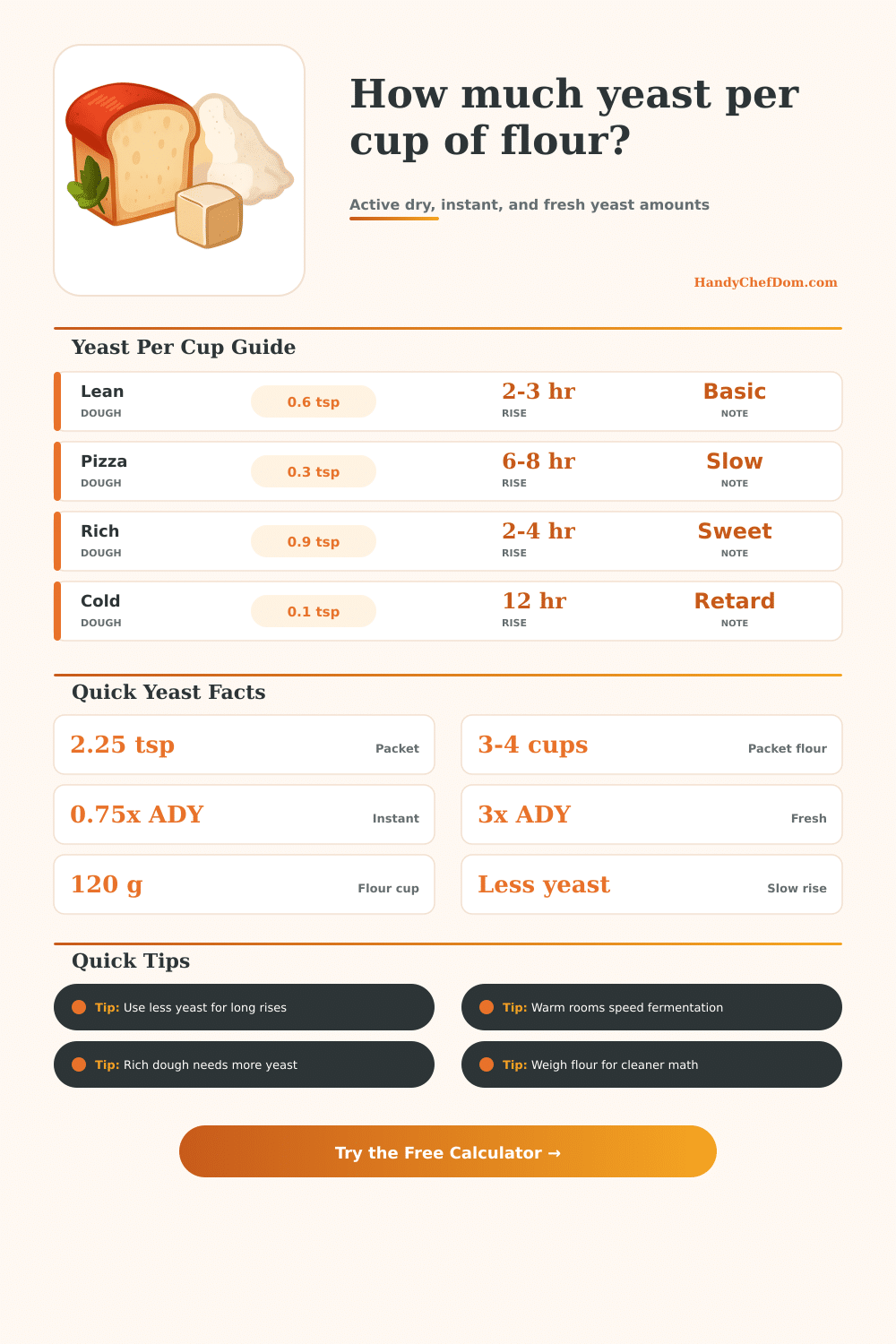
Common bread starts near one 2.25 teaspoon packet for about 3 to 4 cups flour. This calculator scales that baseline down for slow rises and up for rich, cool, or fast doughs.
| Yeast Measure | Active Dry | Instant | Fresh Cake Yeast |
|---|---|---|---|
| 1 teaspoon active dry | 1 tsp / 3.1 g | 0.75 tsp / 2.35 g | 9.3 g fresh |
| 1 teaspoon instant | 1.33 tsp / 4.1 g | 1 tsp / 3.1 g | 12.4 g fresh |
| 1 packet dry yeast | 2.25 tsp / 7 g | About 2 tsp / 7 g | 21 g fresh |
| 1 gram active dry | 1 g | 0.75 g | 3 g fresh |
| 1 gram instant | 1.33 g | 1 g | 4 g fresh |
| Flour Type | Approx Cup Weight | 3 Cups Flour | Yeast Note |
|---|---|---|---|
| All-purpose flour | 120 g | 360 g | Good default for sandwich bread |
| Bread flour | 125 g | 375 g | Often used for chewy loaves and pizza |
| Whole wheat flour | 113 g | 339 g | May ferment faster from minerals |
| High extraction flour | 130 g | 390 g | Dense cups need gram-based scaling |
| Soft flour | 114 g | 342 g | Best for soft rolls, not chewy bread |
| Schedule | Typical Yeast Level | Room Target | Best Use |
|---|---|---|---|
| Fast rise, 1 to 2 hours | 0.9% to 1.4% instant | Warm room | Rolls and same-day bread |
| Standard rise, 2 to 4 hours | 0.5% to 0.9% instant | Mild room | Everyday loaves |
| Slow rise, 5 to 8 hours | 0.2% to 0.5% instant | Mild room | Flavorful lean dough |
| Overnight, 8 to 16 hours | 0.08% to 0.25% instant | Cool room or fridge | Pizza and artisan bread |
| Long cold, 18 to 48 hours | 0.03% to 0.12% instant | Refrigerated | Retarded pizza or baguette dough |
| Dough Type | Yeast Demand | Hydration Clue | Calculator Adjustment |
|---|---|---|---|
| Lean bread dough | Moderate | 60% to 72% | Neutral baseline |
| Pizza or focaccia | Low to moderate | 62% to 80% | Less yeast for long flavor rise |
| Whole grain bread | Moderate | 70% to 85% | Slightly reduced due to active flour |
| Sweet enriched dough | High | 55% to 68% | More yeast for sugar and fat |
| Brioche-style dough | Very high | 45% to 60% | Highest enrichment factor |
| Bagel dough | Moderate | 50% to 58% | Small boost for firm dough |
A yeast per cup of flour calculator allow an individual to determine how much yeast is require for a specific recipe. The amount of yeast required for a recipe can depend on a variety of factors. For instance, the amount of flour in the recipe will impact the amount of yeast that is required.
Other factor that impact the amount of yeast that is required for a recipe include the type of dough in the recipe, the length of time in which the dough will rise, the room temperature in which the dough will rise, and the amount of sugar or fat that is included in the recipe. Each of these factors can be entered into the yeast per cup of flour calculator, and the calculator will return an accurate result regarding the amount of yeast that should be used in the specific recipe. The amount of flour to be used is one of the primary variable that will impact the yeast needed.
How Much Yeast to Use per Cup of Flour
The type of dough to be made is another variable that will impact the yeast needed. For example, dough that contain sugar and fat, such as enriched doughs, may require more yeast than plain doughs due to the fact that sugar and fat can slow the yeast fermentation process. The rise time of the dough is a third variable that will impact the amount of yeast needed.
The longer the dough needs to rise, the less yeast that will be needed. Conversely, if the recipe require the dough to rise in a shorter period of time, then more yeast will be needed. The fourth variable that will impact the amount of yeast needed is the room temperature in which the dough will rise.
If the rising temperature is high, yeast activity will be high, which indicates that less yeast will be needed. If the temperature is low, more yeast will be needed to allow the dough to rise. The yeast per cup of flour calculator will provide specific information regarding the amount of yeast that should be use in the recipe.
The calculator will provide information regarding the weight and volume of the yeast that should be used; it will also provide information regarding the equivalent amount of fresh yeast that should be used. Additionally, the yeast per cup of flour calculator will provide information regarding the rise time that will be required for the recipe to properly set; it will also provide the baker’s percent figure for the recipe. These figures make it possible to compare the specific recipe to baking formula that are commonly used by bakers.
The common rule of 1 packet of yeast for 3-4 cups of flour is generally not accurate. Factors like environment and ingredients can change the amount of yeast that should be used. For example, if a pizza recipe is to be refrigerated overnight, half of the usual amount of yeast will be needed.
Brioche doughs, which contain sugar and butter, will require more yeast because the sugar and butter will slow the yeast activity. The yeast per cup of flour calculator makes it visible to the baker what changes in ingredients will require alteration to the amount of yeast that should be used. Tables are provided for the baker to understand the relationship of each of these variables.
One table display the conversion factors between active dry yeast, instant yeast, and fresh yeast. Another table displays the amount of yeast required for different rise lengths. This can allow a baker to determine if a specific rise time is realistic for a recipe.
A third table displays the amount of yeast that different type of dough require. Each of these tables can be used as a standard to ensure that the yeast per cup of flour calculator is returning an accurate estimate for the recipe. Bakers may make mistakes when adding too much or too little yeast to the dough.
If there is too much yeast for an overnight cold fermentation, the dough can overproof and have a yeasty aftertaste. If there is too little yeast for a recipe that contain enriched dough in a warm room, the dough will not rise enough in the center of the dough. The yeast per cup of flour calculator will help to estimate the amount of yeast needed to avoid these mistakes, but it is also necessary to observe the dough for proper rising.
If the dough begins to double in size, it should be shaped. If it is moving slow, it should be given more time to rise, not more yeast. The temperature of the kitchen is a critical factor in the rising of the dough.
Dough may rise well at 70 degrees but rise too quickly at 78 degrees and not at all at 64 degrees. While the yeast per cup of flour calculator accounts for these temperatures, bakers should use the figure as a starting point for recipe adjustments for rising times. Any adjustment to the recipe that is created should be small, so that yeast can be adjusted accordingly for the next batch of dough.
Finally, precision in measuring the amount of yeast is necessary. The yeast per cup of flour calculator may calculate amounts that are less than a quarter of a teaspoon. In these instances, it is better to use a gram scale to measure the yeast.
A gram scale is more precise for measuring yeast for small batches of dough. The yeast per cup of flour calculator will also display the gram equivalents for yeast amounts to make it easy for bakers to use a gram scale for measuring the yeast. In creating the yeast per cup of flour calculator, its goal is to allow bakers to create batch of bread that contain consistent fermentation times.
Once bakers understand the effect of each variable on the amount of yeast needed for a recipe, the yeast per cup of flour calculator can assist bakers in planning their bread batches.