🍜 Barley to Put in Soup Calculator
Calculate dry barley cups, grams, cooked yield, broth absorbed, and per-serving barley using soup quarts, barley type, thickness, add-ins, cook method, and leftover plans.
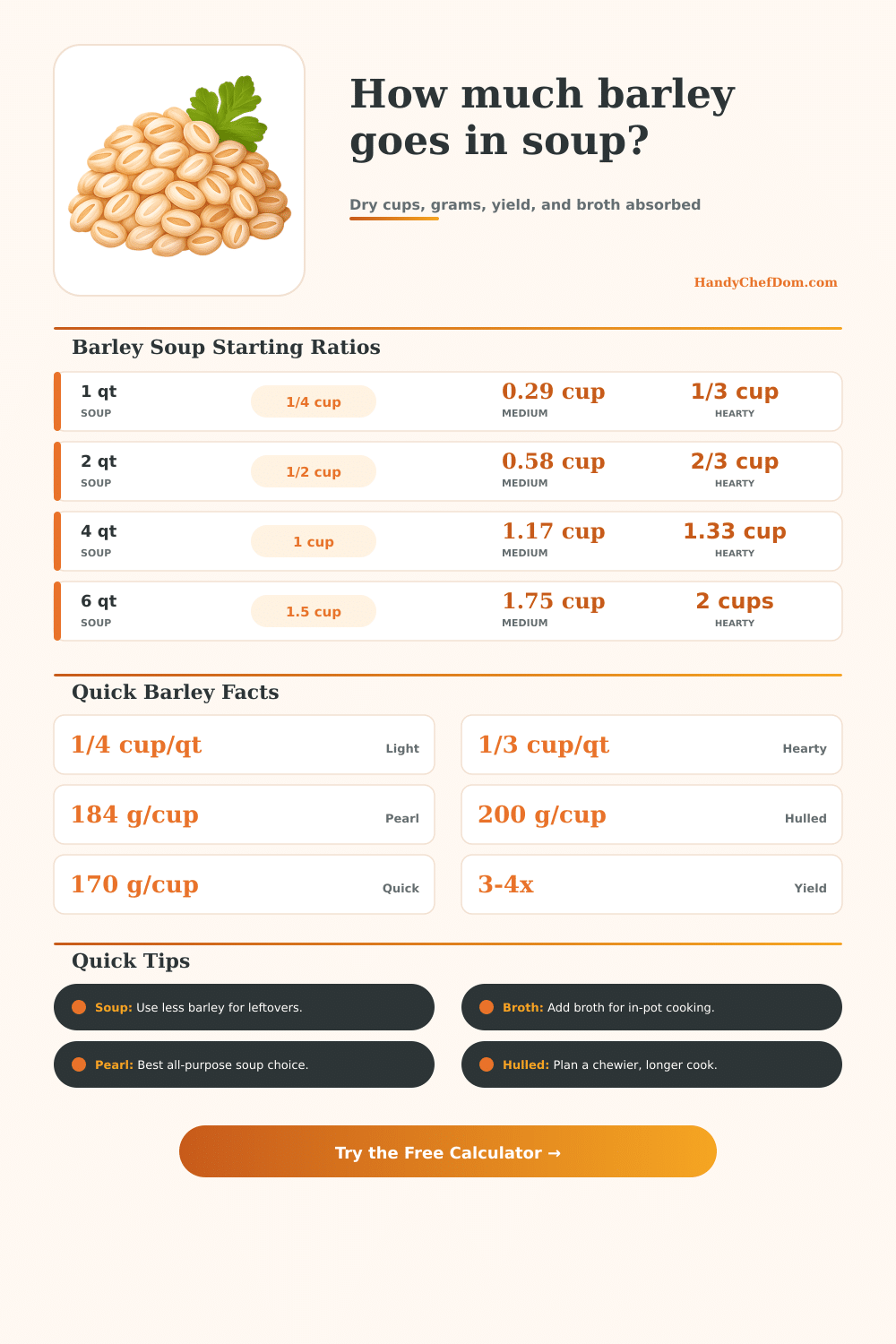
Reference rule: start with 1/4 cup dry barley per quart for lighter soup and about 1/3 cup dry barley per quart for hearty soup. This calculator adjusts for barley type, add-in load, broth absorption, cooking method, and leftovers.
| Barley Type | Dry Cup Weight | Cooked Yield | Best Soup Use |
|---|---|---|---|
| Pearl barley | About 184 grams per dry cup | About 3.5 cups cooked per dry cup | Classic beef, chicken, mushroom, and vegetable barley soup |
| Hulled barley | About 200 grams per dry cup | About 4 cups cooked per dry cup | Chewier whole-grain soups where longer cooking is planned |
| Quick barley | About 170 grams per dry cup | About 3 cups cooked per dry cup | Fast weeknight soup or adding barley near the end |
| Thickness Goal | Dry Barley Ratio | Resulting Texture | Best Use |
|---|---|---|---|
| Light brothy soup | 1/4 cup dry barley per quart soup | Noticeable grains with plenty of free broth | Chicken soup, vegetable soup, or side bowls |
| Medium barley soup | About 0.29 cup dry barley per quart soup | Balanced spoonfuls without turning into stew | Everyday pearl barley soup and mixed leftovers |
| Hearty barley soup | 1/3 cup dry barley per quart soup | Generous barley in most ladles | Beef barley, mushroom barley, and main-course bowls |
| Extra thick meal soup | About 0.40 cup dry barley per quart soup | Thick, grain-forward soup that tightens as it sits | Only when the soup is meant to eat like a stew |
| Dry Barley | Pearl Cooked Yield | Typical Broth Absorbed | Soup Planning Note |
|---|---|---|---|
| 1/4 cup dry barley | About 7/8 cup cooked | About 1/2 to 3/4 cup broth | Good for 1 quart of light soup |
| 1/2 cup dry barley | About 1 3/4 cups cooked | About 1 to 1 1/2 cups broth | Good for 2 quarts of light to medium soup |
| 1 cup dry barley | About 3 1/2 cups cooked | About 2 to 3 cups broth | Good for 3 to 4 quarts depending desired thickness |
| 1 1/3 cups dry barley | About 4 2/3 cups cooked | About 2 2/3 to 4 cups broth | Good for 4 quarts of hearty barley soup |
| 2 cups dry barley | About 7 cups cooked | About 4 to 6 cups broth | Large batch amount for 6 quarts hearty soup |
| Soup Grain | Dry Ratio Per Quart | Texture in Soup | Calculator Note |
|---|---|---|---|
| Barley | 1/4 to 1/3 cup dry per quart | Chewy, hearty, and broth-absorbing | This calculator sizes barley only |
| Rice | About 1/4 cup dry per quart | Soft grains that can split during long holding | Use less for leftovers because rice swells quickly |
| Farro | About 1/4 cup dry per quart | Chewy and nutty with a firmer bite | Similar planning style but different weights |
| Lentils | About 1/3 cup dry per quart | Thickening and soft, especially red lentils | They act as both grain and thickener |
| Small pasta | About 1/3 cup dry per quart | Soft, quick, and very absorbent in leftovers | Add near serving for the best texture |
To determine the proper amount of barleys to add to the soup, one must understand how the barley will interact with the liquid in the soup. If too little barley is add to the soup, the barley wont provide a notable contribution to the meal. However, if too much barley are added, the barley will absorb too much of the soups liquid, creating a thick soup like a stew.
These factors will influence the amount of dry barley necessary to prepare the soup, the type of barley to be use, and how long the soup will sit after the cooking process. Depending on the type of barley used in the recipe, the barley can exhibit different behavior when cooking. For instance, pearl barley will produce a chewily texture and absorb medium amount of liquid.
How Much Barley to Put in Soup
Hulled barley will remain firmer and take up more space within the recipe once cooked. Quick barley will cook faster but will contain less chewiness than the other type of barley. A specific type of barley must be chosen in the recipe, as the type will change the amount of dry barley that are needed for the recipe.
Using the calculator, you can enter the amount of liquid that will be used in the recipe along with the type of barley that will be used. Additional factor that can be entered into the calculator are the thickness of the soup that is targeted, the additional ingredients to the recipe, the cooking method, and whether or not the soup will contain leftovers. The amount of barley will continue to absorb liquid even after the soup is cooked.
For instance, if you plan to refrigerate the soup, the amount of barley that is used can be less, as the barley will absorb the liquid while the soup is sitting in the refrigerator. Additionally, if the cook is to be cooked direct in the soup, there will have to be extra broth for the barley to absorb the liquid while it cooks. The general rule of thumb is using a quarter cup of barley per quart of the soup for lighter soups.
For heartier soup, a third cup of barley per quart of soup can be used. However, these general guidelines are not necessarily accurate due to the amount of liquid that the vegetables and the meat will add to the recipe, along with the fact that the barley will change the consistency of the soup as it cools. The calculator accounts for these factors to ensure that each serving of the soup contains the same amount of barley to liquid ratio.
It is essential to keep extra broth available while cooking the soup, as the barley will absorb several cup of the liquid. This will allow room to adjust the thickness of the soup if the barley becomes too thick. If the soup is to contain leftovers, the hot soup will remain the proper thickness while cooking but will thicken once it sits overnight.
To prevent the soup from becoming too thick when stored, extra broth must be add when cooking the soup. The calculator will also provide the amount of space that the cooked barley will take up in the recipe. If the cooked barley takes up a significant portion of the recipe, the barley will act as the main part of the meal.
However, if the barley takes up a small portion of the recipe, the broth will be the main part of the meal, and the barley will only contribute to the texture of the recipe. The cooking method for the barley will change the amount of liquid that is required for the recipe. If the cook cooks the barley separately from the soup, the amount of liquid in the soup will remain at the added volume.
However, if the barley is to be cooked direct in the soup, the barley will take up the amount of liquid while it cook. Therefore, extra broth will be required for this cooking method. However, the difference in the amount of liquid needed is minimal for one serving of the soup.
However, if making a batch of soup, this difference will be noticeable. The initial calculation of the amount of barley to be use is just a starting point. The recipe can be run again to find a central point for the amount of barley to be use.
However, it is essential to taste the soup once the barley has softened. Depending on the space that the cooked barley will take up, the amount of broth that the barley absorbed can be used to determine whether more liquid is needed for the recipe or whether less barley can be use in the future. By tasting the broth and observing the amount of liquid that the barley absorbed, it is possible to adjust the amount of barley and the amount of liquid in the recipe to create the desired consistency.