🍕 Pan Pizza Dough Calculator
Scale pan pizza dough from inside pan dimensions, pan area, desired dough thickness, hydration, oil percentage, number of pans, fermentation loss, and baker percentages.
Measure the inside bottom of the pan. Rectangle mode uses width times length, square mode uses width on both sides, and round mode uses the diameter field.
Higher dough load for a tall edge, airy crumb, and sturdy rectangular slice.
Large sheet pan dough with generous hydration and moderate oil.
Thinner pan dough that spreads wide and stays crisp under sauce.
Tall, soft, oily dough when you want a breadier pan base.
Balanced loading for a tender center and a crisp bottom.
Lower dough weight for a thinner bar-style pan pizza.
Light rectangular dough with open crumb and easy portioning.
Round pan dough sized for a thick rim and crisp fried base.
| Style | Typical g per sq in | Thickness range | Hydration | Oil in dough |
|---|---|---|---|---|
| Detroit pan | 4.5 to 5.8 | 4.5 to 5.8 mm | 70 to 74% | 3 to 6% |
| Sicilian sheet | 4.2 to 5.5 | 4.2 to 5.7 mm | 70 to 76% | 2 to 5% |
| Grandma pizza | 3.0 to 4.2 | 3.0 to 4.2 mm | 65 to 70% | 3 to 6% |
| Focaccia style | 5.0 to 7.0 | 5.0 to 7.5 mm | 75 to 82% | 4 to 8% |
| Crispy pan | 2.8 to 3.8 | 2.5 to 3.6 mm | 62 to 68% | 2 to 5% |
| Pan size | Area | Thin pan | Detroit | Sicilian |
|---|---|---|---|---|
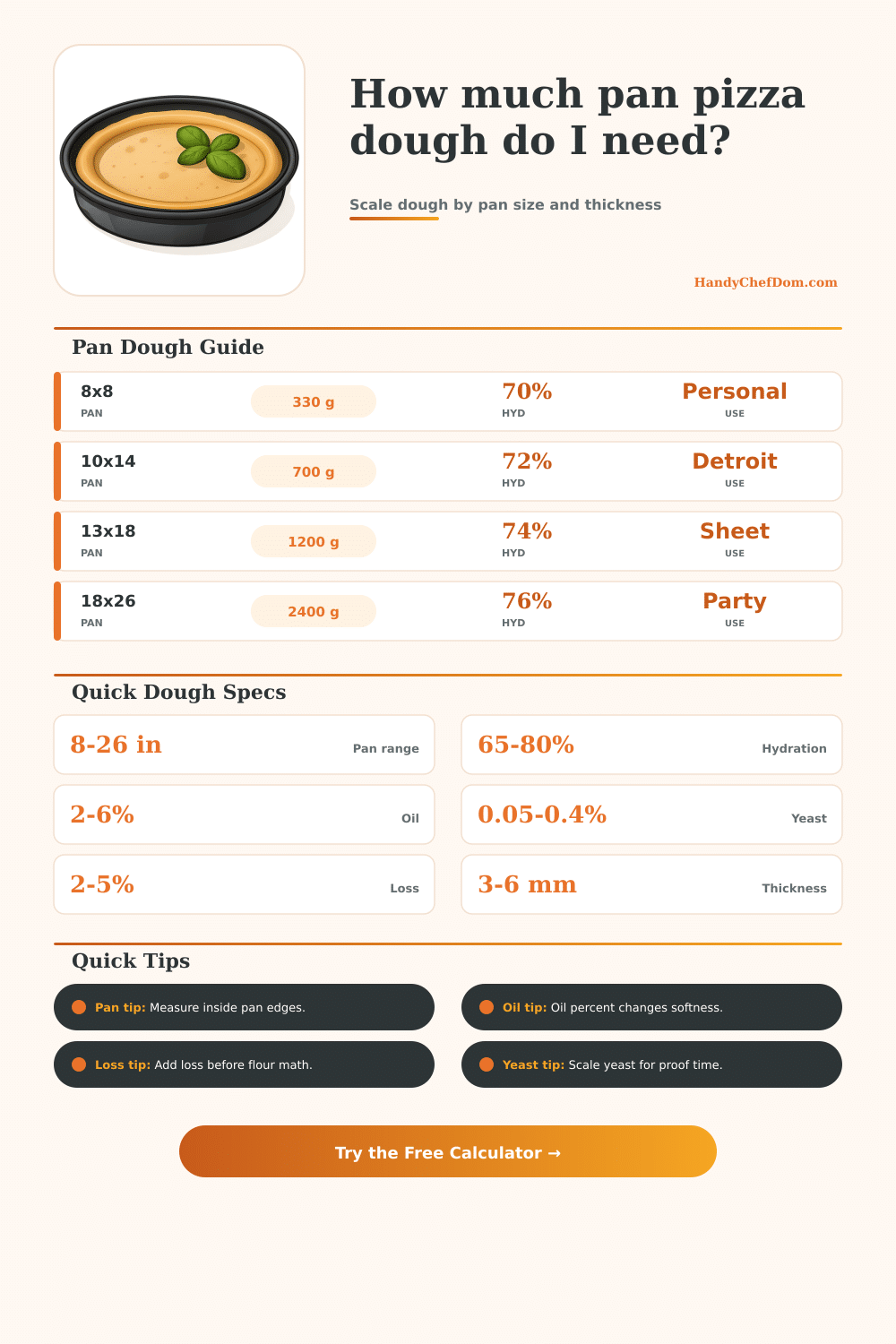
| 8 x 8 inches | 64 sq in | 210 to 250 g | 300 to 370 g | 300 to 360 g |
| 10 x 14 inches | 140 sq in | 460 to 530 g | 630 to 810 g | 590 to 770 g |
| 12 x 16 inches | 192 sq in | 630 to 730 g | 865 to 1115 g | 805 to 1055 g |
| 13 x 18 inches | 234 sq in | 770 to 890 g | 1050 to 1360 g | 985 to 1290 g |
| 18 x 26 inches | 468 sq in | 1540 to 1780 g | 2105 to 2715 g | 1965 to 2575 g |
| Formula | Hydration | Salt | Yeast | Oil | Sugar or malt |
|---|---|---|---|---|---|
| Detroit | 70 to 74% | 2.2 to 2.6% | 0.08 to 0.25% | 3 to 6% | 0 to 2% |
| Sicilian | 70 to 76% | 2.2 to 2.6% | 0.08 to 0.22% | 2 to 5% | 0 to 2% |
| Grandma | 65 to 70% | 2.2 to 2.6% | 0.12 to 0.35% | 3 to 6% | 0 to 2% |
| Focaccia | 75 to 82% | 2.0 to 2.5% | 0.08 to 0.25% | 4 to 8% | 0 to 1% |
| Crispy pan | 62 to 68% | 2.1 to 2.5% | 0.18 to 0.45% | 2 to 5% | 0 to 3% |
| Proof plan | Instant yeast | Loss buffer | Pan oil cue | Best fit |
|---|---|---|---|---|
| Same day, 4 to 8 hr | 0.25 to 0.45% | 2 to 3% | Light oil | Crispy pan |
| Overnight, 12 to 24 hr | 0.12 to 0.25% | 3 to 4% | Moderate oil | Classic pan |
| Cold proof, 24 to 48 hr | 0.06 to 0.16% | 3 to 5% | Generous oil | Detroit |
| Long cold, 48 to 72 hr | 0.03 to 0.10% | 4 to 6% | Generous oil | Sicilian |
Pan pizza dough calculations are planning estimates. Weigh each divided pan dough portion, then adjust the thickness value after you see how your pan, flour, and proofing schedule behave.
Making pan pizza requires calculate the amount of dough for your pan. If there is too little dough, the pizza will be too thin and dryly. If there is too much dough, the pan will overflow a pan.
In order to make the perfect pan pizza, the dough has to be of the correct weight for the pans that will be used to bake the pan pizza. You can use a dough calculator to determine the amount of dough that is required for your pan. In order to use the calculator, you will need to input three different element: the dimension of the pan that will be used, the thickness of the dough that you would like to use, and the hydration level for the dough.
How to find the right dough weight for a pan pizza
The dimensions of the pan determine the area that the dough will be baked into. The thickness of the dough will allow for the recipe to determine how much dough is required for the pan. The hydration level of the dough will determine the amount of water that will be in the dough.
These elements will be the only elements needed to determine the weight of the dough for your pan pizza. The shape of the pan will play a crucial role in determining how to calculate the area of the pan. If you are using a rectangular or a square pan, you must calculate the area of the pan by multiplying the width of the pan by the length of the pan.
If you are using a round pan, you will need to calculate the area of the pan using the diameter of the pan. The pan dimensions will calculate the area, and the dough weight will be scaled to this area. A buffer will be added to this weight to account for fermentation loss.
During the fermentation process, some of the dough will stick to the mixing bowl and the counter-top where you will knead the dough. Therefore, some dough will be lost during this process. Accounting for this loss will ensure that you have enough dough to fill the pan.
You will add oil to the dough to help keep it tenderly. The other portion of oil that the cook will use will be used to grease the pan. When greasing the pan with oil, the dough will fry against the pan.
This creates the crust for the pan pizza. The dough calculator will allow you to separate the amount of oil that will be in the dough from the amount of oil that will be used for greasing the pan. This is crucial for the proper recipe for the pan pizza.
The amount of salt and yeast will need to be scaled according to the weight of the flour. Salt will play a crucial role in the flavor of the dough. Yeast will allow the dough to rise at an appropriate rate.
There are different thickness of dough that will be required to make different styles of pan pizza. Detroit style pan pizza and focaccia require a thick layer of dough because these pizzas will have alot of toppings. Grandma style pan a crispy bar style pan pizza will require a thin layer of dough so that the crust is easy to eat with the hands.
The reference tables will allow you to determine the thickness that will be required for your style of pan pizza. If the thickness of the pan pizza isnt what you would like for your pan pizza, you can alter the thickness in the dough calculator. The amount of yeast will need to be adjusted according to the length of time that the dough will proof.
For one day proofing, there will need to be more yeast in the dough. Two day proofing for cold dough will require less yeast. The dough calculator will avoid mistakes when making the dough because the dough calculator will alert the baker if the amount of yeast that is chosen does not match the time for proofing.
Using too much yeast will cause the dough to over-proof. Using too little yeast will cause the dough to not rise enough before adding it to the pan pizza. There are other factor that will affect the outcome of the pan pizza.
However, these factors will not be part of the dough calculator. The protein content of the flour will impact the amount of water in the dough. The temperature of the room where the dough is mixed and proofed will play a role in the fermentation process.
It is important to observe the dough while it is being mixed and proofed. The dough calculator will provide you with the weight of the dough that should be used for your pan pizza. However, your observations of the dough will help you to determine if more water or more oil should be added to the dough.
With experience making pan pizza, you will be able to learn how your oven and flour can impact the recipe for the dough. You will be able to use the dough calculator to make adjustments to the recipe according to these findings.