🥥 Coconut Flour to Replace Almond Flour Calculator
Convert almond flour in a recipe to a coconut flour starting amount, then estimate extra eggs, added liquid, and how suitable the swap is for your bake.
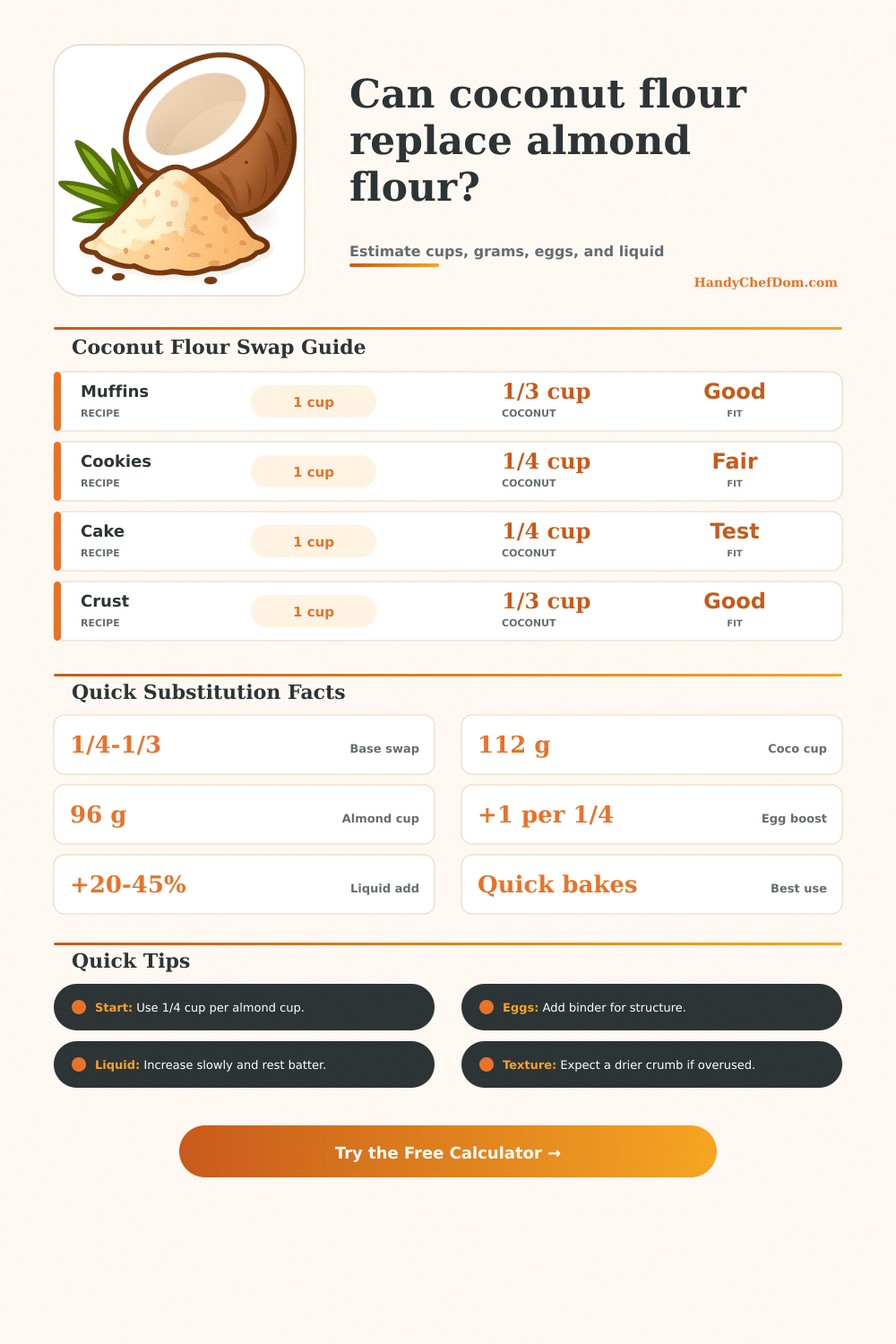
Coconut flour is highly absorbent. A practical starting point is often about 1/4 to 1/3 cup coconut flour for every 1 cup almond flour, plus extra eggs or liquid to keep structure and moisture balanced.
| Almond Flour In Recipe | Coconut Flour Start | Approx Coconut Grams | Adjustment Note |
|---|---|---|---|
| 1/4 cup almond flour | 1 to 1 1/3 tablespoons coconut flour | 7 to 9 g | Small binders may need only a splash of liquid |
| 1/2 cup almond flour | 2 to 2 2/3 tablespoons coconut flour | 14 to 19 g | Add binder only if the mixture feels fragile |
| 1 cup almond flour | 1/4 to 1/3 cup coconut flour | 28 to 37 g | Usually needs extra egg, gel, or added liquid |
| 2 cups almond flour | 1/2 to 2/3 cup coconut flour | 56 to 75 g | Rest batter before judging final thickness |
| 3 cups almond flour | 3/4 to 1 cup coconut flour | 84 to 112 g | Large swaps are safer in coconut-flour recipes |
| Yeast bread formula | Do not use as a full flour swap | Varies | Coconut flour cannot replace gluten structure |
| Flour Or Form | Approx Cup Weight | Absorption Behavior | Calculator Use |
|---|---|---|---|
| Blanched almond flour | 96 g per cup | Moist, fatty, low starch | Original recipe basis |
| Almond meal | 88 to 92 g per cup | Coarser and more fragile | Use gram entry if known |
| Fine coconut flour | 112 g per cup | Very absorbent and dry | Standard result basis |
| Light coconut flour | 104 g per cup | Less dense, still absorbs fast | Lower absorbency option |
| Coarse coconut flour | 118 g per cup | Can hydrate unevenly | High absorbency option |
| Coconut plus almond blend | Varies | Balances moisture and structure | Use blend setting when cautious |
| Recipe Type | Coconut Flour Fit | Starting Swap | Likely Adjustment |
|---|---|---|---|
| Muffins and cupcakes | Good | 28% to 33% of almond volume | Add eggs or gel and increase liquid |
| Cookies and bars | Fair | 22% to 28% of almond volume | Use less coconut flour to avoid dry cookies |
| Quick breads and loaves | Good with testing | 30% to 34% of almond volume | Deep pans need more binder and rest time |
| Cakes | Moderate | 24% to 29% of almond volume | Best with egg support and softer batter |
| Brownies | Fair to good | 23% to 27% of almond volume | Works better in fudgy, egg-rich batters |
| Pancakes and waffles | Good | 24% to 30% of almond volume | Rest batter before adjusting again |
| Press-in crust or crumble | Good | 30% to 36% of almond volume | Add fat or egg white if crumbly |
| Yeast bread or pizza dough | Low | Small blend only | Not a direct substitute for gluten dough |
| Feature | Almond Flour | Coconut Flour | Practical Impact |
|---|---|---|---|
| Absorbency | Moderate, fatty moisture feel | Very high, dries batter quickly | Use much less coconut flour and add liquid |
| Structure | No gluten, tender crumb | No gluten, needs binder | Extra eggs or gel improve sliceability |
| Flavor | Nutty and rich | Mild coconut sweetness | Best when coconut flavor suits the recipe |
| Fat and starch | Higher fat, very low starch | Lower fat, high fiber | Coconut flour can taste drier if overused |
| Best formats | Cookies, cakes, crusts, muffins | Muffins, pancakes, quick breads | Egg-rich batters are more forgiving |
| Yeast dough | Weak for yeast dough alone | Very poor for yeast dough alone | Neither builds the gluten network by itself |
Almond flour and coconut flour is different ingredients with different property that impact teh baking process. Almond flour contain the elements necessary to allow cookies to spreads and contain softness in the baked cake. However, coconut flour contains more fiber than almond flour and contains almost no fat.
Because coconut flour contains very little fat, it absorb the liquid in the batter much more quick than almond flour. Using coconut flour as a replacement for almond flour without making adjustments to the recipe will result in dry and crumbly baked good. The calculator included on this page allow you to easily convert almond flour to coconut flour.
How to Replace Almond Flour with Coconut Flour
To perform the calculation, you must first enter the amount of almond flour that you wish to replaces, and then you must select the type of recipe for which you are replacing the almond flour. The type of recipe determine the amount of structure that the baked product should have. Additionally, you must also adjust for the amount of binder and the amount of liquid that the recipe will use, as these ingredients will help to create the batter.
You can also adjust for the absorbency and texture of the brand of coconut flour that are to be used. Finally, the calculator will output the amount of coconut flour (in both cups and gram) that should be used in the recipe, the amount of extra egg or extra binder that should be added, and a suitability score for the replacement of almond flour with coconut flour. The suitability score is a score that indicates the likelihood of success of the replacement of almond flour with coconut flour.
High score indicate that the coconut flour is likely to create baked goods with a texture similar to the texture that would be create with the use of almond flour. Low score indicate that the texture of the baked goods that are bake with coconut flour will differ great than those that use almond flour. For instance, using coconut flour in place of almond flour in meatballs may not work well, as coconut flour will not have the same binding property as almond flour.
Additionally, low suitability score may suggest the use of a partial swap of the two flour instead of a complete replacement. Keep in mind that coconut flour continue to absorb moisture even after you have mixed the baking soda and baking powder with the dry ingredient. Therefore, it is important to allow the batter to rest for a few minute after mixing the ingredients.
After allowing the batter to rest, test the consistency of the batter. If the consistency is too thick once it has rested, you should add additional liquid to the recipe. If the baking recipe isnt allowed to rest before baking, it is possible that too much liquid will be added to the batter.
Excess liquid in the batter will lead to the formation of a gummy center within the baked good. When scaling a recipe to make a large batch of batter with coconut flour, be aware that the coconut flour will absorb the liquid over a longer period of time. Therefore, it is possible that more liquid will be required to be add when baking large batch of batter with coconut flour.
While the recipe calculator provide a starting point for adding coconut flour to a recipe that use almond flour, it is still up to the baker to ensure that the flavor of the coconut flour match the recipe, as well as that the change in texture of the baked good made with coconut flour is acceptable to the individual that is bake the product.