🍊 Orange Juice Per Orange Calculator
Estimate juice yield per orange by variety, size, juicing method, pulp loss, recipe servings, and optional zest.
Use recipe target mode when you need enough juice for servings, or fruit count mode when you want to estimate the juice from oranges on hand.
| Orange Variety | Medium Juice | Flavor Profile | Best Calculator Use |
|---|---|---|---|
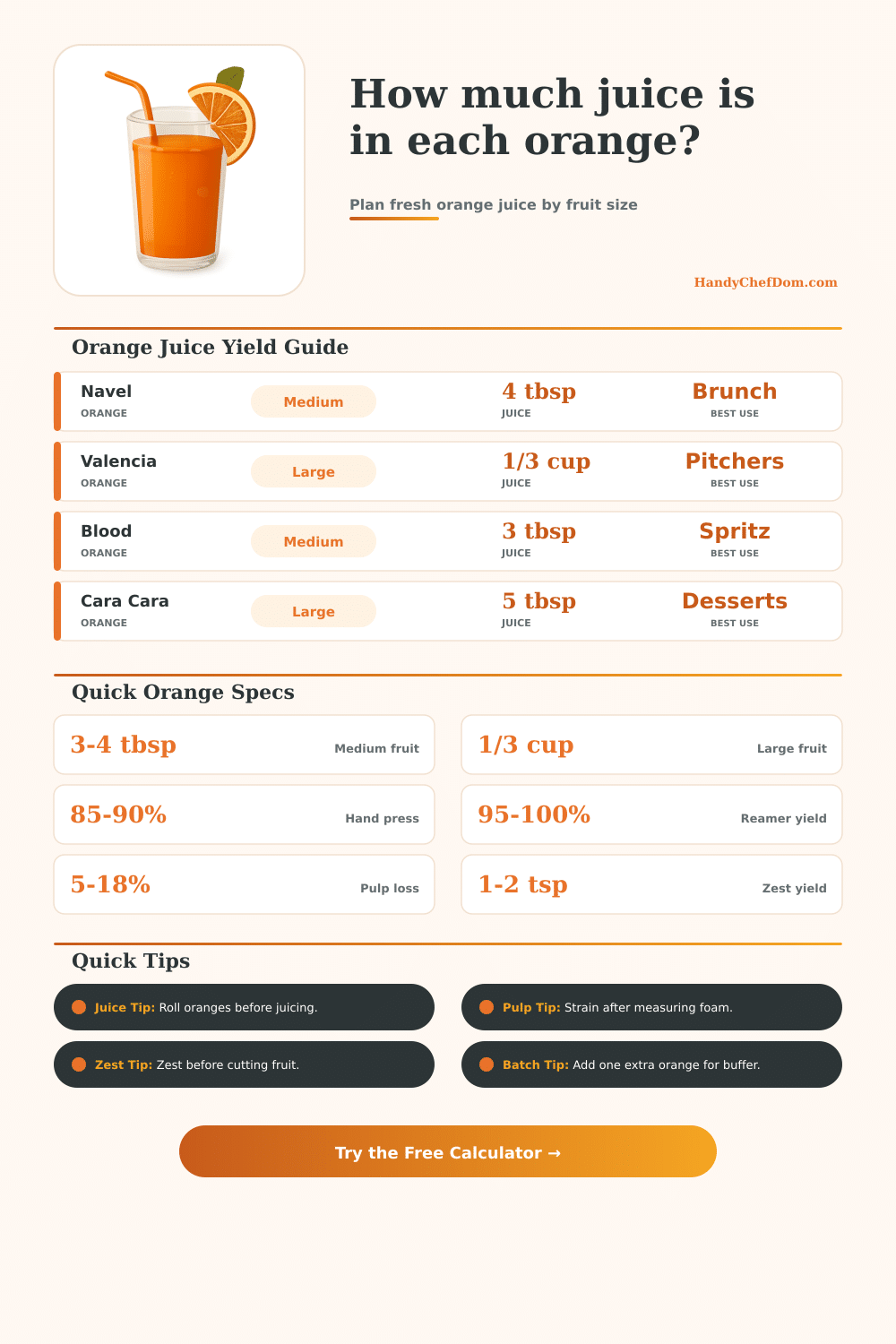
| Navel orange | 60-70 ml | Sweet, low seed | Brunch glasses and quick recipes |
| Valencia orange | 70-85 ml | Juicy, balanced | Pitchers, mimosas, fresh juice |
| Cara Cara orange | 65-80 ml | Sweet, berry note | Dessert sauces and pink juice |
| Blood orange | 50-65 ml | Tart, berry-like | Cocktails and colorful glazes |
| Seville orange | 45-60 ml | Sour, aromatic | Marinades, marmalade, punch acid |
| Mandarin orange | 30-45 ml | Sweet, fragrant | Small snacks and kid servings |
| Tangelo | 65-90 ml | Juicy, tangy | Breakfast juice and citrus blends |
| Clementine | 22-35 ml | Sweet, mild | Small-batch dressings and snacks |
| Average Size | Diameter Guide | Yield Multiplier | Typical Juice Range |
|---|---|---|---|
| Small orange | About 2.5 in | 0.78x | 1.5-2.5 fl oz |
| Medium orange | About 2.75 in | 1.00x | 2-3 fl oz |
| Large orange | About 3 in | 1.22x | 3-4 fl oz |
| Jumbo orange | 3.25 in or more | 1.45x | 4-5 fl oz |
| Juicing Method | Yield Factor | Pulp Texture | When To Use |
|---|---|---|---|
| Hand squeeze | 0.88x | Rustic pulp | One or two oranges |
| Manual citrus reamer | 1.00x | Medium pulp | Recipes and everyday glasses |
| Lever citrus press | 1.08x | Light pulp | Repeated juicing with less hand strain |
| Electric citrus juicer | 1.15x | Foamy pulp | Pitchers and meal prep batches |
| Centrifugal juicer | 1.10x | Fine foam | Mixed citrus and fast service |
| Recipe Need | Juice Target | Medium Valencia | Medium Navel |
|---|---|---|---|
| 2 small drinks | 8 fl oz | 4 oranges | 4-5 oranges |
| 4 brunch servings | 16 fl oz | 7 oranges | 8 oranges |
| 6 mimosa servings | 24 fl oz | 10 oranges | 11-12 oranges |
| 1 quart pitcher | 32 fl oz | 13 oranges | 15 oranges |
| Half gallon | 64 fl oz | 26 oranges | 30 oranges |
First: Count your ingredients. Don’t find yourself with less juice then you have cups to fill. There’s nothing worse than realizing you’ve run short and everyone’s waiting with glass in their hand, panic time! If only we’d just counted first… but we didn’t. So don’t guess, count.
Citrus fruits are naturaly and different, no two oranges is alike. You may have one that’s full and liquidy, one that’s soft, one that’s super-firm. Tossing all those orange into a single group will either result in a pile of unused fruit or underprepared pitchers. The calculator does the math for you after you enters your specific details. No more guessing and eyeballing recipe to get the balance right.
Why You Should Count Your Oranges Before Juicing
It’s worth noting that some oranges produces more juice than others. Because Valencia oranges are thinner-skinned with higher water content, they’re workhorse orange for juicing. On the other hand, navel oranges has a thicker rind, so they have less liquid per pound. You’ll probably end up short if you don’t adjust your estimate according to (which is fair since most people treat every orange as uniform unit). The tool takes this botany into account, so you don’t have to remember how juicy each orange are.
The size thing is important but it’s not linear; doubling the size doesn’t get you twice as much stuff. In fact, larger things has their volume scale by the cube of their radii. And the skin tends to increase relative to the size. This is true unless it’s realy thin to begin with. So you’re getting more absolute juice from a big orange but maybe less efficiently per-ounce. To adjust for that, I use diameter instead of just weight in the calculator. It provides a better bridge between what’s on the scale and what ends up in your glass.
How do you intend to get it out? Depending on which tool you choose, you’ll extract more or less liquid. If you’re just squeezing an orange with your hands, you feel good about it, but leave a lot of pulp in there. Using a reamer will remove some of that pulp but an electric juicer or even a lever press will squeeze almost every last drop. You can get up to fifteen to twenty percent of what you started with, depending on your tools. For every 4 servings you prepare, that’s another glass of juice.
Before purchasing the fruit itself, familiarize yourself with the yield you’ll be able to obtain from your equipment. Interestingly enough, ripeness also factor into it. If an orange is heavy for its volume, odds are it’s hydrated and ripe. Underripe, firm fruits has tighter cells and less free liquid. Also, cold oranges straight from the fridge are difficult to juice because the tissue contracts in the cold. Breaking up inner membranes by rolling the oranges around on the countertop prior to cutting can help loosen things up. It’s just a simple mechanical trick that releases more liquid with no change to any other variable. When every drop counts, whether you are saving food from your fridge or money from your wallet, it matters.
Fiber retention affects resulting amount. Straining juice using a fine mesh sieve will remove pulp (which is mostly fiber) as well as some of the liquid suspended in it. Straining removes water and some pulp from your finished product. The calculator lets you input a loss percentage for straining pulp. It’s forcing you to accept that cloudy juice isn’t the same thing as clear juice, and they won’t have the same yield. Don’t pretend otherwise when planning.
One less common byproduct is zest. When using a fruit for both its peel and juice (as in some recipes), first zest it. That way, when you cut it open, you can easily extract clean strips of zest without any bitter pith still on the skin. Its surface area hasn’t been disrupted. The gadget allows you to calculate this separately. This is helpful when you’re mixing multiple flavors in something complex, like a cocktail or sauce. You don’t want to end up with oranges for juice when you actualy need them for their more aromatic peel.
But juicing is a balancing act between what happens in the world outside of your kitchen and what happens inside it. There’s no way to know exactly how many grams of sugar are stored within any given sphere, nor can we change the weather conditions that gave rise to that sphere. But here’s what we can do: We can control our math, and we can control how well prepared we are. With adjustments made for loss, method, size, and variety, a guessing game becomes a steady equation. Next time you pick up a bag of citrus, think twice before you reach for it. What’s in your hand isn’t merely something to snack on; it’s a measurable resource waiting to be planned for, not panicked over.