🍰 Heavy Cream for Whipped Cream Calculator
Estimate cream volume, whipped yield, sweetness, stabilizer, servings, and timing risk for soft spooned cream, firm cake filling, or piped dessert topping.
Use either chilled cream cups or a desired whipped yield. The calculator uses the standard kitchen reference that 1 cup heavy cream typically yields about 2 cups whipped cream, then adjusts for fat, whipping stage, bowl chill, and waste.
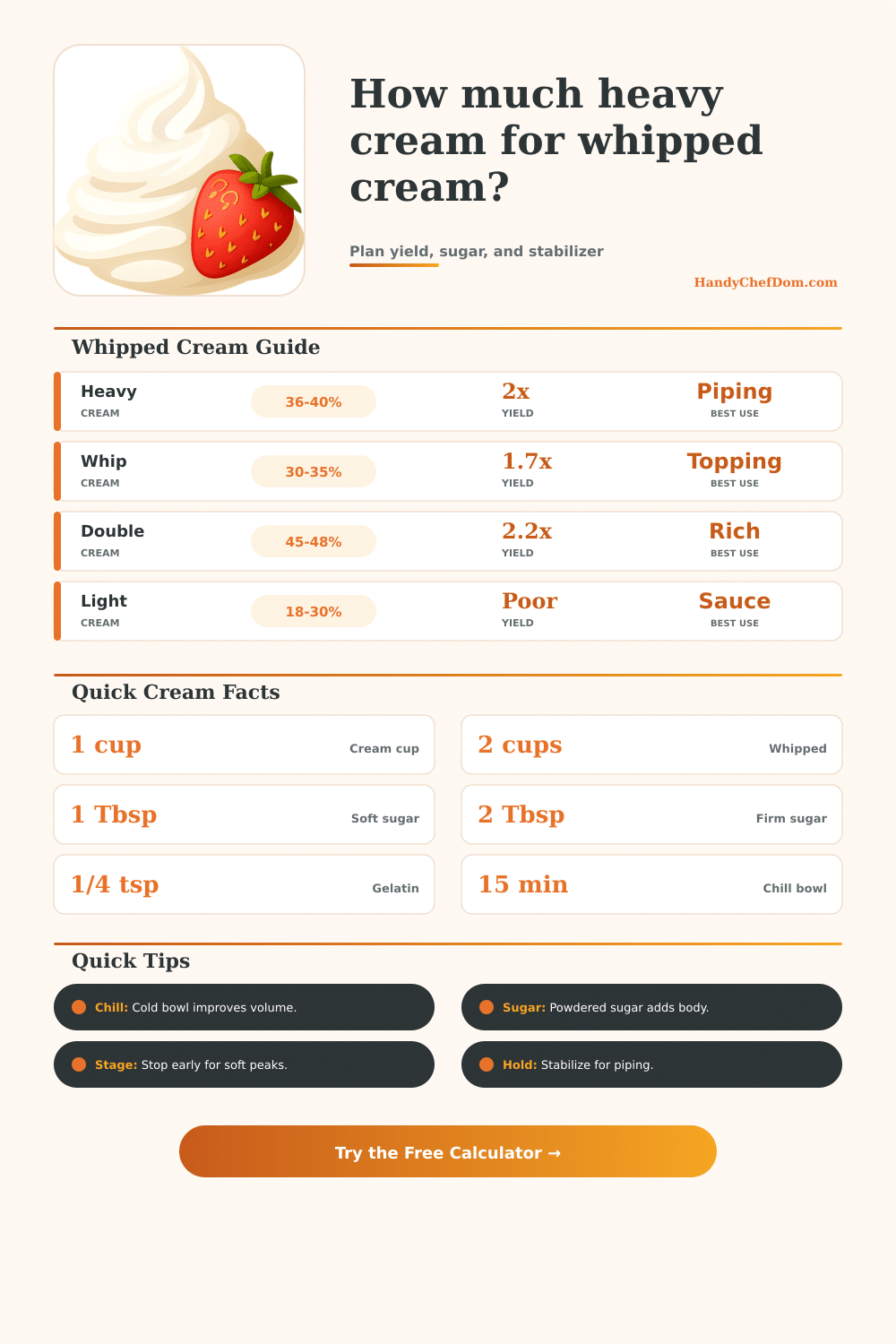
| Cream type | Typical fat | Yield from 1 cup | Best role |
|---|---|---|---|
| Light cream | 18% to 30% | 1.2 to 1.4 cups | Sauces more than whipped topping |
| Whipping cream | 30% to 35% | 1.6 to 1.8 cups | Soft spooned topping |
| Heavy cream | 36% to 40% | About 2 cups | Reliable whipped cream and cake topping |
| Heavy whipping cream | 36% to 40% | About 2 cups | Piped swirls and dessert service |
| Double cream | 45% to 48% | 2.1 to 2.3 cups | Dense rich cream with fast thickening |
| Whipping stage | Visual cue | Yield effect | Best use |
|---|---|---|---|
| Loose peaks | Ribbon slowly sinks | Higher volume, softer set | Folding into mousse or custard |
| Soft peaks | Peak bends over | Standard volume | Spoon over berries or shortcake |
| Medium peaks | Peak mostly stands | Balanced volume and hold | Pies, cakes, and plated desserts |
| Stiff peaks | Peak stands firm | Slightly lower volume | Piping and defined swirls |
| Sweetness level | Powdered sugar | Granulated sugar | Liquid sweetener |
|---|---|---|---|
| Plain or barely sweet | 0 to 1 Tbsp per cup cream | 0 to 2 tsp per cup cream | 0 to 2 tsp per cup cream |
| Lightly sweet | 1 Tbsp per cup cream | 2 tsp per cup cream | 2 tsp per cup cream |
| Classic dessert | 2 Tbsp per cup cream | 1 Tbsp per cup cream | 1 Tbsp per cup cream |
| Firm piping | 3 Tbsp per cup cream | 1.5 Tbsp per cup cream | 1 Tbsp per cup cream |
| Extra sweet filling | 4 Tbsp per cup cream | 2 Tbsp per cup cream | 1.5 Tbsp per cup cream |
| Starting cream | Typical whipped yield | 2 Tbsp portions | 1/4 cup portions |
|---|---|---|---|
| 1/2 cup | 1 cup | 8 portions | 4 portions |
| 1 cup | 2 cups | 16 portions | 8 portions |
| 1 1/2 cups | 3 cups | 24 portions | 12 portions |
| 2 cups | 4 cups | 32 portions | 16 portions |
| 3 cups | 6 cups | 48 portions | 24 portions |
| 4 cups | 8 cups | 64 portions | 32 portions |
Whipped cream are made when you fold air into fat structure of heavy cream. The more you push it and the cooler the temperature, the more the whipped cream will expand. You’ll have to make a lot of guesses about outcome if you’re a home cook whipping cream, which explains why so many folks end up with bowl that are half empty (or overfull).
Enter your cream, target yield, sweetness and hold time into this calculator and it do all the math for you. As with all things dairy, a bigger percentage of fat is more significant than most users might think. A 36 percent cream, for instance, will expand about twice its original volume at ordinary temperatures. If you have a lighter cream, however, it won’t rise as high and will collapse quicker if left out on counter. You can tweak the percentage of fat in input field; this way the overrun calculation takes into account how much fat is realy in your carton of cream. That way you don’t make the mistake of using a standard two-to-one ratio if the cream is only, say, 30 percent rather then 36 or if the room is already warm.
How to Use This Whipped Cream Calculator
This is where sugar comes into play (and in a support, not a starring, role). It enhance flavor and stabilizes foam, but too much will weigh it down. And sugar slows down how quickly air can absorbs. This balance is what sweetness selector takes into account, adjusting the sugar level based off the volume of cream and the desired use. The amount of sugar changes depending on whether you’re piping stiff swirls onto cupcakes or spooning soft peaks over berries. That way, no matter what the final use, the cream stays cohesive enough without being overpoweringly sweet.
If your finished cream is expected to last more than a few minutes, then stabilizers comes into play. Dry milk powder or gelatin will increase the wait time until the cream begin to weep, which comes in handy if you’re making something plated or having a dessert table set up at a party. With this option, the calculator takes into account hold time, room temperature, and the amount of stabilizer added and outputs a risk reading. If it’s low risk, go ahead and keep it out; high risk mean it’s probably best to add some stabilizer or eat it soon.
The dessert’s all together but nobody thought to plan portions? Here’s why: If you know how many servings each spoonful require, you don’t run short. Or you end up left with a deflating puddle in the fridge. Figure it out backwards from total yield. With the portion and serving fields, you can play around fast with “what if” scenarios. Will those two cups of cream dress eight generous scoop, or make twenty-four little garnishes before you get the mixer out?
Every choice is a temperature call. Chilling the bowl, using cold cream, those things will speed up whisking time and yield more volume in the finished product. But most recipes either ignore the step (or presume it’s been done). By making the bowl-chill factor clear, I’m giving you the option to judge if the resulting difference is worth fifteen minutes of upfront prep work.
After entering the variables, it will spit out the nuts-and-bolts of what’s required to get that dessert on the table, from the amount of time to the amounts of each ingredient. Change whatever you want and see instantly how your timing risk, sugar, stabilizer, and yield all move in sync. One recipe becomes a tool for planning: you can use it for shortcake on a weeknight or for a bigger get-together, without having to do the math over again every time.
You should of tried this earlier.