Vinegar Substitute Calculator
Swap vinegar confidently with acidity and flavor-aware conversions.
🧪Quick Presets
⚙Calculator Inputs
📊Substitute Profile Grid
📘Acidity Conversion Table
| Target Vinegar | Substitute | Start Ratio | Notes |
|---|---|---|---|
| White (5%) | Lemon juice | 0.75 : 1 | Bright, tart finish |
| Apple cider (5%) | Lime juice | 0.75 : 1 | Sharper citrus edge |
| Rice (4.2%) | White wine | 1.20 : 1 | Mild acidity, cleaner taste |
| Red wine (6%) | Sherry vinegar | 1.00 : 1 | Closest savory profile |
| Balsamic (6%) | Balsamic + water | 0.85 : 1 | Thin texture for dressings |
| Malt (5%) | Rice wine + citrus | 1.10 : 1 | Rounder, less malty |
🧾Kitchen Conversion Table
| Measure | ml | tbsp | tsp |
|---|---|---|---|
| 1 tsp | 5 ml | 0.33 tbsp | 1 tsp |
| 1 tbsp | 15 ml | 1 tbsp | 3 tsp |
| 1/4 cup | 60 ml | 4 tbsp | 12 tsp |
| 1/2 cup | 120 ml | 8 tbsp | 24 tsp |
| 3/4 cup | 180 ml | 12 tbsp | 36 tsp |
| 1 cup | 240 ml | 16 tbsp | 48 tsp |
🥫Flavor Impact Grid
💡Quick Tips
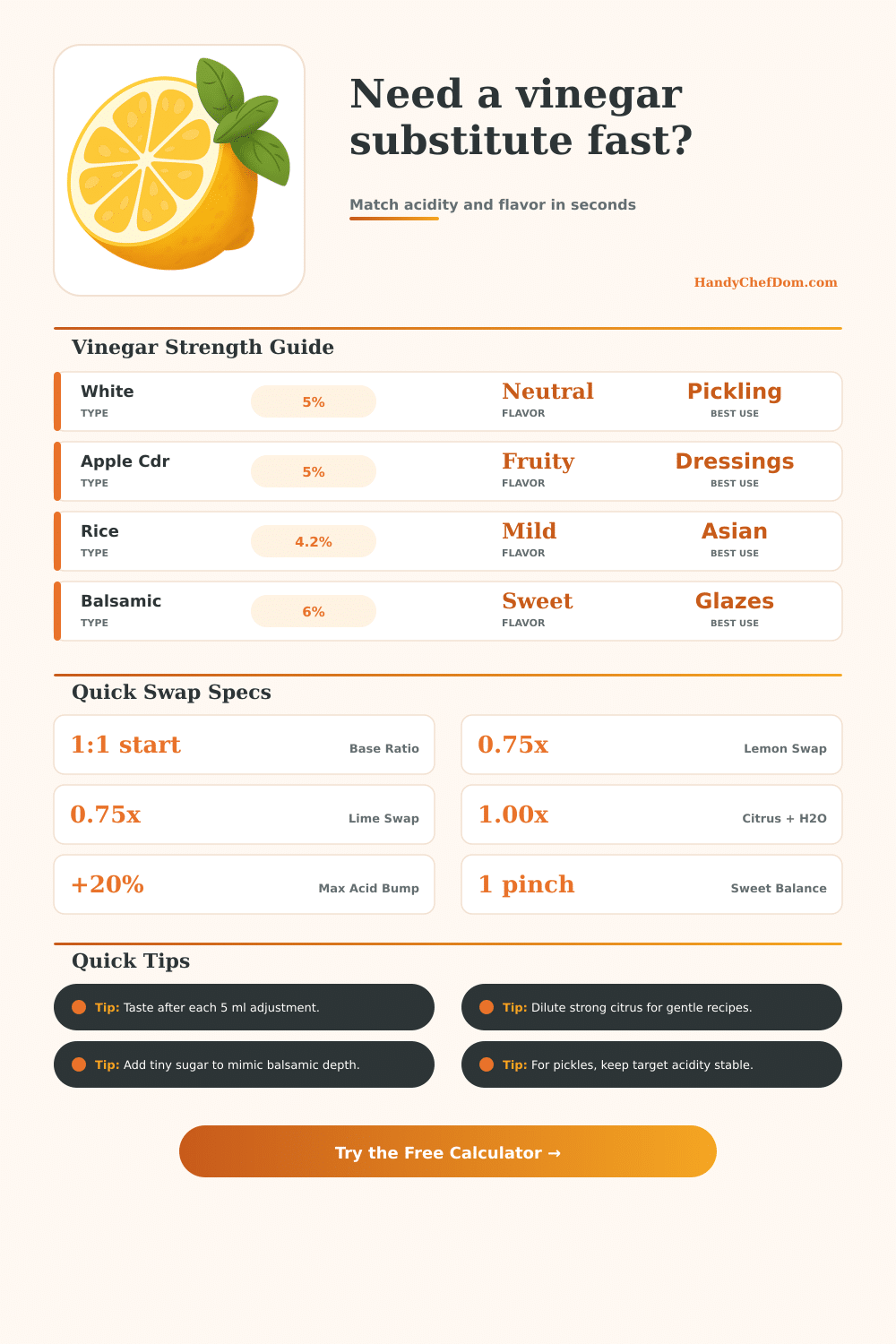
When a recipe call for using vinegar but vinegar isnt available, a substitute for vinegar must be selected. To ensure that the recipe produce the expected results, the acidity level and the sweetness level of the substitute for vinegar must be the same as the acidity level and the sweetness level of the vinegar that is specify in the recipe. The calculator make it possible to determine the amount of substitute for vinegar that should be used in the recipe by taking into account the different acidity percentage of each type of vinegar.
Factors to consider when choosing a substitute for vinegar include the acidity percentage of the vinegar that are to be substituted, the flavor of the vinegar that is to be substituted, and the total amount of liquid that is to be used in the recipe. Common substitutes for vinegar include lemon juice and lime juice. Lemon juice and lime juice are often available in kitchens, and both contains a high level of acidity, making them a good substitute for five percent white vinegar and five percent apple cider vinegar.
How to Choose and Use Vinegar Substitutes
The issue with using lemon juice and lime juice as a substitute for vinegar, however, is that they have a different aroma then vinegar, and they tend to taste sharper than vinegar. For these reasons, a smaller volume of lemon juice or lime juice than vinegar should be use in a recipe. The calculator will tell how much of the lemon juice or lime juice should be used to ensure that the acidity levels of the recipe are not too highly.
The same logic can be applied to using other types of vinegar as a substitute for the vinegar that is to be used in the recipe. The cook must determine the function of the vinegar within the recipe before a substitute for the vinegar can be selected. For instance, vinegar may be used to provide brightness to a coleslaw, balance to a barbecue sauce, or to help tenderize meat in a marinade.
Each of these different function can be performed by different substitutes for vinegar. For instance, sherry vinegar can often be used to replace red wine vinegar due to their similar flavor and strength, and white wine can be used as a substitute for rice vinegar in recipes due to the low acidity of white wine relative to rice vinegar. The calculator will provide appropriate adjustment to the recipe to account for the changes in vinegar types.
However, it is essential to understand the role of vinegar in the recipe before making any substitution. When using a substitute for vinegar, the flavor profile of the recipe may change. For instance, apple cider vinegar contains a fruity flavor, but lemon juice does not contain a fruity flavor.
For these reasons, if lemon juice is used as a substitute for apple cider vinegar, additional sugar may be added to provide the same level of fruity flavor that is provided by the vinegar. Balsamic vinegar is both very sweet and very thick in its consistency. If balsamic vinegar is dilute with water, its thickness will decrease.
The calculator will indicate how much additional volume that is required to make up the thickness of the vinegar that is being diluted. However, it is up to the cook to decide if the new thickness of the vinegar is appropriate for the recipe. For instance, a vinaigrette may tolerate a change in the thickness of the vinegar, but a thick glaze may not be able to tolerate such change in thickness.
One common mistake when substituting for vinegar is to use the same volume for each type of vinegar substitute. For instance, one tablespoon of six percent balsamic vinegar is not the same as one tablespoon of four percent rice vinegar. The balsamic vinegar contains more acidity than the rice vinegar.
Using the same volume for each type of vinegar will result in either an acidity level that is too high or too low in the recipe. The calculator allow for adjustments to the acidity levels of the vinegar substitutes. Another factor to consider is that many vinegar substitute contain additional liquid.
For instance, lemon juice and white wine each contain additional water and alcohol, respectively. If the recipe contains a specific amount of liquid that is to be used, using these substitute will increase the amount of liquid in the recipe. The calculator will indicate how much liquid that will be contributed by the vinegar substitute, allowing cooks to adjust the amount of other liquid in the recipe to account for the additional liquid from the substitute vinegar.
This factor is especially important to consider in the preparation of small recipe. Another reason to use the calculator is for the preparation of large batch of food. While the flavor of a small batch of food can easily be adjusted by tasting the food, the same is not true for large batches of food.
For instance, if pickles are prepared in large batches but the acidity level is incorrect, the batch of pickles cannot be adjusted. Once the batch is prepared, it cannot be correct. The calculator includes button for different batch sizes, indicating how much of each vinegar substitute should be used to prepare large batches of food.
Finally, the sense of taste should be used to determine whether the acidity level in the food are correct. For instance, each bottle of vinegar is slightly different from another bottle. Each lemon also may have different acidity level from another lemon.
For these reasons, it is recommended to begin using the substitute vinegar according to the measurement provided by the calculator, and then gradually add more of the substitute vinegar in small amount while tasting the food. The calculator will provide an indication of the amount of substitute vinegar that should be used, but the final determination of the acidity of the food is up to the cook, through their sense of taste.