Semolina to Milk Calculator
Estimate milk for semolina porridge, breakfast bowls, and pudding by semolina weight or cups, desired texture, servings, simmer loss, sugar, enriched milk type, and rest time.
Your Semolina Milk Ratio
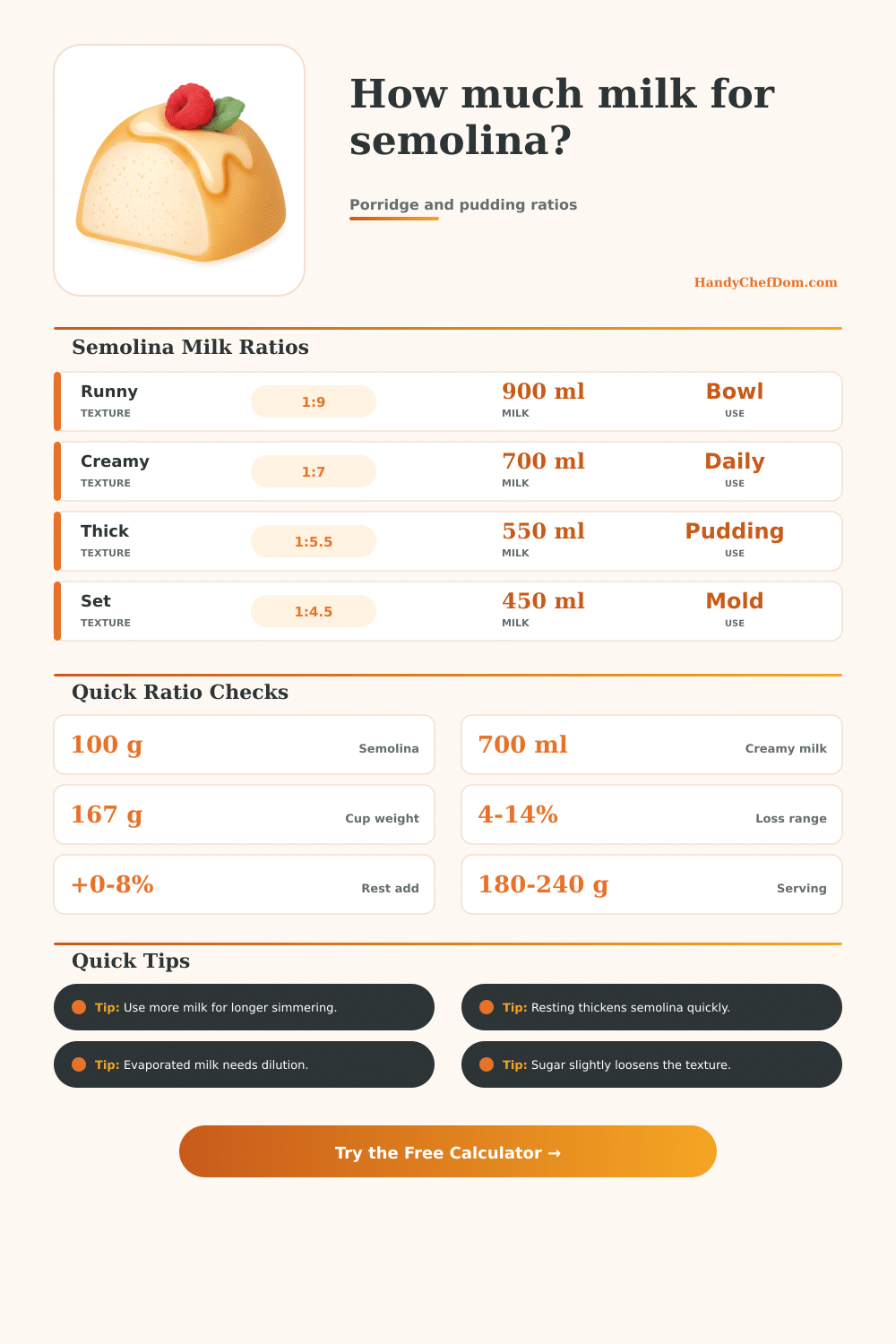
| Desired texture | Base milk ratio | 100 g semolina needs | Best portion style |
|---|---|---|---|
| Pourable breakfast bowl | 9 ml milk per 1 g semolina | 900 ml or 3.8 cups | Loose bowl, pourable finish |
| Creamy spoonable porridge | 7 ml milk per 1 g semolina | 700 ml or 3 cups | Classic breakfast texture |
| Thick pudding cup | 5.5 ml milk per 1 g semolina | 550 ml or 2.3 cups | Dessert cup or ramekin |
| Firm chilled pudding | 5 ml milk per 1 g semolina | 500 ml or 2.1 cups | Holds a mound on a spoon |
| Sliceable set style | 4.5 ml milk per 1 g semolina | 450 ml or 1.9 cups | Cut squares after chilling |
| Dry semolina measure | Approx grams | Creamy milk | Thick pudding milk |
|---|---|---|---|
| 1 tablespoon | 10.4 g | 73 ml or 0.31 cup | 57 ml or 0.24 cup |
| 1/4 cup | 42 g | 294 ml or 1.24 cups | 231 ml or 0.98 cup |
| 1/2 cup | 84 g | 588 ml or 2.49 cups | 462 ml or 1.95 cups |
| 3/4 cup | 125 g | 875 ml or 3.7 cups | 688 ml or 2.91 cups |
| 1 cup | 167 g | 1169 ml or 4.94 cups | 919 ml or 3.88 cups |
| Serving plan | Dry semolina target | Creamy milk start | Finished portion estimate |
|---|---|---|---|
| Light breakfast for 2 | 55 to 70 g | 385 to 490 ml | 210 to 260 g each |
| Family breakfast for 4 | 110 to 140 g | 770 to 980 ml | 220 to 270 g each |
| Dessert cups for 6 | 150 to 180 g | 825 to 990 ml for thick | 170 to 210 g each |
| Meal prep for 5 | 150 to 190 g | 1050 to 1330 ml | 230 to 280 g each |
| Brunch sides for 10 | 240 to 300 g | 1680 to 2100 ml | 190 to 240 g each |
| Adjustment | Calculator effect | Use when | Typical range |
|---|---|---|---|
| Simmer loss | Adds milk before heating | Pan is wide or heat is longer | 4% to 14% |
| Rest time | Adds a texture buffer | Serving is delayed after heat | 0% to 8% |
| Sugar | Slightly reduces added milk | Sweetened pudding or porridge | 0% to 4% |
| Milk solids | Adjusts for thickness | Using skim, oat, or enriched milk | -3% to +6% |
Semolina is tricky, measuring your milk accuratly makes all the difference. The right proportion ensure that your mixture stays smooth rather then lumpy. This means you won’t need to spend time adjusting consistency afterwards.
This throws out timing and wastes time! By using a reliable ratio, which takes into account both the type of milk used, its thickness and how long you simmer it, you are assured of success. When you cook semolina, it will soak up water and keep soaking it up once you remove the pan from heat. Giving it some time to rest (about five minutes on the counter) have the same effect as another minute or so on the stovetop, thickening the mixture up niceley.
Why Milk Amount Matters for Semolina
In fact, that’s why there’s a buffer in the initial amount of milk calculated: so resulting consistency is right even if you’re serving it later than expected. It is also worth noting that wider pans loses more water during evaporation than you’d think. Before you begin heating, tool factors this in and puts the “lost” water back into equation.
What’s your type of milk? You may need more milk at the start depending on whether you use whole milk versus skim or oat milk. This is because skim or oat milk are thinner, containing less protein and fat to help keep grains suspended in liquid. On the other hand, evaporated milk is concentrated, meaning you don’t need as much total liquid to achieve thickness. To save you from remembering different rules for each milk type, calculator accounts for these differences.
It also impacts the texture somewhat: a little bit of sugar break down the starch network, and you wind up with something that’s a little softer in the end than if no sweetener were used. That’s why you can get away with using less milk when making sweetened puddings versus unsweetened porridges, both cooked to the same desired consistency. It’s not a huge change, but it’s real.
To use these, there is a table of reference for each ratio, including what the ratio will be by changing thickness or size of your serving. So if you want to make a double batch, you know how that will translate in numbers. And how they will stretch. You don’t have to guess if a double batch behaves the same as a single portion. It also lets you know if you should of set aside some milk at the beginning.
Semolina’s a raw starch; as such, it swallows up liquid greedily (rice doesn’t release much at all; oats have been broken down to start with, so they don’t act the same). And it firms up as it cools, meaning: One cup of semolina might need anywhere from four-and-a-half to nine times its weight in milk. That’s why folks gets it wrong when using semolina as if it were just another cereal grain.
But that’s not it: That liquid does two things simultaneously. Both adds flavor and determines how thick it is. When you get your head around that, then the inputs no longer seems random. Now it’s a matter of how much water I let the starch absorb. And how much do I leave as free in bowl? Describe the meal you wish to serve and calculator does the math for you.