🥜 Cashews Protein Calculator
Calculate cashew protein, calories, fat, and carbs by grams, cups, whole cashews, or pieces for snacks, curry toppings, and cashew cream.
Choose the cashew label and measurement style you have on hand. The calculator converts whole nuts, pieces, cups, ounces, pounds, and grams into total nutrition.
| Portion Purpose | Typical Amount | Protein Estimate | Best Measurement |
|---|---|---|---|
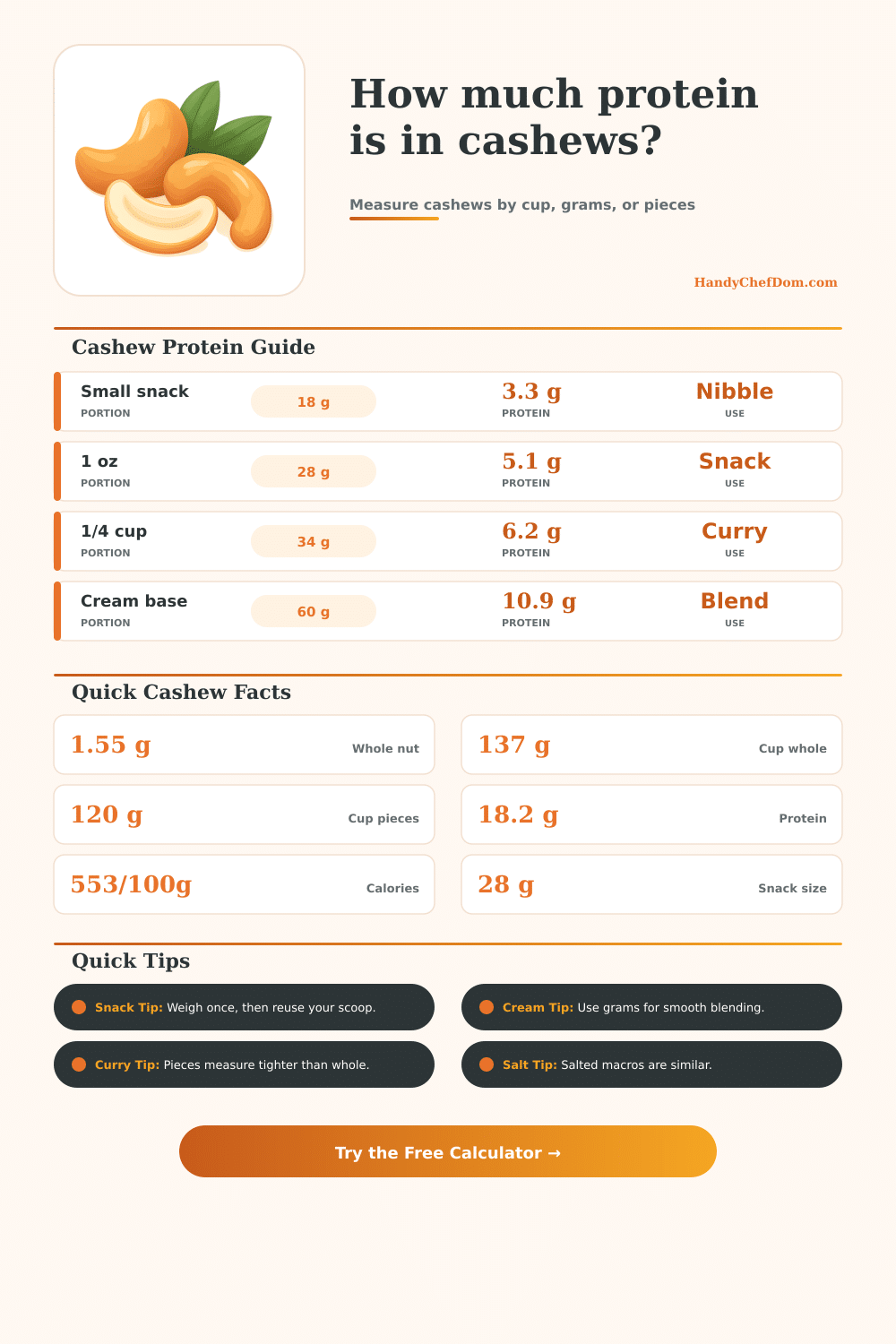
| Snack handful | 28 g or 1 oz | 5.1 g | Grams or ounces |
| Light snack | 18 g | 3.3 g | Whole cashew count |
| Curry garnish | 20 to 34 g | 3.6 to 6.2 g | Pieces or cups |
| Cashew cream | 50 to 70 g | 9.1 to 12.8 g | Grams |
| Smoothie blend | 25 to 45 g | 4.6 to 8.2 g | Grams or cups |
| Meal prep topping | 24 to 30 g | 4.4 to 5.5 g | Ounces |
| Measurement | Raw Whole | Raw Pieces | Protein |
|---|---|---|---|
| 1 whole cashew | 1.55 g | About 3 pieces | 0.28 g |
| 10 whole cashews | 15.5 g | About 28 pieces | 2.8 g |
| 1/4 cup whole | 34 g | 30 g pieces | 5.5 to 6.2 g |
| 1/2 cup whole | 68 g | 60 g pieces | 10.9 to 12.4 g |
| 1 cup whole | 137 g | 120 g pieces | 21.0 to 25.0 g |
| 1 pound | 454 g | 454 g | 69.5 to 82.7 g |
| Cashew Label | Calories | Protein | Fat | Carbs |
|---|---|---|---|---|
| Raw whole cashews | 553 | 18.2 g | 43.9 g | 30.2 g |
| Raw cashew pieces | 553 | 18.2 g | 43.9 g | 30.2 g |
| Dry roasted unsalted | 574 | 15.3 g | 46.4 g | 32.7 g |
| Roasted salted whole | 574 | 15.3 g | 46.4 g | 32.7 g |
| Salted roasted pieces | 574 | 15.3 g | 46.4 g | 32.7 g |
| Cashew meal | 553 | 18.2 g | 43.9 g | 30.2 g |
| Soaked raw cashews | 346 | 11.4 g | 27.4 g | 18.9 g |
| Scenario | Servings | Total Cashews | Total Protein |
|---|---|---|---|
| Desk snacks | 5 | 140 g | 25.5 g |
| Curry garnish | 4 | 96 g | 17.5 g |
| Small cream batch | 2 | 120 g | 21.9 g |
| Family cream base | 6 | 360 g | 65.6 g |
| Salad topper | 8 | 160 g | 29.2 g |
| Party snack bowl | 12 | 336 g | 61.2 g |
Cashews are one of those foods most of us lump together in a neat little package. Get a handful out of jar for snacking and all you think about is whether they’re raw, roasted, salted, soaked, but whatever. Nutritionally speaking, there’s a bit more to it: Depending on its physical form, the cashew nut will pack differently into your cup, and consequently also deliver a different amount of protein per cup.
It matters when you have a bunch of cashews destined for cooking, not just topping salad, so knowing which type of cashew is what is most important. Blending? Sprinkling? The math can differ greatly if you’re serving four instead of yourself. So far so good, but how does it account for the fact that broken-up nuts pack together different than whole nuts?
Why You Should Measure Your Cashews
That’s where the nut calculator comes into play: it knows that one cup of whole nuts isn’t necessarily equal to one cup of cashew halves, and it adjusts accordingly so you don’t need to think about it. Because most people use volume as a measure of ingredients (not weight), many home cooks will find that their snacks come out over-calorie, or their sauces turn out too runny, simply because they forgot to account for how density differences between whole and broken-up nuts can affect the actual weight. If you’re only measuring cups and not grams, you might be off by multiple grams of protein when relying on volume alone. You’ll see a realistic estimate of your macros if you select the right input type that matches whatever you’ve got in your bowl.
What about cashews? Imagine soaking your cashews to blend them into a creamy sauce or soup, then comparing those nuts with dry roasted ones. Even if they contain exactly the same amount of protein before soaking, they will have fewer nutrients per gram after soaking until you drain off the liquid. The tool takes this into account: it provides weight factors for soaked ingredients. Enter the weight of wet nuts, and get back your macronutrient information accurately. This comes in handy especially for dairy-free people who rely on cashews as a base for their soups and sauces. You could of believed you’re consuming twenty grams of protein when you’re really only consuming half that, since the other half is simply water from soaking.
Intuition also doesn’t seem to serve us well regarding portion control. When we’re eating commercially packaged food, there’s typically a serving size noted somewhere on package, and a single serving is typically an ounce, or about fifteen whole nut. It sounds tiny until you put it in your bowl. You might toss them into your hand as you cook dinner or watch TV. It is easy to double or even triple that quantity without realizing it.
To illustrate this, the page features a reference table outlining meal prep portions, and even some common examples (garnish for curries, etc.). This will make clear how rapidly ounces accumulate throughout your household. One serving for snacking vs. Comparing one serving for snacking to six for a cream base helps visualize the scale.
Cashews are very fatty, but most of that fat is unsaturated (rather than saturated fat, which clogs arteries), which actualy helps the heart. But here’s the catch: Calories are calories no matter what they’re made of. If you want to manage your weight, you still need to track them. The calculator not only shows how much fat/carbs you’re getting per serving; it also reveals protein, and all three factors together make up the energy density. Unlike isolating supplements such as protein powder, you can’t isolate the fat from the protein when eating a whole food source like this. Knowing that trade off will allow you to offset cashews with lower-fat protein sources throughout the day.
The effectiveness of nuts as part of your diet depends not just on what you pair them with, but also how many you have at once (as snacking is a strategy). If you want them to work better toward your health goals, eat them with another food that is higher in fiber, such as a vegetable or fruit; this will make them digest slower and keep you more satisfied. Because nuts are so tasty, easy to pop into mouth, and quick to eat, eating directly from the bag results in over-eating. Portioning out the nuts ahead of time takes the guessing game out of it and discourages mindless grazing.
There are preset buttons for trail mixes or desk snacks. However, you can change exactly how much you put into each container based on your hunger or dietary needs to count more accurately. The bottom line is that when it comes to losing weight, gaining muscle, or just eating well-balanced meals, more precision equals better outcomes.
When you know the exact amount of protein you’re consuming, you can confidently tweak the rest of your meal accordingly. It becomes a conscious decision instead of an educated guess. Instead of wondering “Does this bowl of soup feel heavy enough?”, you’ll know that yes, it’s plenty substantial. Once you go through the trouble of measuring once, you get the benefits of sustained nutrition from there on out.