🧀 Nutmeg in Mac and Cheese Calculator
Scale nutmeg for stovetop, baked, creamy, sharp cheddar, and party-pan mac by pasta, sauce, cheese, cream, pepper, and serving size.
Mac and cheese usually needs nutmeg to read as background warmth, not dessert spice. This calculator starts from the sauce volume, then adjusts for pasta absorption, cheese load, cream richness, white pepper, and whether the pan is baked or stovetop.
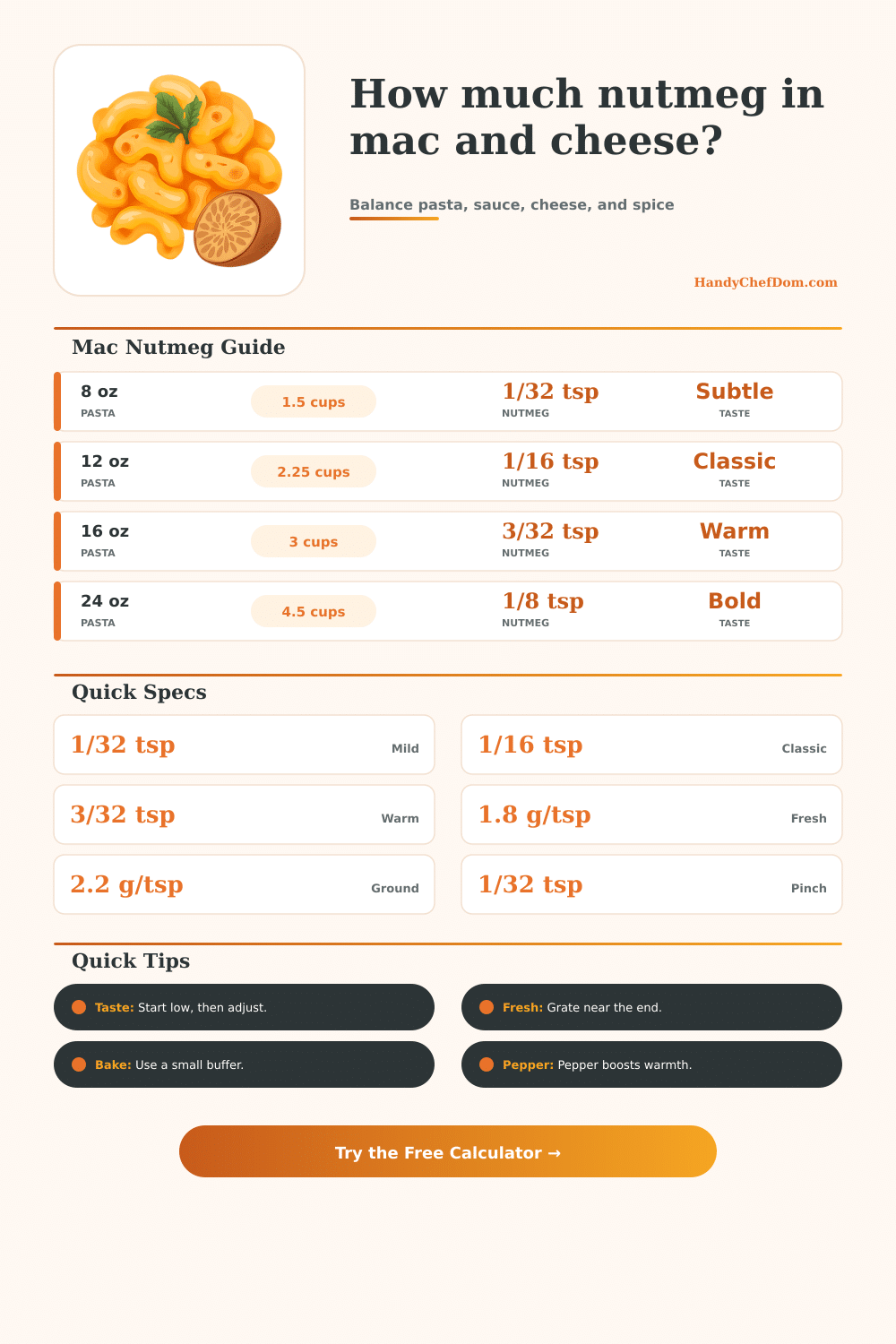
| Dry Pasta | Sauce Cups | Classic Nutmeg | Mac Notes |
|---|---|---|---|
| 8 oz elbows | 1.25 to 1.75 cups | 1/32 to 1/16 tsp | Stovetop bowls need the lower middle range. |
| 12 oz shells | 2 to 2.75 cups | 1/16 to 3/32 tsp | Shells trap sauce, so the flavor reads a little stronger. |
| 16 oz cavatappi | 2.75 to 3.75 cups | 3/32 to 1/8 tsp | Good family-pan range for cheddar blends. |
| 24 oz macaroni | 4 to 5.5 cups | 1/8 to 3/16 tsp | Use the lower end for mild cheese, upper for baked pans. |
| 32 oz pasta | 5.5 to 7.5 cups | 3/16 to 1/4 tsp | Party batches need even mixing before topping. |
| 48 oz tray | 8 to 11 cups | 1/4 to 3/8 tsp | Scale by sauce cups, then check cheese strength. |
| Nutmeg Form | Weight Guide | Flavor Strength | Mac Adjustment |
|---|---|---|---|
| Fresh grated | 1.8 g per tsp | Floral and round | Use slightly less by teaspoon. |
| Pre-ground | 2.2 g per tsp | Warm and direct | Standard measuring baseline. |
| Older ground | 2.2 g per tsp | Muted aroma | Needs a small boost, then taste. |
| Fine microplane | 1.6 g per tsp | Very aromatic | Use the smallest measured amount. |
| Coarse fresh grate | 1.4 g per tsp | Soft pockets | Better for finishing, not batch mixing. |
| Ground plus pepper | 2.2 g per tsp | Sharper warmth | Reduce if white pepper is assertive. |
| Mac Style | Nutmeg Direction | Sauce Behavior | Best Target |
|---|---|---|---|
| Stovetop creamy | Slightly lower | Sauce stays glossy and direct | Subtle or classic |
| Roux-thickened | Baseline | Flour and cheese soften aroma | Classic balance |
| Baked pan | Small buffer | Pasta and topping absorb sauce | Classic to warm |
| Dense casserole | More support | Cheese, eggs, or topping mute spice | Warm, not bold |
| Make-ahead or held | Small buffer | Flavor settles during holding | Classic plus |
| Extra creamy shells | Moderate | High sauce volume spreads flavor | Classic warmth |
| Mac Profile | Cheese Coverage | White Pepper | Nutmeg Cue |
|---|---|---|---|
| Mild cheddar and Jack | 0.65 to 0.85 oz per oz | None or light | Keep nutmeg very subtle. |
| Medium cheddar blend | 0.85 to 1.05 oz per oz | Light | Classic 1/16 tsp per 2 cups works well. |
| Sharp cheddar | 1.0 to 1.25 oz per oz | Light to balanced | Use a small boost for rounded flavor. |
| Aged cheese blend | 0.75 to 1.1 oz per oz | Balanced | Let pepper carry some warmth. |
| High cream sauce | Any coverage | Light | Cream carries aroma, so avoid overdoing it. |
| Smoky cheese blend | 0.8 to 1.1 oz per oz | None or light | Nutmeg should stay behind smoke. |
Adding nutmeg to your macaroni and cheese doesn’t call attention to itself; instead, it rounds out the flavors of the dairy components. It’s that little something that takes the sauce from tasting flat to being more complete, particularly if the cream is rich or the cheese are sharp. Add too much spice and dish starts to taste like dessert.
It’s an easy thing to get wrong, which is why it is important to scale the quantity based on how many batches you’re making. So, where do you start calculating? Start with amount of sauce. This determine how much nutmeg goes into the final dish. More sauce means more nutmeg.
How to Use Nutmeg in Macaroni and Cheese
Next consider pasta shape, since that determines how much sauce coats each bite; elbows vs. Shells vs. Wide noodle shapes will result in different levels of sauce flavoring per serving (and therefore different levels of spice, too). Cheese will also change equation, since it often mutes any other flavor in the background. Maybe adding just a little something extra here help bring out the nutmeg while staying subtle enough not to get noticed.
White pepper and cream. The nutmeg interacts with both cream and white pepper. Cream carries aroma well, and a richer sauce will make that same amount of nutmeg seem like there’s even more. White pepper brings its own warmth to the party, so if the pepper is strong, use less nutmeg.
Topping thickness and bake time pull in other direction. If you’re making something with a breadcrumb crust, or letting it rest in the oven long enough for the breadcrumbs to absorb some sauce, that can dull final flavor. Measure the nutmeg based off the sauce volume, but keep in mind that baking and crust can dull the flavor.
Depending on your intent, you can add more or less spice. You can add so much that it’s obvious, or just enough to enjoy the creaminess of the cheese while still tasting the flavor. For the majority of what you’d make during the week, classic balance fits the bill: Something warm but not obviously nutmeg-y. For holiday casseroles, or something with sharp aged cheese, bump it up to warmer, since that added layer let the dish hold its own against larger flavors.
And the tool allows you to toggle back and forth between them without having to guess at the right setting each time. Fresh-grated nutmeg is a little stronger (and more fragrant) than pre-ground (though as time goes by, older ground nutmeg will weaken, which is where a small increase sometimes helps if the jar has been on the cabinet shelf for several months).
When adding to the warmed sauce, you’ll want to stir it in sooner rather then later, allowing its flavor to distribute throughout. If you grate onto individual plates just before serving, the scent remains fresher. “Once, calculate; twice, taste,” as my mother used to say: Once you know how much, try it, before you add it all in with a final stir.
White pepper and sharp cheese will also hasten the burn, and if you’re adding either or both, your first bite after the cheese melts will let you know if it needs more spice (or not). A little pre-spicing check saves you from the most frequent error: adding it all, only later to wish you hadn’t.
Unless you’ve got all your other ratios right, nutmeg is a secret ingredient that hides in the shadows. When the cream, cheese, and sauce are dialed-in to each other, the spice sneaks up on you as an understated detail, something that someone notices but can’t put their finger on until it’s asked: “What did you do?!”
You should of used more nutmeg if you want a moddern taste. It feels naturaly good when the furnitures is set right in the kitchen.