Vanilla Extract for French Toast Calculator
Estimate vanilla extract, paste, bean, or powder for French toast by bread slices, slice thickness, custard cups, egg count, milk type, sweetness, soak time, servings, and spice additions.
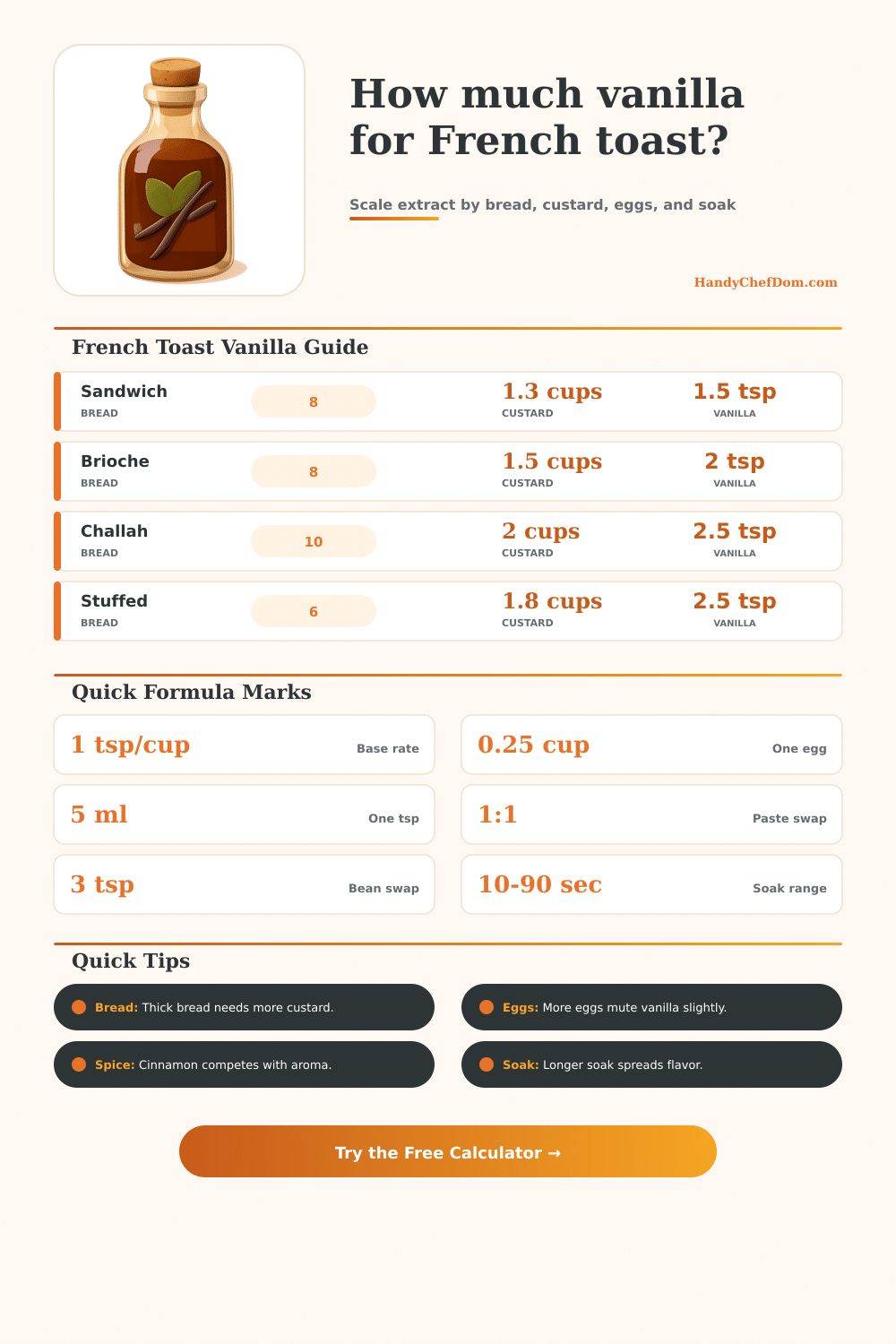
French toast vanilla depends on how much custard the bread absorbs. Thick, enriched bread and longer soaks spread vanilla across more custard, while eggs, spices, and maple sugar can compete with aroma.
Vanilla Plan for This French Toast
Your vanilla result will appear here after calculation.
Bread Slice Custard and Vanilla Table
| Bread style | Typical custard per slice | Best vanilla range | Calculator treatment |
|---|---|---|---|
| Soft sandwich bread | 0.14 to 0.18 cup | 0.8 to 1.0 tsp per cup | Lower absorption and quick soak |
| Brioche | 0.18 to 0.24 cup | 1.0 to 1.2 tsp per cup | Rich bread carries dessert vanilla |
| Challah | 0.17 to 0.23 cup | 1.0 to 1.15 tsp per cup | Egg bread works with classic strength |
| Texas toast | 0.24 to 0.32 cup | 1.05 to 1.25 tsp per cup | Thick slices need more custard |
| Baguette or French bread | 0.13 to 0.20 cup | 1.0 to 1.25 tsp per cup | Dry crumb benefits from longer soak |
| Casserole cubes | 0.22 to 0.34 cup | 1.0 to 1.3 tsp per cup | Deep soak spreads flavor widely |
Vanilla Form Conversion Table
| Vanilla form | Extract equivalent | Metric equivalent | French toast use |
|---|---|---|---|
| Pure vanilla extract | 1 tsp extract | About 5 ml | Everyday custard and griddle batches |
| Vanilla bean paste | 1 tsp paste | About 5 ml | Visible specks in brioche or challah |
| Whole vanilla bean | 1 bean equals about 1 tbsp extract | About 15 ml extract | Best for overnight custard or casseroles |
| Double fold extract | 1/2 tsp equals 1 tsp extract | About 2.5 ml | Strong aroma with less liquid |
| Vanilla powder | 1/2 tsp equals 1 tsp extract | About 1.2 g | Low-liquid custards or dry mixes |
| Homemade mild extract | 1.35 tsp equals 1 tsp extract | Variable | Use more unless the batch is strong |
Egg and Milk Balance Table
| Custard build | Eggs per cup liquid | Vanilla direction | Texture cue |
|---|---|---|---|
| Light egg custard | 1 egg per 3/4 cup | Keep baseline | Soft, milk-forward slices |
| Classic French toast | 1 egg per 1/2 cup | Small boost if spiced | Balanced set and custard flavor |
| Egg-rich diner style | 1 egg per 1/3 cup | Boost 5 to 12 percent | More egg aroma competes |
| Cream or half-and-half | Any classic ratio | Reduce slightly | Fat carries vanilla well |
| Oat or almond milk | Any classic ratio | Boost 6 to 14 percent | Plant base can read flatter |
Batch Size and Serving Table
| Batch | Slices | Likely custard | Classic vanilla | Servings |
|---|---|---|---|---|
| Mini breakfast | 4 slices | 2/3 to 1 cup | 3/4 to 1 tsp | 2 servings |
| Family pan | 8 slices | 1 1/3 to 2 cups | 1 1/2 to 2 tsp | 4 servings |
| Brunch griddle | 12 slices | 2 to 3 cups | 2 to 3 1/2 tsp | 6 servings |
| Party batch | 24 slices | 4 to 6 cups | 4 1/2 to 7 tsp | 12 servings |
| Casserole pan | 10 to 14 cups bread | 3 to 5 cups | 3 to 6 tsp | 8 to 12 servings |
Vanilla is a key ingredient in great French toast, particularly when trying to get the measurement just right. To most cooks, adding vanilla to the custard mean pouring until it smells right. That’s fine, except when the next batch do not. One bread soaks up more than another; eggs mute flavors while other ingredients compete for attention. Sometimes all that matters is that small measurement, whether it is a gentle sweetness or flat. Because vanilla doesn’t taste like anything on its own.
On each slice, vanilla is riding shotgun with the rest of the custard. Thicker bread pulls in more liquid per piece which dilutes the extract. Less fat equals leaner milk, which carry fewer aromas. Cream keeps that aroma locked down for longer. Soaking longer pushes flavor further into the crumb, but if you soak them too long you end up spreading the flavor too thin.
Why Use a Vanilla Calculator for French Toast
After plugging in your milk type, egg count, custard volume, soak time, slice count, bread style, spices (if any) and sugar (if any), the calculator do the math for you. The closest I can come to explaining it is, it doesn’t really matter what spoon size your teaspoons are as long as you know which variables tend to pull in opposing direction.
For instance: Eggs create structure but they also mute the vanilla slightly, while cocoa and cinnamon competes for the same space on your tongue. So the tool increases amount needed whenever you add more cocoa or cinnamon to your eggs. This is why you can choose between a dessert-forward and bakery-style output (when those flavours are factored in) using strength dial. Then you see how much of whatever you prefer to use, be it whole beans scraped, paste, or single fold extract, is needed for the task.
Everyone else has a tendency to overcompensate. It’s too quiet, so you add an extra splash. You notice the vanilla the next morning once the flavors have settled because people overcorrect by adding to much… The reference tables on the page shows typical absorption ranges for various breads to help prevent this. Did yours fall within normal bounds? Or does the bread want more custard first? That’s how you avoid most common error: adding more extract to try to save dry slices.
Real kitchens are not uniformly consistent. A good batch recognize this. Bread is not all made equally; day-old dries different than fresh. Eggs come in all different size and the weight of each slice will impact its capacity for custard. Instead of a hard-and-fast rule, the calculator provide a starting place that you can measure from. Establish a baseline for your typical custard and bread. As you get better at making smaller adjustments, you’ll be able to tweak things with eyes and nose instead of just guessing.
Scaling up (or down) a recipe is where the magic realy shows itself. Multiplying a recipe for four people will give you something different from what worked for four. It won’t taste as good with double the ingredients, unless you consider things like a thicker slice of bread or a spiced custard that doesn’t need the same ratio of vanilla to other flavors. Running the numbers ahead means keeping those flavors in check so that, slice after slice, the French toast has a balanced flavor made off every note rather than just one.