🥔 Potato Air Fryer Time Calculator
Estimate air fryer minutes from potato type, cut style, thickness, load size, temperature, preheat, crispness, and shake rhythm.
Use the count field for whole or baby potatoes and weight for fries, wedges, cubes, hash, or frozen fries. The calculator adjusts the base time for thickness, temperature, basket fill, preheat, crispness, and shake interval.
| Cut style | Best thickness | Usual temp | Base time |
|---|---|---|---|
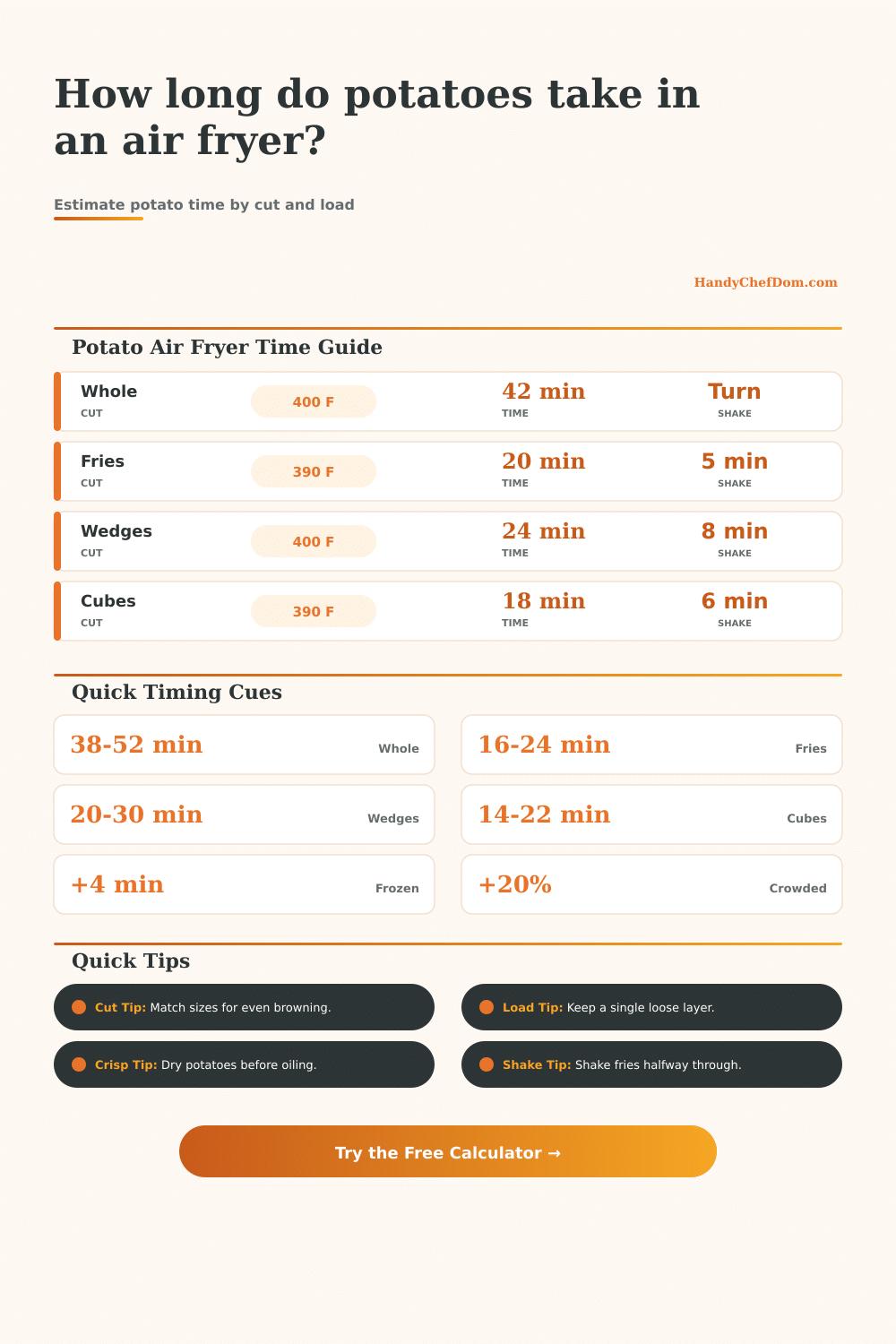
| Whole russet | 2.5-3.5 in | 400 F | 38-52 min |
| Fries | 0.25-0.5 in | 380-400 F | 16-24 min |
| Wedges | 0.75-1.25 in | 390-400 F | 20-30 min |
| Cubes | 0.5-1 in | 380-400 F | 14-22 min |
| Hash | 0.1-0.25 in | 370-390 F | 10-16 min |
| Baby potato | 1-1.5 in | 390-400 F | 18-28 min |
| Potato type | Texture | Timing effect | Best cuts |
|---|---|---|---|
| Russet | Fluffy | Baseline | Whole, fries |
| Yukon Gold | Creamy | Similar | Cubes, wedges |
| Red potato | Waxy | Slightly faster | Cubes, baby |
| Sweet potato | Soft center | Slightly faster | Fries, cubes |
| Baby potato | Creamy bite | Count based | Whole, halved |
| Frozen fries | Crisp shell | Add early heat | Fries, tots |
| Basket fill | Airflow | Time change | Shake cue |
|---|---|---|---|
| Single layer | High | No change | Once or twice |
| Half basket | Good | Add 8% | Every 7 min |
| Full basket | Moderate | Add 16% | Every 5 min |
| Crowded | Low | Add 25% | Every 4 min |
| Two batches | High | Split load | Cleaner crisp |
| Tray style | Mixed | Add 10% | Rotate tray |
| Texture target | Color cue | Time change | Finish cue |
|---|---|---|---|
| Tender | Pale gold | Reduce 8% | Fork slides in |
| Balanced | Even gold | No change | Soft center |
| Extra crisp | Brown edges | Add 10% | Dry surface |
| Deep crunch | Deep brown | Add 18% | Firm edges |
| Meal prep | Light gold | Reduce 5% | Reheats well |
| Snack crisp | Brown spots | Add 12% | Audible crisp |
Is it a small oven? Is it an oven you can cook things quickly in? No. An air fryer is a convection oven with an incredibly strong fan. That means you’re dealing with all three: heat, moisture, and airflow in a tiny amount of space.
Unlike your primary range, which require less attention, an air fryer demands a different kind of respect for its physics. Don’t learn this lesson by burning the outsides while the insides don’t cook. (That’s what happens when they steam or char.)
How to Cook Potatoes in an Air Fryer
The calculator handles the load size and cut style conversion math for you. You won’t have to guess anymore. But as a cook, it’s important to know why you’re putting that in so you can be better cook.
The number one variable is thickness. Whole potatoes takes longer to get to temperature then thin ones do. Fry a thin one too long and it’ll burn. Do the same thing with a whole potato and it won’t even be done. The tool considers average thickness of whatever you cut into. If you’re doing something like wedges, consider the thickest piece. That piece is going to determine the minimum time the entire batch take.
Another problem is crowding. Blocking the vents is bad. From the reference table, you can see that time goes up with a full basket, as steam slowly escapes. When packed tightly, your potatoes creates a humid environment. That steam inhibits browning. To get the right reaction, hot air must come into contact with the potato surface. Because they’re touching, the air can’t get there. The potatoes turn out pale and soft and taste like they was boiled. Better to make two smaller batch than one big one. The calculator accounts for a crowded basket, but the texture is not as good.
The temperature is too hot. Many folks crank up the heat (450 degrees) in order to get things done quicker. Potatoes are very dense and high temperatures just scorch the exterior without allowing the interior to soften much. Adjusting the temperature on the calculator is possible. Lowering the temp by even a bit and increasing the cook time can actualy produce a better product. This lets the heat slowly creep its way into the center of the potato without searing the surface. This is especially true with thicker pieces such as wedges. Not intense heat but rather a steady heat.
Second, consider how the potato starts out. Battered frozen fries? More shake, less time. Less shake, less time. Fresh spuds contain plenty of water, making them non-crispy. Before you add oil, they has to be bone-dry. Why? A wet surface means the oil slides away and the potato steams as it releases its own juice. With our tool, you adjust depending off potato freshness (or soakiness, or pre-cooking). Soaking the potatoes removes their surface starch. Which help crisp them faster. It is a small detail that makes a big difference.
You must shake it, in order to cook evenly. It’s not a drum with a revolving basket, it’s a grid. The fan blows on potatoes at the bottom most. Top ones are cooler. Shake them or they’ll be a combination of raw/overcooked. You should of shaken more. How often? The calculator will indicate based on your total time. Go by its beat. Set a timer, if necessary. Intuition doesn’t work as well as consistency.
Use an air fryer because it’s fast, and keep it around because of how it cooks. Respect the variables. Rush it if you want to. Otherwise, plan a little more time and space for the air. Measure your cuts, dry your surface, and give it some room.