🍲 Cornstarch To Thicken Chicken And Dumplings Calculator
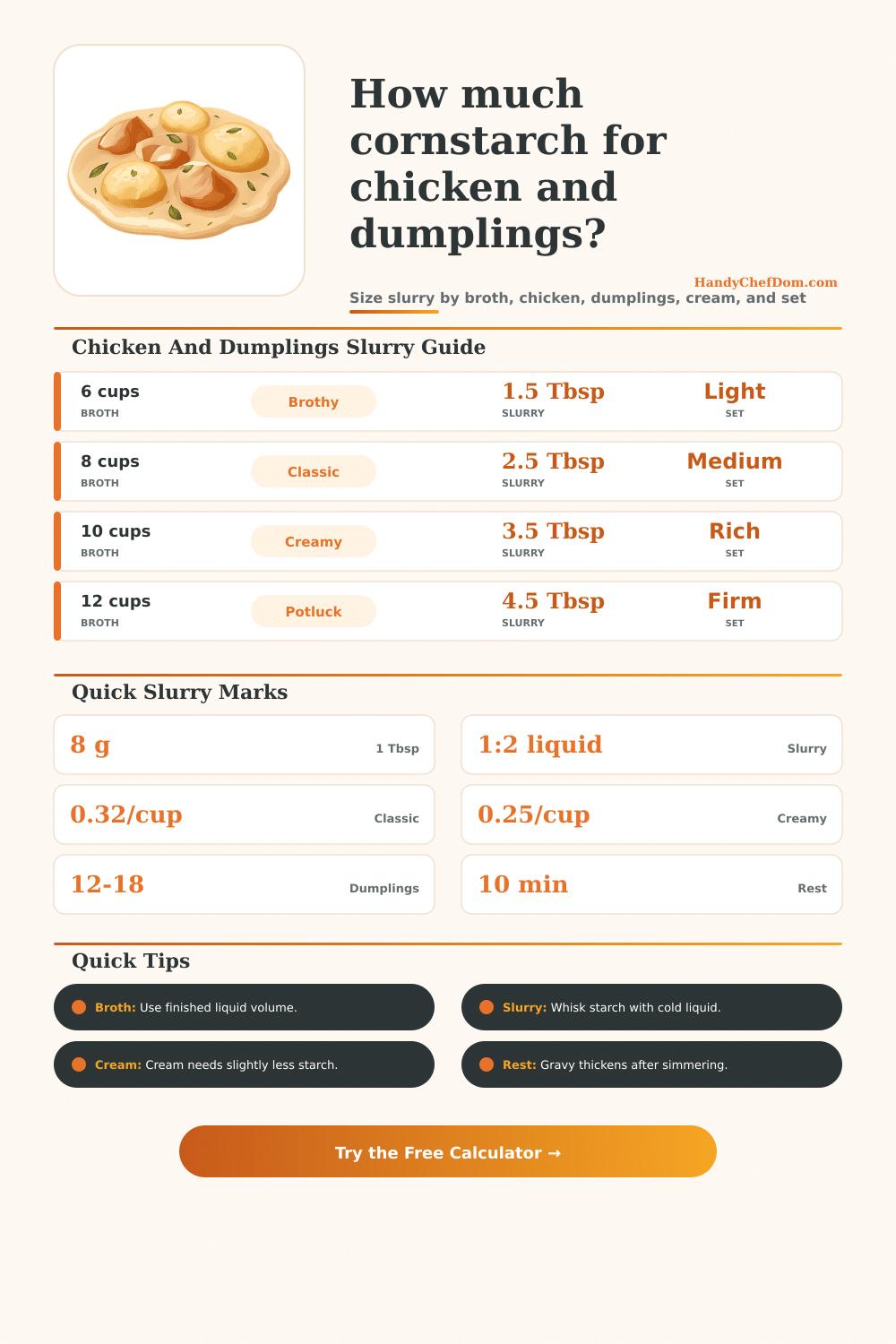
Estimate cornstarch tablespoons, grams, and cold slurry liquid for chicken and dumplings using broth cups, chicken pounds, dumpling count, simmer reduction, creaminess, servings, and target thickness.
These presets are built around real pot sizes: weeknight batches, family Dutch ovens, creamy versions, dumpling-heavy pots, and larger serving pans. Each one loads the inputs and recalculates the slurry.
Enter the liquid you expect in the pot near the end of cooking. The calculator estimates total thickening load, then adjusts for dumpling starch, chicken solids, cream, simmer reduction, and how thick you want the spoonful to land.
Chicken And Dumplings Thickening Result
Your cornstarch slurry estimate will appear here.
Cornstarch Targets By Broth Body
| Target thickness | Base Tbsp per cup broth | Best for | Calculator adjustment |
|---|---|---|---|
| Brothy spoon coating | 0.16 Tbsp | Soup-style bowls with plenty of broth | Reduced further by cream and floury dumplings |
| Light gravy | 0.24 Tbsp | Soft gravy that still pours around dumplings | Good when the pot will thicken while resting |
| Classic chicken gravy | 0.32 Tbsp | Most chicken and dumplings family pots | Balanced for broth, chicken, dumplings, and cream |
| Thick spoonable stew | 0.40 Tbsp | Dumpling-heavy pots and wider shallow pans | Adds body for large servings and holding |
| Firm potluck hold | 0.48 Tbsp | Large batches that sit before serving | Highest target before manual buffer |
Dumpling And Chicken Body Factors
| Ingredient input | Low effect | Medium effect | High effect |
|---|---|---|---|
| Dumpling count | 8 to 12 pieces lightly offset starch | 14 to 24 pieces create noticeable body | 30 or more pieces can make the pot thicken fast |
| Dumpling size | Small strips absorb less broth each | Medium drops balance starch and absorption | Large biscuit pieces need more liquid awareness |
| Dumpling flouriness | Sealed dough releases little starch | Typical dough dusting offsets some cornstarch | Dusty strips can thicken the pot before slurry |
| Cooked chicken | Under 1 pound keeps the broth loose | 1 to 2 pounds supports a classic body | 3 pounds or more makes the pot feel stew-like |
Slurry Conversion Table
| Cornstarch | Approx grams | Cold liquid at 1:2 | Useful batch size |
|---|---|---|---|
| 1 tablespoon | 8 grams | 2 tablespoons cold broth | Small 4 cup brothy pot |
| 2 tablespoons | 16 grams | 4 tablespoons cold broth | 6 to 7 cup light gravy pot |
| 3 tablespoons | 24 grams | 6 tablespoons cold broth | 8 to 10 cup classic family pot |
| 4 tablespoons | 32 grams | 8 tablespoons cold broth | 10 to 12 cup thick pot |
| 5 tablespoons | 40 grams | 10 tablespoons cold broth | Large potluck or firm hold |
Preset Planning Table
| Scenario | Broth cups | Chicken pounds | Dumplings | Typical target |
|---|---|---|---|---|
| Weeknight 4 bowls | 5.5 cups | 1.0 pound | 12 medium | Light to classic gravy |
| Classic family pot | 8 cups | 1.5 pounds | 18 medium | Classic chicken gravy body |
| Creamy Sunday pot | 9 cups | 2.0 pounds | 22 large | Thick spoonable stew |
| Potluck 12 servings | 14 cups | 3.5 pounds | 42 medium | Firm potluck hold |
Soup or stew? Somewhere in between is chicken and dumplings. A good broth should clings to your spoon, but never become paste. How much cornstarch do you add? That depends on what’s already in there.
Most cooks gets off track right here: they weigh out the initial broth and overlook the fact that dumplings will absorbs some broth and release some starch. So they get either a runny broth or a gluey finish.
Stop Guessing: How to Get the Right Thickness
So how many starches do I put in? Basically, that’s not really the issue. How much finished liquid do you end up with once everything’s cooked? The chicken give up its juices, the dumplings cook, and whatever cream/milk/whatever else you stir in come into play as well. Simmering reduces (concentrates) what you’ve got. Flour-covered, larger dumpling offset some of starch that would be required otherwise. A spoonful of cornstarch thickens a creamy pot more then it does pure broth. Why? Because all these things interact.
There is no one magic ratio for every batch. You enter the amount of broth, size of your chicken, number and size of dumplings, amount of cream, percentage of reduction and desired thickness. Then a calculator will spit out results so you don’t have to guess what it all adds up to.
Plus, you’ll be able to try different possibilities. You could change the dumplings from flat strips to drop ones. You could even switch things up by deciding to serve it immediately or holding it back for a potluck.
There’s no one right answer; just a reasonable starting dose that already factors in impact of the added flour from the dumplings, plus the fact that gravy will keep setting as it cools. Under-thickness is most common, initially. So: Measure the cold slurry, and see it loosen back up again when the dumplings is done soaking up moisture. Or add starch until spoon stands up straight. Ten minutes off-heat later, the same pot tightens right up. Ten minutes off-heat later, the same pot tightens right up.
In both cases, the issue is that they’re treating volume of slurry like a constant instead of something responsive to everything else going on in the pot. You can see just by looking at the reference comparisons within the tool what tiny changes in your desired thickness mean to the entire batch.
You need fewer cups of starch per cup if you want a brothy soup then you do if you’re going for something with more body (i.e., something that holds together). But either one might well be right if you ladle the stuff out in bowls right now, versus leaving it warm for a group later on. That’s easy to see from calculator, and doesn’t require you to figure any math out.
After finding your trustworthy starting point, it’s all about adjusting, not reinventing. Taste, wait a moment then see if an extra quarter tablespoon would of helped. And that last little tweak? That’s where experience lives. Ultimately, the tool just eliminates the bigger guesswork that once existed between first spoonful and recipe.