🍞 Bread Flour Cup Weight Converter
Convert bread flour cups, tablespoons, or grams into dough-ready weights, hydration water, salt, yeast, and bench flour buffer for repeatable bread formulas.
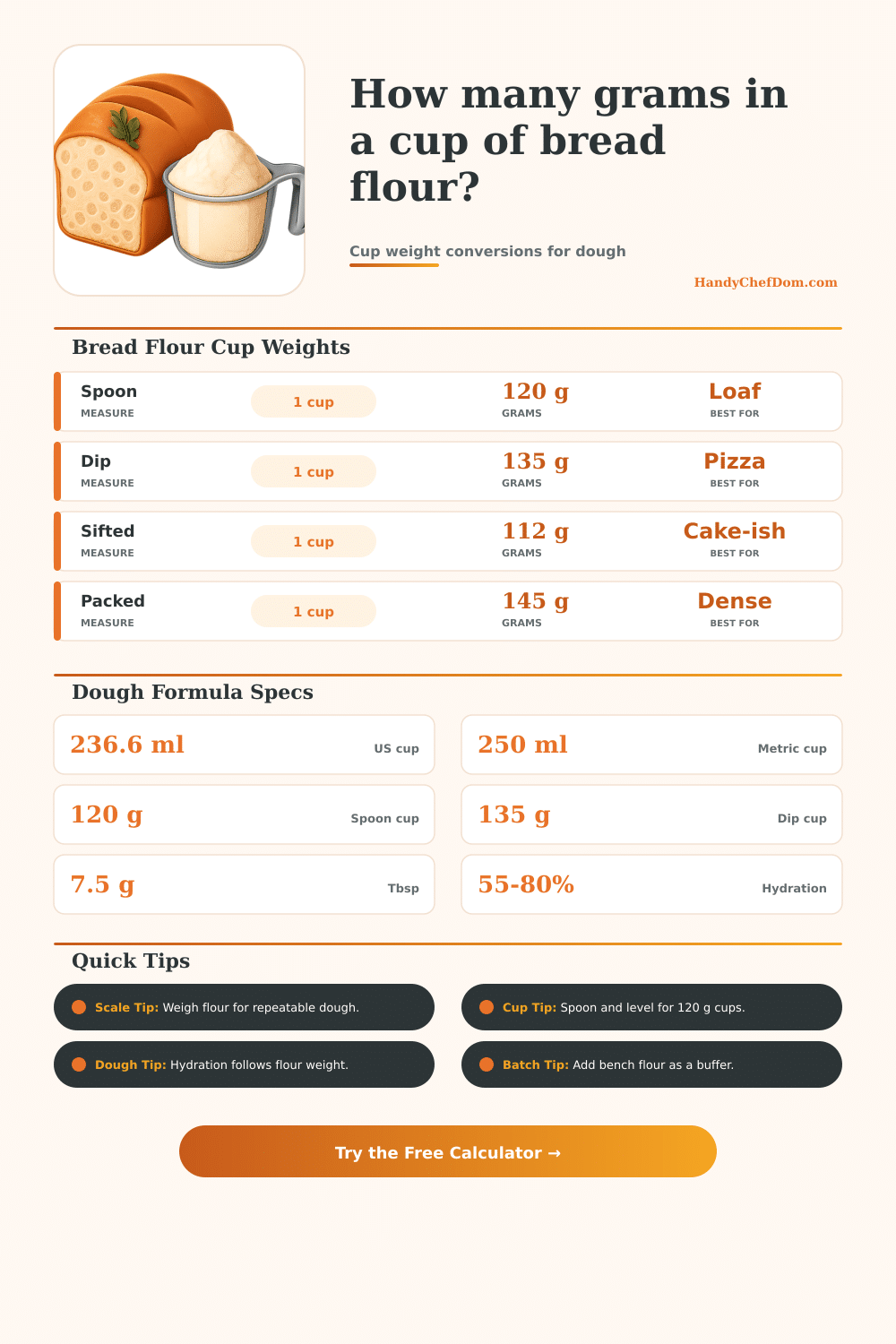
Choose how the bread flour was measured. Spoon-and-level is commonly treated as about 120 g per US cup, while dipping or compacting can add enough flour to change dough hydration.
| Cup Standard | Volume | Spoon-Level Bread Flour | Dough Note |
|---|---|---|---|
| US customary cup | 236.6 ml | 120 g | Common US recipe baseline. |
| Metric cup | 250 ml | 127 g | Slightly more flour than a US cup. |
| Imperial cup | 284.1 ml | 144 g | Large cup; check older Commonwealth formulas. |
| Japanese cup | 200 ml | 101 g | Smaller cup; gram conversion matters. |
| Half US cup | 118.3 ml | 60 g | Useful for small rolls and preferments. |
| US tablespoon | 14.8 ml | 7.5 g | Sixteen tablespoons equal one US cup. |
| Measuring Style | US Cup Weight | Density | Formula Impact |
|---|---|---|---|
| Spoon and level | 120 g | 0.507 g/ml | Best cup method for repeatable bread dough. |
| Whisked then scooped | 115 g | 0.486 g/ml | Airier cup; dough may need less water. |
| Sifted before measure | 112 g | 0.473 g/ml | Lightest cup; common in older baking notes. |
| Dip, scoop, level | 135 g | 0.571 g/ml | Heavier cup; lowers effective hydration. |
| Settled bag flour | 128 g | 0.541 g/ml | Middle ground for flour stored in canisters. |
| Packed or compressed | 145 g | 0.613 g/ml | Dense cup; can make loaves tight. |
| Bread Dough | Typical Hydration | Flour for Batch | Water Guide |
|---|---|---|---|
| Bagels | 52-56% | 600 g | 312-336 g water for a firm dough. |
| Sandwich bread | 60-65% | 360 g | 216-234 g water for one loaf. |
| Pizza dough | 60-68% | 550 g | 330-374 g water for four balls. |
| Focaccia | 75-85% | 600 g | 450-510 g water for open crumb. |
| Ciabatta | 78-90% | 600 g | 468-540 g water for slack dough. |
| Brioche | 45-55% | 420 g | 189-231 g liquid before eggs and butter. |
| Common Flour Amount | Spoon-Level Cups | Dip-Level Cups | Best Use |
|---|---|---|---|
| 250 g | 2.08 cups | 1.85 cups | Small preferment or mini loaf. |
| 360 g | 3.00 cups | 2.67 cups | Single sandwich loaf. |
| 500 g | 4.17 cups | 3.70 cups | Country loaf or sourdough boule. |
| 600 g | 5.00 cups | 4.44 cups | Focaccia, ciabatta, or bagel batch. |
| 720 g | 6.00 cups | 5.33 cups | Two medium loaves. |
| 1000 g | 8.33 cups | 7.41 cups | Large bake day formula. |
It’s hard to bake with volume measurements, espeshally when it comes to bread. You follow the directions to the letter, but somehow your loaf is heavy as lead while your friend bakes up light-as-a-feather loaves. It’s not your fault; it’s not your oven (it’s probably the flour).
Flour isn’t all that heavy when you hold it in your hand, but if you don’t know what you’re holding, weight of one cup of bread flour may vary from one cup to the next. A dip-scoop method will bring significantly more flour to mixing bowl than a loose scoop-and-level. All that extra starch soaks up the liquid intended to hydrate the flour and form gluten. This results in a stiff dough brick by the time you reaches the kneading stage.
Why You Should Weigh Flour Instead of Using Cups
That’s the key to learning to bake consistently: Understanding the variation. Many household recipes is written with one hidden standard for how much a cup of flour weighs, without mentioning which measuring method to use, such as scooping or sifting. That standard applies to, such as sifting. While some authors will explicitly call out “sifted,” others scoop straight from the package, so we end up guessing at whether our dough is just right, or whether recipe is wrong.
With the tool below, we take the guessing out of equation. It lets you choose the measuring style that matches how you scoop into your own container. If you tend to dig in with a scoop-and-dip, just pick the appropriate style and it’ll calculate actual gram amount of that particular volume. It is not some generic average that might not reflect what happens in your kitchen.
But it doesn’t stop at translating weights. For bread baking, there’s the matter of baker’s percentages: hydration as a percentage of total flour weight. Change the amount of flour by the way you scoop it, and you’ll need to adjust the water accordingly to have the right dough structure. The calculator figure all this out for you. It not only considers hydration (water), but also yeast, salt, and even a little bit of bench flour (for shaping). That way if you measure your dry ingredients too tightly or loosely, you’re still going to get the right dough yield at the end.
For example, when comparing a pizza base to a sandwich loaf, they need similar flours (bread flour) but very different levels of hydration. Sandwich bread tends to be hydrated at 60% or so, enough for an even, tender crumb. Pizza dough typicaly goes up higher, maybe 70%, to help it stretch out and char well.
If you measure three cups of flour using the dip method instead of spooning it level, you’ll add about forty-five grams of extra flour; effectively decreasing your hydration to under what recipe intended. Your end product will be more dense with a harder outside crust. Little tweaks like this is how the same recipe can succeed in the test kitchen but flop at your house.
Over time, flour settles as well. Aerated flour from a fresh bag will weigh less per cup than flour that’s been sitting in the bin for months. Recipes from other parts of the world might call for imperial or metric cups. These cups is larger than the US customary cup used today. These differences accumulate fast. A recipe asking for four cups of settled flour could need up to nearly half a cup more liquid then another with freshly poured ingredients.
Knowing how your dry goods behave is far more important than blindly following directions. These changes in density are readily apparent from the reference tables shown above. Sifting the flour decreases its effective hydration and therefore its weight, whereas packing it will do the reverse. Understanding this context visually makes diagnosing problems in previous bakes easy: Has your flour been overly compacted by a habit of scooping? If your bread is too dry, change how you add flour to match your actual habit. You can now make precise corrections to get things right.
At the end of the day, bread baking is comfort food wrapped in chemistry. Weight is under your control; ambient temperature and humidity are not. Learning to think in terms of grams instead of cups gives you troubleshooting power. The calculator becomes the connection between old-school volume-based recipes and the world of precision baking. It converts your familiar measuring practices into numbers you can trust.
I promise, after seeing how far off a cup can be, you’ll never trust volume measurements again. Weighing becomes less of a trend and more of the only means of knowing exactly what you’re dealing with. Accepting that a “cup” is nothing more than an arbitrary volume will lead to better bread.
You should of tried this sooner.